In 2025, David Vickery took us behind the visual effects of Jurassic World: Rebirth. Now, he steps into a completely different universe to discuss his work on Masters of the Universe.
Since starting at MPC in 2001, Rich Yeomans has built an impressive career in visual effects, with credits spanning the Harry Potter franchise, Maleficent, Tom & Jerry, The School for Good and Evil, and The Gorge.
How did you get involved on this film?
Rich Yeomans (RY) – Tim Burke reached out to me while he was looking for a VFX producer to partner with on Masters of the Universe. Shortly afterwards, I had a call with Travis, where we discussed the project in more detail—and, inevitably, which toys from the franchise we each had growing up. From there I was offered the job and started the next week up at Sky Elstree Studios.
David Vickery (DV) – To say the project was well underway when I joined would be an understatement! I was brought on to take over the reins from Tim Burke during post production, exactly 2 weeks before the directors cut was due to be screened to the studio. It was like going from 0 to 100mph in the blink of an eye. Having grown up with the franchise like so many people of my generation, I knew the characters and world of Masters of the Universe well, but what I needed to understand quickly was everything that I had missed during the year of pre-production and shoot that had already happened.
How was the collaboration with Director Travis Knight?
DV – From the first moment I met Travis it was clear that he was a huge fan of Masters of the Universe. He spoke so passionately about his vision for the film. I knew a little of Travis from his work as a director at Laika and with ILM on Bumblebee, but I wasn’t fully aware of his entire career. Travis is an animator at heart, he has an incredible eye for character posing, movement, timing and storytelling, and he has a really great understanding of the VFX process. Travis always invited us to offer up new ideas and contribute creatively to the film, but what I really appreciated was his ability to make quick decisions. He was so incredibly sure of what he wanted to achieve and his feedback was clear and direct – we rarely wasted time experimenting with versions to see what Travis liked, it was either ‘Yes, I like that’ or ‘No’ followed by clear notes as to how to achieve what he was looking for.
RY – From the outset, Travis had a very clear vision and tone for the film. His background in animation, combined with his strong understanding of the VFX process, made collaboration straightforward and allowed us to establish a creative shorthand very quickly.

What was your feeling to be part of such an iconic universe?
RY – It was one of those special projects that comes along only once in a while, something with the scale and cultural significance of a Star Wars or Bond. As a longtime fan of the Masters of the Universe franchise, being part of it was an incredible experience.
DV – It was an absolute no-brainer for me. I was a huge fan of the franchise as a kid, so getting to play with all those toys again in the format of a film was an opportunity I wasn’t going to pass up!
How did you approach selecting the different VFX studios involved in the project?
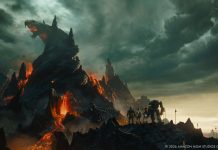
RY – After our first pass of the script breakdown, we realised that while Masters of the Universe has a rich variety of characters requiring varying degrees of CG work, it made more sense to divide the work by environment rather than by asset type. DNEG took on Eternos, ILM handled Snake Mountain and Subternia, and Rodeo FX was responsible for the Eternia landscapes in the Sky Sled sequence and forest floor extensions.
DV – The three main vendors had already been decided by the time I joined the project, but we still had a few hundred shots that we needed to find a home for, including the incredibly challenging and creative opening sequence of the film. We were very careful in selecting studios that we felt had both the right experience and the creative teams available to execute the project successfully. It definitely comes down to those two things for me: having a team with previous experience executing the type of work that we needed, but it’s equally important that you have creative and production leadership at those studios whom you have a good working relationship with. Rich and I felt that we had that with Christian Irles at Cinesite, and James Hattsmith and Pete Jopling at Untold Studios. Among other things, Christian and the team at Cinesite did some really seamless and invisible work on the corridor fight with Man-At-Arms at the beginning of the film, and Untold put together some really stunning work that involved some very complex and heavily choreographed, FX driven storytelling for the opening sequence of the film.

Masters of the Universe takes audiences to Eternia, a world filled with very different landscapes and kingdoms. How did you approach the creation and visual development of such a diverse world?
DV – Well, we had a really great starting point with all the fantastic artwork produced by Guy Hendrix Dyas and his team. It also helped that Guy is an ILM alumni, so we had a great working relationship and lots to talk about on the phone! Guy was happy to continue to guide us throughout post production where-ever we had questions.
Guy and his Art department team crafted an incredibly detailed compendium for the film comprising over 430 images that detailed the characters, costumes, weapons, sets, landmasses, environments, weather patterns, skies and plant life of Eternia. Basically anything you could think of, Guy drew it. We also had access to huge amounts of the published material associated with the comic and animation side of the franchise. Our job was to follow through with the fantastic vision that he and Travis had established, and get all the vivid colour of Eternia onto the big screen.

What were the main challenges in balancing practical sets, locations, and digital environments when bringing Eternia to life?
DV – Light and Colour were our biggest challenges. Guy and the team built some really fantastic sets at Sky Studios, Elstree, but it can be a real challenge for VFX when sets meant for exterior locations are built on interior green screen stages. We opted to build as many of our sets outside as possible, and take advantage of as much natural exterior daylight as we could to light our scenes. In my opinion, this will always result in a more natural look to the finished shots, but you still have to deal with the fact that English weather can change very rapidly, resulting in plates that wildly mismatch from shot to shot. It’s a tradeoff that I’m personally willing to take. Light changes all the time in the real world, and there’s something about the overly controlled constant light that you can get on a green screen stage that can contribute to the fake feeling you sometimes get watching films with a lot of visual effects.
It was clear during post production that Travis wanted VFX to get as close to the look of his finished graded film as possible and not leave it all to DI. This sounds like a lot of extra work, but in this case it was actually a boon for us. VFX took over control of the shot CDL’s set by our DOP, changing them on a shot by shot basis to balance lighting, colour and contrast so that what we were showing Travis in our daily reviews could be an accurate representation of what he would see in his finished film. That is not to say that Stephen Nakamura at Company 3 didn’t still have plenty of work to do in the DI, but they definitely had a more complete delivery from VFX than they might usually expect.
We didn’t want to hide in a wash of grey and shadows on this film. It was critically important to Travis that our environments felt tangible and real, but also alien, bright and colourful. It wasn’t as simple as cranking the saturation on the finished shots – that would have left all the VFX in the film feeling like they had been heavily graded in DI. What we needed to do was find colour in the worlds we were rendering but still keep them feeling believable. We did that in many subtle ways – pops of unusually coloured plantlife, moss and lichen on stones and rocks. Even rocks could be subtly re-textured to bring out a depth of colour that otherwise would have been grey. Skies could have rich blues, but still have warmth in the way the sun scattered through the clouds and the optical effects we applied to many of the shots added another depth of colour and photographic coherence to the final images.
RY – The main challenge was interconnecting the practical sets built at Elstree. Space was at a premium, so we had to work closely with Guy Hendrix-Dyas and his art department team to be strategic about what needed to be built physically and what could be extended digitally. The goal was always to support the story requirements while ensuring the scale of Eternia could be achieved without pushing the budget beyond its limits.

Skeletor is one of the most iconic villains in popular culture. How did you adapt his design for live action while staying faithful to the character fans know and love?
DV – Skeletors body was created as a physical muscle suit worn by Jared Leto on set. It was built by Barrie Gower and his prosthetics team. The armour, boots and hood were built by costume designer Richard Sale. VFX handled Skeletors’ skull and its integration into the rest of the practical suit. It was clear that from a model, texture, shading and rendering perspective we needed to treat the skull as if it was an accurate representation of a human skull. There is a slight yellow discolouration to the skull which is definitely a nod to the original cartoon, but otherwise it’s pretty accurately modelled after a human skull There would be many places within the animation of that skull where we needed to stretch the limits of how a real skull would move and perform, so making it look and feel real became very important to sustaining believability of the final shots

His skull-like face presents unique animation challenges. How did you develop his facial performance and expressions despite the lack of traditional facial features?
DV – Good question! Animation was one of the most complex things to get right for Skeletor. Just think about it for a second. You have Jared Leto, who is an incredible actor, delivering some very subtle, nuanced performances on set and you aren’t allowed to use any sort of HMC system to record that performance. Add to that the fact that a human skull has already lost 99% of the range of motion that a human face has. There are no muscles to tense and create frowns and smiles or eyelids to blink with. There are no lips, so you lose a huge amount of the detail in all the phonemes. BUT Skeletor is one of the main characters in the film and we absolutely needed his performance to stand out.
ILM and DNEG animation supervisors Mike Lum and Greg Fisher experimented with animation tests to see what tools we could use to restore the expressive range of motion that Skeletor needed. We settled on a combination of tools that worked with different levels of success depending on the type of performance Jared was giving. We used subtle blendshape deformations across the face to create our version of Skeletors FACS shapes – These could be dialed in at the beginning of a shot to create a certain expression and then changed subtly during the shot, but if those shapes were over-used they would quickly make the skull feel rubbery. We deformed the upper and lower jaw line and teeth to create phonemes and help make animation feel in sync and accurate to Jared’s dialogue, but it was another tool that had to be used carefully or it looked cartoon-like. We’d often need to see final beauty renders before we could fully evaluate the success of the animation. We frequently rendered the deforming areas of the skull performance on 2’s to give it a more staccato, stop-motion feeling. We carefully controlled the size, brightness, scale and intensity of his pupils, along with the lens flares that they created. Even with all these tools, it still required a hugely talented animation team at both DNEG and ILM. The artists working on the shots had to capture the emotion and intent of Jared’s on set performance and they did it beautifully. Skeletor is one of the standout characters in the film.

The film features many fully digital characters. How did you establish a consistent visual language between all these CG heroes, villains, and creatures?
RY – The visual language for the characters was a genuinely collaborative, inter-departmental process. Working closely with Guy Hendrix-Dyas (art), Richard Sale (costume), and Barrie Gower (CFX), we developed the overall look, feel, and texture needed to bring these iconic heroes and villains to life.
Roboto is a fan-favorite character. Can you tell us about the design, animation, and technical work required to bring him to life on screen?
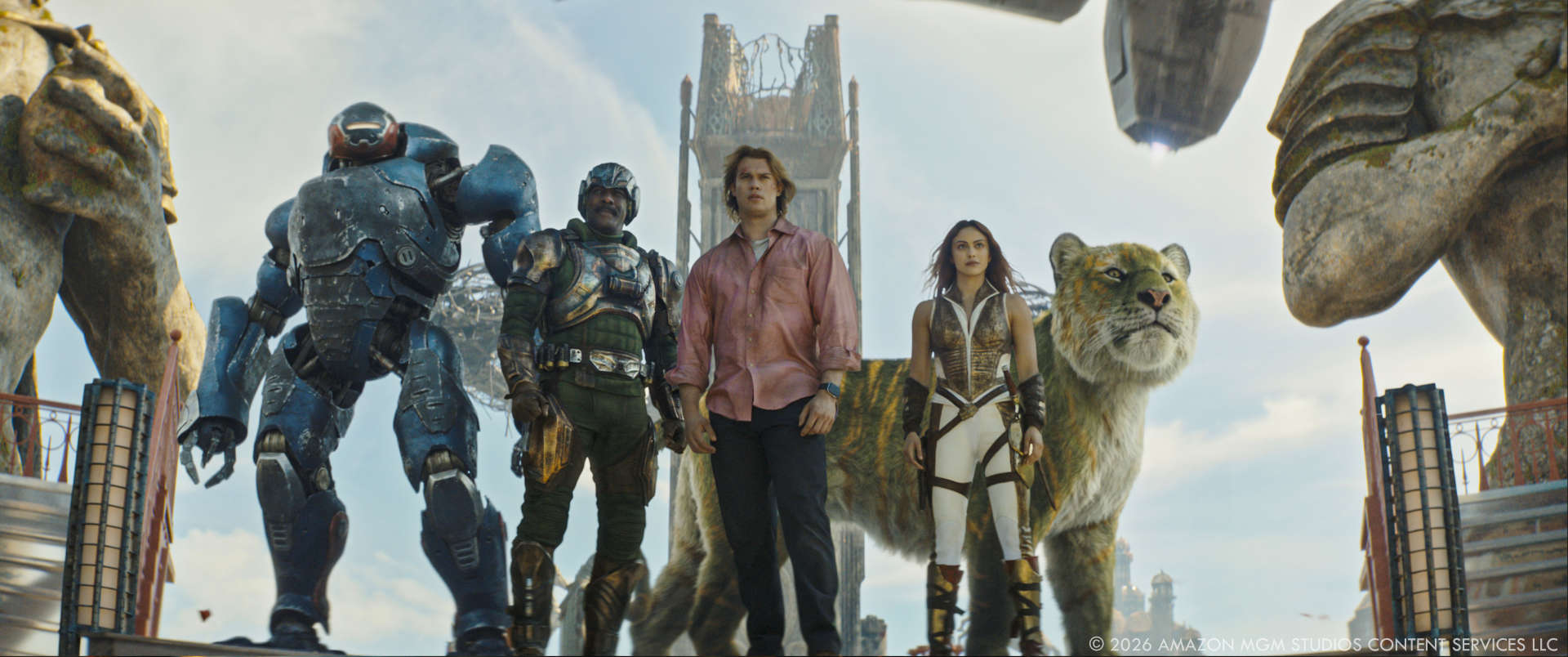
DV – The design of the character really came from Guy Hendrix-Dyas’ team in the art department, but the movement and characterisation of Roboto came from the animation teams at DNEG and ILM. Roboto appears in many scenes in the film so the animation was split fairly evenly between those two vendors. One of the big challenges was how to convey emotion through her performance without it becoming too overly stage-like and dramatic. Travis wanted subtle performances, disappointment, frustration, fear and sarcasm. A lot of that came through in Kristen Wiig’s vocal performance but it also had to be felt in the way she moved. The animation needed to be human-like in its response but also not performative. We also had even less in the way of a face than we did with Skeletor; no moving parts, just a small visor and four LED lights. The visor represented Roboto’s eyes so we designed motion graphics which changed the shape of the visor light that the animators could control in maya and bake out curves for our lighting team to render.
Masters of the Universe features numerous large-scale battles. How did visual effects help enhance the action while maintaining clarity and impact for the audience?
DV – All the fights and battles in the film were heavily choreographed; Travis had a really clear vision and a set of detailed storyboards that formed a loose animatic for those sequences. They were predominantly shot by Liang Yang, our Second Unit Director and Stunt Coordinator. To give Travis as much flexibility in post as possible, all of the Second Unit photography was shot at 48fps. Travis would take the 48fps footage and heavily retime it to get the shots he needed. The re-times were often combined with split-screens of different takes, frame drops, animated repo’s, resizes and fluid morphs that had been done in the AVID, and the retimes were a constantly evolving fluid process that continued to change throughout post-production. We had literally hundreds and hundreds of shots like this. As you can imagine this posed some interesting challenges for VFX.
We had to fix shots with huge amounts of retime artefacts, others that lacked motion blur or had been scaled up to the limits of their resolution and this was just the beginning of staging the VFX work for the battle sequences!
For all of the battle sequences there was some sort of digital set extension required. Cinesite handled the building extension and replacement of all the glass in our Wells Cathedral location, ILM created an entirely digital cavern for Subterranea and a digital Oklahoma City for when Beastman first finds Adam on Earth. DNEG crafted the beautiful Eternia landscape, Castle Grayskull and the city of Eternos and Rodeo created the Geothermal plains and giant forests we travel through during the sky sled chase.
On-set, Special Effects Supervisor Chris Corbould (jnr) deployed practical explosions, dust impacts, sparks, smoke and steam and in post our VFX teams had to match the physical qualities of those practical effects to blend seamlessly with them. We had a line in our VFX breakdown called ‘battle FX’ and it covered a multitude of VFX tricks: laser and ballistic fire, missiles and fireballs, spark and dust impacts for weapon contacts as well as bigger explosions and destruction. All those elements contributed to bringing the battle sequences together, but it was the vision our director had and the clear storyboards he delivered that became the focus and really brought clarity to the work.

What’s your best memories during this production?
It has to be the first time I saw ILM’s version of the ‘I have the power’ moment in Subteranea. It literally gave me chills. It was like being a kid again.
How long have you worked on this show?
DV – 8 months
RY – 1 year and 10 months.
What’s the VFX shots count?
RY – Total shot count for the movie was 2,180 VFX Shots.

What is your next project?
DV – There’s loads of films I’d like to work on.. They just haven’t asked me yet!
RY – I’m taking some time off whilst I look for what’s next.
A big thanks for your time.
WANT TO KNOW MORE?
ILM: Dedicated page about Masters of the Universe on ILM website.
DNEG: Dedicated page about Masters of the Universe on DNEG website.
Rodeo FX: Dedicated page about Masters of the Universe on Rodeo FX website.
Cinesite: Dedicated page about Masters of the Universe on Cinesite website.
Untold Studios: Dedicated page about Masters of the Universe on Untold Studios website.
© Vincent Frei – The Art of VFX – 2026