In 2018, Pietro Ponti shared the story behind Important Looking Pirates‘ work on Jurassic World: Fallen Kingdom. Since then, he has contributed to Aladdin, Carnival Row, and Lovecraft Country before joining ILM in 2021, where he worked on The Marvels and Gladiator II.
With a visual effects career spanning over 23 years, Michael Lum has worked at leading studios such as MPC, DNEG, and ILM. His filmography features Star Trek Beyond, Avengers: Endgame, A Quiet Place: Day One, and Gladiator II.
How did you get involved on this film?
Pietro Ponti (PP): I got involved in the early stages of pre-production as ILM was getting awarded the work on the Show. We discussed the work allocation for ILM and discussed how to best shoot the different sequences with Tim as well as what additional shoots or elements might be required to aid us in the process.
Michael Lum (ML): I joined Pietro in pre-production to begin development on our hero Beastman character.
How was the collaboration with Director Travis Knight and with VFX Supervisors Tim Burke and David Vickery and VFX Producer Rich Yeomans?
PP: It was great working again with Tim, David and Rich since we all last worked together on the Harry Potters. They were all extremely supportive and collaborative and helped us get the best work done. Working with Travis was a great experience, he always had a clear vision for his movie and he understands the VFX process very well. He was very involved and his feedback was always to the point and clear. It was truly a collaborative effort all along.
ML: It was exciting to work with a director who is actually an animator, because I knew we could speak the same language. All of the choices we made with our characters in the film were guided by the principle of serving the story. That principle, along with Travis’ clear vision, meant that we could find the right performances without wasting any time. Once Travis saw what he liked, it held up throughout the show.
What was your feeling to be part of such an iconic universe?
PP: It was great really. I am a child of the 80s and this is a Universe I know very well, so to be able to be part of this production was a fantastic experience, especially since Travis was very keen for us to always source ideas from the original material.
ML: He-Man was the first action figure I remember holding as a kid, so the whole project was like a big nostalgia bomb.
What are the sequences made by ILM?
PP: ILM worked on multiple sequences that span the whole breadth of the movie. The key ones were the Earth sequence where we meet Beastman early on in Oklahoma, then the Rift spacetime travels back to Eternia. Once on Eternia we tackled all the sequences taking place in Subternia, where He-Man transforms for the first time and all the sequences in and around the iconic Snake Mountain.

What were the main creative and technical challenges of bringing Masters of the Universe to the screen while handling such a wide variety of characters, environments, and action sequences?
PP: It was definitely a very challenging show creatively. The desire to be rooted on the source material whilst still retaining believability required us to come up with different visual solutions to combine the two.
Travis wanted to remain faithful to the source material with very saturated and vibrant colors. So to inject our plates and environments with that, sometimes we would rely on heavy chromatic aberration or very colorful flares that would introduce color but via very physical and tangible elements. The choice of Anamorphic glass as the Arri Alfa primes, Xelmus Apollo and Xtal Express by Fabian Wagner, our DoP gave us a lot of cues on how we could disrupt the image to help us bring colorful effects in the real world.
It was a challenge that needed serious structure and planning which was carried out masterfully by our production team, led by our Producer Sophie Dawes. Sophie was on the show from day one and understood deeply the extreme creative nature of the show, so we were always able to approach this in the best way possible by pre-emptively putting the time required in the key dev items which we knew would accompany us till the very end.
ILM worked on Beastman in the Oklahoma sequence. How did you approach translating this iconic character into a believable live-action performance?
PP: Beastman was the first character we developed. It was a fantastic challenge and something we really enjoyed exploring with our team. We had a concept and a beautiful sculpture from the Art Department, that was the basis of it all, and we then complemented that with further research and ideas to give Beastman his final look.
We came up with all the functional details on how the armour of Beastman worked over his body, and how the different furs were laid on it to get the different qualities and colors that resembled the patterns of the source material. Our lead Look Dev artist Valentina Rosselli created different concepts to better establish how to translate the mask of Beastman into reality as well as various color studies where we conveyed the original toy and cartoon look. Valentina worked closely with our Lead Modeller Paul Adams to recreate the imposing figure of Beastman and lots of care was put into every detail of our creature which is on beautiful display on several of the shots across the sequence.
On shot production our Lighting Lead Michael Hipp did a fantastic job with his team to light Beastman in the best way, to blend between the plates shot at the Bovingdon backlot and the CG environments we created for the show. They worked with references of stunt doubles on the plate as well as this Beastman-Orange hide the VFX team run as refs at the end of each take.
ML: We started developing Beastman with the help of some really strong storyboards. The boards were very dynamic and expressive, showing a simian physical behaviour. Once we built a first version of the character, we made sure that the limbs of the rig were scalable. We then recreated the shots from the boards, experimenting with body proportions to see how far we could push the simian quality while staying true to the concept art and finding a balance that could work across the sequence.
Beastman’s performance was then entirely hand-keyed by our super talented animation team to bring just the right level of brutishness to the character. Looking into motion capture, the result would have been far too pedestrian. Instead, we relied on reference from personal shoots, stand-in plate photography, gorilla and monkey footage, and our animators’ own feral imaginations.


What made the Oklahoma battle sequence particularly challenging from a visual effects and animation standpoint?
PP: For the Oklahoma sequence we had to reconstruct the city around the highway from scratch, as the shoot took place on the Bovingdon Airfield Studios with a small strip of tarmac. Our Oklahoma city was a mixture of Canary Wharf in London and the actual urban layout surrounding downtown Oklahoma. The sequence plays out on a specific layout where we run all the way down one side to then double back down where we came from until they jump off the overpass.
Our Layout Supervisor Alex Hurst worked extensively on this layout and as the animation of Beastman was taking shape we were making sure that each beat would respect the geography of the sequence as it evolved. Our Environment Lead Ollie Kane and Comp Lead James Moxon, worked together to ensure that all the elements blended together beautifully.
They used a mixture of Drone references of Canary Wharf which we collected during the shoot together with the lighting from the actual plates. Those elements together were our bible for the environment and helped us get the level of realism needed for the sequence.
ML: In the Oklahoma sequence, Beastman needed to bound across practically filmed vehicles and leap 20 feet into the air. At the same time, he isn’t magical with invisible jet thrusters in his pockets—he’s really just a beastly man. Before the shoot, we worked with Tim, using the on-set plans, to develop the right body mechanics for our character. They needed to be believable enough to justify incredible feats, but also fit naturally into the eventual photography.

Subternia introduces a very different environment from the rest of the film. How did you develop the look and atmosphere of this underground world?
PP: Subternia was a fantastic environment to develop and the biggest one for our team. Together with our Generalist Lead Thomas Dohlen, we started early on to create blocking layouts to figure out the structures and distances of the whole environment. The set was quite small compared to the final environment which meant huge green screens surrounded the whole stage. Subternia is a mixture of locations in Iceland and the Dolomites, where we captured a multitude of plate references as well as photogrammetry assets during the shoot. Those real locations together with the beautiful concepts from our Production Designer Guy Hendrix Dyas, where the core and the base of our look.
Travis was also very specific about the need for color in this subterranean and dark environment, so we devised multiple different devices to help us introduce color without breaking away from the believability of the rocky walls and stalactites. For instance we would push the lichens and vegetation in an array of saturated green and yellows, or use cold blue mist in the depth of the cave, all to ensure the vibrancy of the image as per the references we gathered in Iceland.
Our Lighting Lead Maria Corcho worked on the Trapjaw Digi-double which had to always seamlessly integrate with the surrounding sets and environment, so she had a close collaboration with Thomas to render the hero Stalactite and the set that interacted with our characters in the main fight and transformation. Multiple additional atmospheric FX added to the picture and depth of the environment.
The other big challenge that we faced in Subternia was the set lighting. As the sequences are very dynamic and shot from different angles we would often end up with light banks or spotlights right behind our actors or flaring straight into camera. Our comp Lead Ben Aickin and Senior Comp Artist Adrian Metzelaar worked together with Thomas to create an environment with strategically placed openings or light fixtures that replicated the practical set and allowed us to marry the plates and our digital background digitally.
On top of that many other comp tools were assembled and used by the team to introduce spotlight haze, edge flares and other tricks that remained true to the anamorphic look of the show but helped us integrate all the elements in the best possible way.


Can you talk about the visual language of the He-Man transformation and how you balanced nostalgia with something fresh and cinematic?
PP: He-Man’s transformation is the iconic moment for everyone that grew up with these toys and cartoons. It was paramount for Travis and for us that we would respect the source material as we found the cinematic look for the sequence. Ultimately our guiding principle was to visually stay as close as possible to the layout and colors and shapes of the original whilst making sure that it felt as much as possible as a physical effect photographed with the rest of the plates.
We started by concepting a few frames that we discussed with Travis, and from the get go Travis had a very clear vision on how much to see of the body’s transformation or how much to push the visibility of effects. We then started working out each bit, always trying to infuse each moment with specific shapes as seen in the iconic Filmation opening sequence.

An extremely high res version of our He-Man digidouble was crafted to perfectly match the photography of Nicholas’s Body, but allowing us to have the muscle expand with very elegant and powerful simulations from our Creature Lead Mathias Norgaard and his team. Together with our FX Leads Bianca Cirdei and Senior Comp Artist Miguel Santana Da Silva, who oversaw all the key visuals of the transformation, we put a lot of care and attention to all the different transitions from the original.
For instance the lighting strikes at the start both layout and timings are a direct nod to the way they behaved on the 80s cartoon. We would then treat these FX with additional effects in comp that had a distinctive 80s graphic look mixed in with physical lens artifacts and flares, some of which were shot by Miguel himself.
We also developed the “I have the Power” moment to recall Castle Grayskull behind He-Man as he transforms by embedding its shapes in the swirling mist. It was a perfect example of the great team work our crew put into the execution, when the first time we presented the idea to Travis, he was thrilled with the result!
What were the biggest animation challenges in portraying the immense power and physicality of He-Man immediately after the transformation?
ML: The powerful physique of He-Man is thanks to our Model Supervisor Dan Brkovic, who is an expert on buff male anatomy. Dan did the heavy lifting (pun intended) to sculpt just the right amount of maximalist muscle that made his post-transformation look impressive and believable.
Skeletor is one of the most recognizable villains in popular culture. What aspects of his design were the most important to preserve in this adaptation?
PP: Skeletor was a fantastic character to tackle. We worked closely with our friends at DNEG who started the build which we ingested and built on from. To begin with Skeletor was a direct recreation of the prop that was built for reference and for a couple of shots. As we developed the motion and character with Michael we also started to intervene on the look of the asset itself. Like many things, balance is the goal, and here we were trying to respect the design of the creature, but infusing it with the tactile and believable texture of a real skull. We also had several back and forth on the colors of the skull, wanting to retain a yellow and green patina on it to be closest to the original look from the toys and cartoons. As we developed it though working closely with David Vickery, we understood that he worked best when lit by two tones lighting, such as a cold key and a warm fill as we can see on many of the Snake Mountain Throne room shots. That is a look that we developed with our Mumbai team led by Associate VFX Supervisor Sreejith S. V..
Because of this, we slowly started backing off the heavily saturated patina on the asset in favour of a more neutral look that was then made vibrant during shot lighting. It was an amazing experience to bring Skeletor to the screen and we knew we had our look when Travis said that he felt he “could reach out and touch it on the screen” during one of our reviews.

How did you tackle Skeletor’s facial animation, considering the unique challenge of conveying emotion and performance through a skull-like face?
PP: Michael and his team did a fantastic job on Skeletor’s Animation, and we quickly understood that the eyes were a big part of the animation process. So to help convey the animation and to help read all the subtleties of Skeletor’s performance, we devised a system of flares and glows for his “stars in the void of space” eyes, for the final look of Skeletor.
Our comp Lead Reece Sanders drove the look dev on that and what we ended up with was a vocabulary and different references on which parts to flare and expose up or down to convey the proper emotional response from Skeletor. Michael and Reece worked together so that every first pass of Comp would be reviewed together with Michael to make sure the performance came across as intended by animation and as approved by Travis, in our reviews of playblasts.
ML: That was something we asked ourselves immediately when we were tasked with bringing him to life. If you were to go strictly off the original cartoon, it would just be a rigid skull with a flapping jaw. But once we heard his dialogue, we knew that failing to express that level of heightened performance in his face would be criminal. So, we decided to see how far we could push it.
We had a test bed of shots that covered varying distances to the camera and a range of character emotions, alongside a rig with a conservatively small number of key shapes that could deform the skull. Some shots with broad changes of expression could be hidden across fast head turns. For others, we experimented with animating on twos—holding every second frame of the face. With motion blur, the effect didn’t feel too staccato, but it helped to make the face feel more rigid. When it started to look like a cartoon character made of clay, we knew we had gone too far. After finding the right balance, we were able to formulate some rules and limits that did justice to the voice performance while still letting you buy into it being a skull.

Were there any specific techniques or animation tools developed to help bring greater nuance and expressiveness to Skeletor’s performance?
ML: It was important when animating the lip-sync to capture the spirit of the dialogue rather than just copying the jaw motion from the plate. Without the benefit of lips, an exact match of the jaw would end up too chattery. So, it was a process of choosing which phonemes the jaw should accent and which could be skipped over, while finding moments to roll and dislocate the jaw to simulate a viseme when we didn’t want to overly deform the mouth.
With limited deformation around the eyes, we utilized Skeletor’s eye glow to express a lot of the performance. To get a sign-off from Travis on the performance, we needed to represent his eyes as a volume of light within our viewport playblasts. The animators controlled attributes that drove point light intensity inside his sockets, as well as the scale and opacity of a glow card layered on top. After the performance was approved, we worked closely with the comp team, led by Lead Compositor Reece Sanders, to ensure that the animated attributes were translated to more realistic optical qualities in the final comp. The comp team utilized iris core intensity, color saturation, atmospheric mist, and a variety of lens flares to bring the graphic nature of the animated eyes into the real world, while still making them feel like a source of infinite light suspended in a void.
ILM handled the Snake Mountain battle sequences. What were the most complex elements involved in creating and coordinating these large-scale fights?
PP: The battle at snake mountain was one the most fun sequences to work on. The work from the stunt department was truly terrific and we complemented that with lots of impacts, sparks and other augmentations to help the spectacle. Travis and Editor Paul Rubell also worked heavily on retimes and repos across it all which helped the pacing and staging massively. That created for our comp and paint teams, led by Comp Lead Remko Kram and Paint&Roto Supervisor Peter Welton, a bigger challenge in terms of variable retimes and plate reconstruction which was executed beautifully and overall enhanced the dynamism of the sequence.
Throughout the sequence multiple digi-doubles were rendered to help with paint work and to outright replace stunt work where necessary. Our Lighting Lead Fabrice Tapare, did a great job with his team to seamlessly integrate all the digital limbs and bodies across the sequence for invisible replacements, especially in and around the He-Man and Goat Man climax fight.
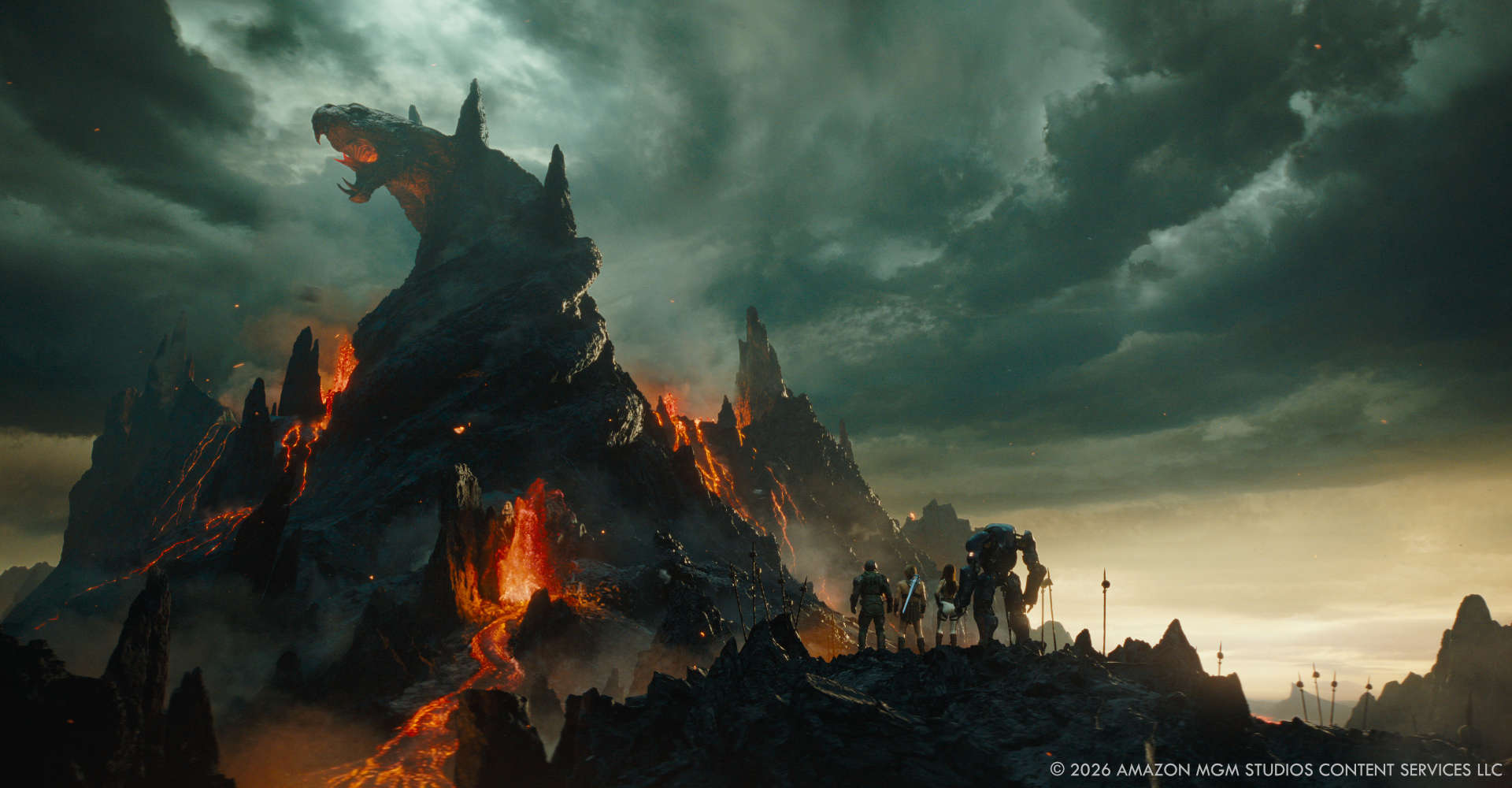
The whole sequence is beautifully framed by the hellish landscape of Snake Mountain which was recreated using a lot of the Photogrammetry we shot in the Dolomites and Iceland. Our Generalist Lead Frederic Fourier collaborated closely with our FX Lead Michael Cashmore and with their teams they did a fantastic job to integrate the lava elements and atmospheric simulations required to sell the danger lurking in every corner of this beautiful environment.


Roboto is another beloved character featured in the film. What were the key challenges in animating a character who needs to feel both mechanical and emotionally engaging?
ML: Travis wanted Roboto’s movement to be fluid and weighty, but not overly robotic. The mechanical aspect came from how we swiveled and pivoted different aspects of her anatomy, allowing her to move more freely and unrestrained. When it came to her performance, we conveyed her dialogue through a pattern of light activation on her face, and expression through the animated aperture of her eye visor. Travis also wanted her performance to feel more naturalistic, so it was important not to have the physical acting go over the top into “Madagascar” territory. There was subtext that needed to come through in her body language in a much more subtle way.

What’s your best memories during this production?
PP: Dailies was truly a great experience on the show, we had a great time trying to bring Travis’ vision to the screen and the whole team pitched in with exciting ideas that very often made it onto the big screen. It was a show that needed that kind of engagement from the Team and seeing it coming together day by day was the best gift for me.
ML: Working alongside some of the best artists in the game, who made the most impressive images out of this fun world.
How long have you worked on this show?
PP: All in all from preproduction to delivery it was around 18 months.
ML: Just about a year and a half.
What’s the VFX shots count?
PP: We delivered 793 shots.
What is your next project?
PP: Still under wraps! I am on-set for it now though and very much looking forward to sharing it later on!
ML: A new big universe is all that I can say!
A big thanks for your time.
WANT TO KNOW MORE?
ILM: Dedicated page about Masters of the Universe on ILM website.
© Vincent Frei – The Art of VFX – 2026


