Last year, Christian Irles shared insights into Image Engine’s work on The Gorge. Since then, he has worked on The Abandons and made his return to Cinesite. Today, he discusses his contribution to Masters of the Universe.
How did you get involved in this film?
I became involved around mid-October 2025, when the production was already filmed. We received plates and started work in November.
How was the collaboration with Director Travis Knight and with VFX Supervisors Tim Burke and David Vickery and VFX Producer Rich Yeomans?
David Vickery was our main contact, the client-side VFX supervisor, and he was an absolute pleasure to work with. He had taken over from Tim Burke and I believe he came on board around the same time as Cinesite. I had worked previously with VFX producer Rich Yeomans, on The Gorge and also The School for Good and Evil, so we were already familiar. Travis had a clear vision of what he wanted to achieve both visually and in terms of animation. His notes were clear and he rarely changed his mind, this massively helped with the compressed schedule.
What was your feeling about being part of such an iconic universe?
I grew up as a kid watching He-Man and had many of the toys for the main characters. It was a dream come true and a trip back in time to my childhood.
What are the sequences made by Cinesite?
The main body of our VFX work is in two sequences. First, there’s a hallway battle near the start of the film; Skeletor and his army are invading Eternos and the royal family is trying to escape their palace, with assistance from man-at-arms Duncan, who’s in charge of Eternia’s armies. There are fights between the opposing armies and a one-to-one battle between Duncan and villain Trap Jaw. There’s also a later sequence set inside Snake Mountain, Skeletor’s lair, and there are some additional shots outside of these two sequences.


What were the main challenges of delivering the Hallway Battle, which became Cinesite’s largest sequence in the film?
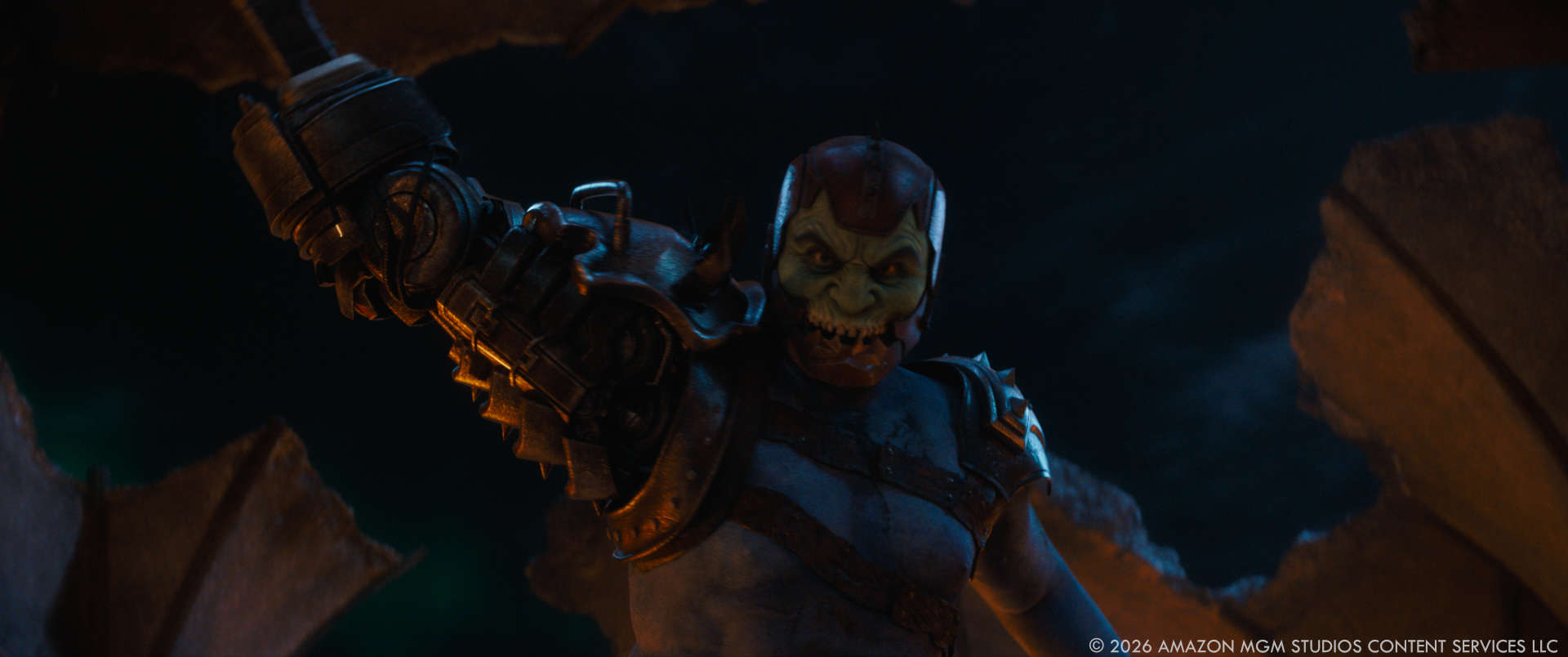
This is the sequence where Duncan is trying to extract the King, Queen, and a young Adam to get them to safety. There is a fierce battle between him and Skeletor’s army before he is confronted by Trap Jaw, whom we see for the first time. A member of Skeletor’s Evil Warriors, Trap Jaw is a cyborg with a mechanical, sharp-toothed jaw and a deadly robotic arm that transforms into a range of weapons.
Delivering the scale of this sequence required our team to overcome three primary challenges across the entire battle: the corridor set extensions, Trap Jaw’s mechanical arm, and achieving a cool, believable look for the various weapon impacts.
Many of the visual effects in this sequence were battle-related, including blaster impacts, sparks, dust, and weapons firing at characters or hitting the walls and columns of the cathedral. It was critical to make these hits feel completely natural in terms of gravity, dynamics, and how the impact energy dissipated. The clients were incredibly happy with our ‘Battle FX’, ultimately using them as a creative guide for other vendors on the show.
Beyond the environmental corridor extensions and Trap Jaw’s complex asset work, Duncan’s gun holster, which sits on his right thigh, needed to be replaced digitally as well. It is recessed behind a shield that moves aside to allow the gun to appear, its pieces assembling into place as it rises. Because it is seen in a tight close-up, the rotation, shifting pieces, texture, and overall detail all needed to be meticulously polished to feel physically grounded.


How did your team approach the corridor extensions and the redesign of the cathedral’s stained-glass windows?
The fight between Trap Jaw and Duncan was filmed across two separate locations, requiring two very different environmental approaches. The first part of the sequence was shot inside the real Wells Cathedral near Glastonbury, where we see the family fleeing their palace. To enhance the scale, we extended the back of the building to make it look much grander, and we also replaced the existing stained-glass windows. The production’s art department provided us with lovely designs steeped in He-Man universe folklore, which made integrating those custom graphics into the windows a fairly straightforward process.
For the rest of the sequence, the action moved to a film stage where production had built a partial corridor set. The set was constructed without a roof so the crew could properly light the scene, meaning we were tasked with designing and building a CG vaulted ceiling that appeared partially destroyed by the battle raging outside. We started by creating 2D concepts, taking direct cues from the physical set to match the exact brick colors and textures. Once the clients approved these designs, we proceeded with building the 3D model. However, the most challenging part of the corridor extensions was the final 2D integration, as every single plate was shot with shifting, inconsistent levels of atmospheric smoke and dust on set, requiring meticulous compositing to make the CG blend seamlessly.


Trapjaw is one of the most iconic villains in the franchise. How did you adapt ILM’s asset and bring the character to life for this sequence?
Our work for Trap Jaw involved recreating his robotic arm, but also working with a full digi-double for some shots; his cyborg arm can transform between three weapon types, making him a dangerous adversary. Actor Sam C. Wilson performed the fight sequence with his arm painted green, at times holding a large prop hook, blade or gauntlet.
ILM were the lead vendors for Trap Jaw and they supplied us with a full body digi double with the three arm stages: hook, blade and gauntlet. This was a very good starting point. The character wears extensive armour across his body and it was important for our CG arm to match seamlessly into it, particularly in terms of lighting. ILM also provided a side-by-side turntable of their CG Trap Jaw next to Clean Angle’s photographs, which they had captured of Sam C. Wilson; we used this material to compare against and to match our own CG Trap Jaw. We also made some adjustments so it would work within our own pipeline and scene.
Action was captured without tracking markers, and the team roto-animated Wilson’s whole body, focusing on the arm. Around half of our shots went straight from rotomation to animation just to fix interpenetrations, requiring no changes to the core poses or silhouettes. However, for the other half of the shots, Director Travis requested that we alter the arm silhouette entirely to make Trap Jaw look much more powerful and aggressive. He was keen to create strong silhouettes and for some shots the movement needed to be altered to look more dynamic, more powerful, which meant key frame animation was necessary.
Trap Jaw’s arm is a modular weapon, able to transform between three states and we needed to add those transitions. There were times when we needed to “cheat” physics; for example, where the large hook rotates and sinks into the base. We added several moving pieces so that when it’s moving and revolving, it disappears. Even though the mechanics were physically impossible, we needed to ensure that they appeared plausible, never seeming magical.

Can you tell us more about the hand-to-hand combat between Duncan and Trap Jaw?
This later part of the escape battle was captured on set, framing Duncan and Trap Jaw as fierce adversaries who must use all their strength and unique weaponry to defeat each other. As I mentioned earlier, production had built a partial set for the corridor, and we designed and built the vaulted ceiling extension to seamlessly add its battle-damaged state throughout the action.
The sequence itself opens with a tense stand-off between the two characters, which is broken when Duncan draws his gun from his holster. In response, Trap Jaw charges forward and launches into the air, instantly revealing a level of leg strength far beyond that of a normal human being. This marks the beginning of their fight, unfolding across a jump shot where he rises high above Duncan with his gauntlet raised to attack. It feels like a decisive moment in the choreography, particularly because it is the first time we see his arm physically transform from its initial hook state into its weaponised blade state.
Production had captured the jump performance on set using wires, and we initially worked with that content, replacing the distant environment and adding the cyber arm. But Travis was unconvinced by it, feeling that it just didn’t show Trap Jaw’s superhuman strength effectively or the sense of threat that the moment needed. With David (Vickery) we decided to try replacing the actor entirely for those shots with a digi double which we could pose as Travis directed, and that’s ultimately what we did to achieve this shot, and the following one.
The second shot of the two runs consecutively from the leap and now we see Trap Jaw more closely, from Duncan’s perspective; he is swinging his powerful arm over his head in slow motion, ready to attack, with his hook transforming into a blade. Since the digi double would be seen fairly close up, we needed to increase the resolution and detail in the textures and lookdev, to make sure it would hold up to close scrutiny.
At one point in the fight, Duncan grabs hold of Trap Jaw, using his thrusters to fly across the corridor before they smash into a column and a wall; the column collapses under the impact. This was filmed with a practical SFX column which was entirely replaced in CG, using a complex simulation created in Houdini. In another shot where Trap Jaw punches a wall with his blade arm, we did a digi double takeover, so we could make his punch very powerful. The wall behind them both was replaced in CG, with convincing debris, dust and sparks as Trap Jaw carves his blade into the masonry while trying to cut Duncan’s head off. Travis was very keen for this shot to show Trap Jaw’s devastating power, the violence of his movement, so a digi-double approach worked best. Many of these action shots also required extensive clean-up to remove the surrounding practical destruction so it could be replaced with CG. Furthermore, this included painting out Trap Jaw’s practical arm in all shots, and sometimes painting him out completely to replace him with his digi-double.
It’s also worth noting that because there is often very close chest-to-chest combat and we were adding a bulky CG arm much larger than the actor’s original limb, lots of invisible adjustments needed to be made to the actors’ movements to fit the arm in. There was a shot near the end of the sequence where Trap Jaw fires his gauntlet right up against Duncan’s stomach, below his armour plate. We needed to reposition his arm higher up Duncan’s body, so that the gauntlet appeared to be pressing against the plating, to ensure that Duncan’s subsequent recovery would be more believable.

For Skeletor’s Boudoir, how did you enhance the environment while working alongside ILM’s work on Skeletor himself?
The Skeletor’s Boudoir sequence starts with Pigboy waking Skeletor from his sleep, in a large, cave-like room, with walls lined by large, carved snakes. Skeletor is sleeping on a raised platform, and there is a large iris-like window behind him which Pigboy opens, using a mechanical contraption, so the circular mechanism rotates to let the light flood into the cave.
For the design of Skeletor’s Boudoir, we started with beautiful hand-drawn concepts received from the Art Department. The production filmed on a partial set that only included the platforms the actors walk on, the mechanism Pigboy interacts with, Skeletor’s bed, and a single staircase with candles; everything else had to be built from scratch in CG. To execute this, we used the original green screen plates to begin our environment work, and closer to delivery, seamlessly integrated updated plates from ILM with Skeletor’s face already composited in.
At the start of the sequence, the room is dark and Pigboy turns the mechanism on the bottom platform to open up the iris. They had built a practical iris on set, smaller than what they wanted. It was important to have that smaller version on set because, as it turns and the blades rotate to open, the light it lets in streams across the large set – we needed to match that reference in our larger, digital version.


The first step in building our CG environment was making sure the size of the room was appropriate. Once we had a couple of cameras that were tracked using the lidar scan, our modelers created the base shape of the room complete with the second set of stairs, adding proxy geometry for the iris so we could present size options to the client. Once the overall size and shape of the room was agreed, we moved forward with building the walls, lined with huge, undulating snakes carved into the rock. We started by building the bodies, concentrating on getting the nice curvature of the intertwining shapes; the positioning and shaping of the bodies was created by the FX team. Once the client had approved that, we were able to add the heads. We made them appear as though they were emerging from beneath other bodies or from behind rocks in the walls. This approach meant that they were more easily positionable to where the client wanted the heads to appear and we did not require a complex merging of FX, geometry and the modelled heads, instead handling them on a shot by shot basis. For texture, we matched the practical walkways and stairs that had been built on set, that had been covered with material which looked like volcanic rock. We also added some wetness and reflections as David had requested, to increase the sense of dampness and definition. For texturing the iris and its opening mechanism, we took our cues from other mechanical objects in the room. Although the original plan was for the iris not to have glass behind it, that changed and we later added the additional layer, complete with dirt and scratches on top of a 2D cyclorama supplied by ILM, with pre-rendered clouds, mountains and skies for us to add to the background. For one shot, with a strong camera move, ILM provided a bespoke render of their environment for us to include.
From a lighting perspective, the left hand stairs had practical candles on the step edges, leading up to the platform, so we recreated that in CG for the right side, matching that lighting. The boudoir is a large, cave-like room; its main light sources are the candles and sunlight. The plates which we received had both of these, as well as a blue/greenish fill light. The trick was in making a round environment blend seamlessly into the partial set, while making the room look asymmetrical and slightly unpleasant.


The “Old Friends” sequence features a holographic projection of Eternia. How did you develop the look and integration of this effect?
In this sequence, our heroes are standing around a table – a hologram of Eternia hovers above it, slowly rotating and semi-transparent. We received references for the Hologram from the production’s art department – again, beautiful, hand drawn concepts. We selected a shot to test a range of 2D concepts on, as well as different designs for the mechanical arm which is attached to the table from which the hologram is emitted. Once approved, we built it up in 3D. Director Travis wanted to steer away from a magical aesthetic, favoring a look that felt grounded in the weathered, functional technology seen in the plates. As the hologram lookdev progressed, we deliberately deviated from the initial Art Department concepts to match this brief, refining and simplifying the design until it sat subtly in the background.
In Hero’s Escape, there are several subtle character-driven effects, from Adam’s mother’s tear to the smoke interactions. How were these invisible details created?
There are two shots where we see He-Man, now in his twenties, meeting his mother, Queen Marlena, for the first time since he escaped as a child. We added a single tear to his mother’s cheek. This was a deceptively tricky effect to achieve. We had no 2D elements, so we used an FX solution, beginning by creating a simple mock up in comp of a red shape slowly moving down her face like a tear, to reference for positioning and timing. This was sent to the client and once they were happy with tear positioning and timing the FX team created a wetness map, and leading tear geometry. The FX artists did their own lighting and passed shots directly to the compositors.
There’s another scene in the “Hero’s Escape” where He-Man and his cohorts, who have been trapped in one of Skeletor’s prisons, manage to escape by shooting down some heavy metal gates. The heroes line up and are seen in super slo-mo in an amusing pastiche of a common shot from superhero films, walking confidently out of the prison towards the camera, with smoke rising around them. As they walk, the dust volume increases, enveloping the characters and making them cough. For closer shots, a 2D approach was taken, using elements from the team’s 2D library. For wider shots, 3D simulations were used to get the timing right, with the smoke wrapping around the actors and the walls correctly. There is also interaction where we see the influence of the actors walking dynamically through the smoke, with it curling around them.

Tri-Klops’ damaged bionic eye and the shockwave effects on the cybernetic arm add extra personality to the action. How did you approach these enhancements?
In the same sequence, another shot was created involving Tri-Klops, another of Skeletor’s gang of baddies who has a rotating visor with three different artificial eyes. Earlier in the film, he had fought with He-Man, a fight which resulted in his head being smashed against a rock. We added a damage effect to his mechanical eye. We replaced the eye interior, adding a sparking, flickering light effect to indicate that it’s lapsing out of life, then rewiring itself. It’s subtle but effective. There was also a shot where we added an energy shock wave when Fisto is fighting the bad guys with his supersonic arm. We received references for this FX from DNEG.
The Earth stitch shot in Memphis is the only Cinesite shot set outside Eternia. What made the seamless combination of two separately filmed plates such a unique challenge?
This shot, although it appears earliest in the film, was the last shot we received and one of the final shots to deliver – it was deceptively tricky. We see Adam, who is driving a yellow car, turn into an alley in a city, pulling up outside a comic book and memorabilia shop called Fright Zone.
We received two plates, neither of which were captured using motion control. The first (plate A) was filmed in the UK (for Memphis) in an alley without any stores, with the camera tracking downwards. The second (plate B), of a car pulling up in front of a shop facade, had been filmed in a studio with a camera mimicking the downward motion of plate A. We needed to combine both plates to add both the distant city and the car. The first step involved tracking the cameras in both plates. Then, for the far background and road outside the alley, in Nuke, we projected the plate A footage onto simple geometry and rendered it using the plate B camera. The cars and people in the background needed to be separated and put onto cards. Step three involved the alley buildings, which needed to be recreated in 2.5D as digital matte paintings using still frames from plate A. Since the camera was so close to one of them, additional detail needed to be added to the DMP. Finally, in the integration stage in Nuke we combined the layers with the storefront and yellow car to create one seamless shot.


What’s your best memories during this production?
My best memory during production was working with our clients David, Rich, Dickie and Joe, and our Cinesite team! It was short, it was lots of fun. I only wish it had lasted longer.
How long have you worked on this show?
We started in November 2025 and delivered in April 2026, so it was in production for around 5 months.
What’s the VFX shots count?
In total, we delivered about 160 shots.
What is your next project?
I’m not on a specific project at the moment, but there are lots of exciting things on the horizon!
A big thanks for your time.
WANT TO KNOW MORE?
Cinesite: Dedicated page about Masters of the Universe on Cinesite website.
© Vincent Frei – The Art of VFX – 2026