
In 2025, Chris McLaughlin walked us through DNEG‘s work on Mickey 17. This time, he joins us to explore the ambitious visual effects of Masters of the Universe.
How did you get involved in this film?
It feels like a very long time ago now, but I’d known that DNEG was having discussions for the project and I was keen to be involved from the outset. Having grown up watching the cartoon and playing with the toys, ‘Masters of the Universe’ was a world I was excited to revisit. So, when the project was awarded, I didn’t need much convincing and jumped in feet first.
How was the collaboration with Director Travis Knight and with VFX Supervisors Tim Burke and David Vickery and VFX Producer Rich Yeomans?
It was a very collaborative process from the beginning. Tim Burke oversaw the project through pre-production and principal photography, and he established the overall VFX strategy. Before shooting began, I travelled to London to spend time with Tim and the production team, discussing the scope of the work, the creative goals for Eternos, and some of the key creative challenges we anticipated.
Once the project moved into post-production, David Vickery took over from Tim and, during that period, I relocated from Vancouver to London which proved incredibly valuable because it allowed me to work much more closely with David, Rich Yeomans and the wider production team. We were able to review work with Travis Knight in person, which meant creative decisions could be made very quickly and there was always a clear understanding of what the film needed.
Travis was incredibly passionate about the material and very focused on character and storytelling. Even on the largest VFX sequences, the conversations were always rooted in narrative and performance rather than spectacle. Having that direct access throughout post-production helped us refine the work continuously and ensured that the visual effects remained in service of the story.


What was your feeling to be part of such an iconic universe?
It was a mix of excitement and a bit of disbelief, to be honest. I grew up with the ‘He-Man and the Masters of the Universe’ series. I was a big fan of the cartoon and I had the toys as a kid, including He-Man and Battle Cat, so it’s one of those worlds that’s been in the background for a long time.
When I first saw the concept art for this version of Eternia, it was immediately clear that the production was taking it in a really ambitious and visually striking direction. That was very exciting from a VFX point of view, because you could see straight away that there was an opportunity to build something really special.
So getting the chance to contribute to bringing that world to life on screen, and to be part of reimagining something that had such a strong place in popular culture, was a real privilege.


What are the sequences made by DNEG?
DNEG worked on 17 sequences in total. We worked on all of the sequences in and around the city of Eternos. That included the ‘Opening Montage’, the ‘First Battle’ and ‘Adam’s Escape’ (where Skeletor and his army attack and take over the city), Adam and Teela’s ‘Return to Eternos’ (where we discover that Eternos has been destroyed and is little more than a ruin), the ‘Greyskull Battle’ (where Adam leads his army back to Eternos to fight Skeletor) and ‘Eternia Restored’(where we return to a rebuilt city, six months after the battle of Greyskull). We also worked on the sequence in the jail cell where the audience first meets Roboto, and we collaborated with Rodeo FX on the ‘Ancient Forest’ sequence.


What were the key visual development challenges in bringing Eternia and Eternos to life for this new adaptation?
The key challenge was creating a world that felt fantastical enough to belong in ‘Masters of the Universe’, while still feeling like a real place that people had lived in for generations. Eternos is an enormous walled city with Castle Grayskull, the Rotunda and the surrounding landscapes all playing important roles in the story. So it needed a sense of scale and grandeur, without feeling like a purely digital environment.
A key part of that was giving the city a sense of history. We weren’t just building a single version of Eternos, we needed to create it in three distinct states across the film: its pristine form, its destroyed state following Skeletor’s assault, and finally a restored version where life has begun to return to the city. The audience needed to instantly recognise each version as the same city, while also feeling the passage of time and the impact of the events that had occurred there.
We needed to think about how damage would spread through the city, and how rebuilding and natural overgrowth would change the environment over time. Every landmark had to carry its history with it. The destroyed city couldn’t just look like a collection of ruins, it had to feel like a once-great civilization had fallen. Likewise, the restored version needed to suggest hope and renewal while still resembling the city that had existed before.
In many ways, Eternos became a character in its own right, evolving alongside the story and reflecting the journey that Adam takes.


How did you approach the look and scale of Eternia to make it feel both fantastical and grounded?
We wanted Eternos to feel epic and mythic in scale, but still believable as a real world with its own history, culture and geography. It’s easy for large fantasy environments to become purely a visual spectacle, so a lot of our effort went into making Eternos feel like a place that people had genuinely lived in.
A lot of our inspiration came from real historic locations. We looked at walled cities in Italy and medieval castles in Wales, and Wells Cathedral in Somerset was also a key reference for the production designers. These places were incredibly valuable references for our texture artists. It wasn’t so much about copying specific architectural details, but more about capturing that sense of history you see in real buildings – layers of construction, weathering, repairs and additions that have accumulated over centuries.
Although relatively little of Eternos was physically built on set, the production always provided strong interactive lighting that gave us something real to anchor our work to. By extending those lighting cues into the CG environments, we were able to make the digital world feel more integrated with the live-action photography.
Can you tell us about the opening battle sequence and the main VFX challenges involved?
The opening battle sequence was a really ambitious way to introduce the scale of the world straight away, and in many ways it also acted as a teaser for the kind of large-scale action audiences could expect in the movie.
One of the key creative challenges was managing the transition from day to night in a way that felt seamless and motivated. The plates were captured under a mix of conditions – some in full daylight, some as day-for-night, and some at night – so we needed to unify all of that into a consistent progression across the sequence.
On top of that, it’s a large-scale assault on the city with extensive destruction and CG crowd work running throughout. We had marauding armies moving through Eternos, with FX driving explosions, environmental damage and the progressive breakdown of the city as the battle unfolds.
It also serves as an introduction to some of the hero characters, which added another layer of complexity and fun. We see Fisto deliver his shockwave punch, Ram Man smash through enemy lines creating waves of destruction through the city, and Mekaneck use his extending neck almost like a whip within the chaos of the battlefield. Each of these abilities needed to remain clearly readable within a dense, fast-moving and chaotic battlefield, while still feeling grounded within the larger-scale destruction of the city.


How did the final battle push the visual effects work further than the rest of the film?
The ‘Greyskull Battle’ sequence was really where everything came together. It effectively included every aspect of the visual effects work we had done for the movie, combined into one climactic battle. CG characters, CG creatures, performance animation, FX destruction and explosions, magic FX, environments, crowds and digi-doubles all featured at various points.
What made it particularly challenging was the scale and density of the action. The sequence moves across multiple key locations within Eternos. At the Rotunda, which sits in the centre of the connecting bridge between the city of Eternos and Castle Greyskull, Roboto and Duncan are holding off Skeletor’s advancing forces; inside the Inner Sanctum, Adam’s transformation into He-Man leads into his final confrontation with Skeletor; and outside in the city, the rest of the heroes – including Fisto, Ram Man and Mekaneck – are engaged in a large-scale battle against Skeletor’s army. Each of those locations had its own challenges, but they were all happening simultaneously and needed to feel like part of a single cohesive event.
It was also a truly global effort. The work was distributed across each of DNEG’s studios in Canada, Europe, India and Australia, so a lot of coordination was required to maintain continuity and consistency across such a complex sequence.


Skeletor is one of the most iconic villains in fantasy cinema, how did you approach translating his design into a believable digital character?
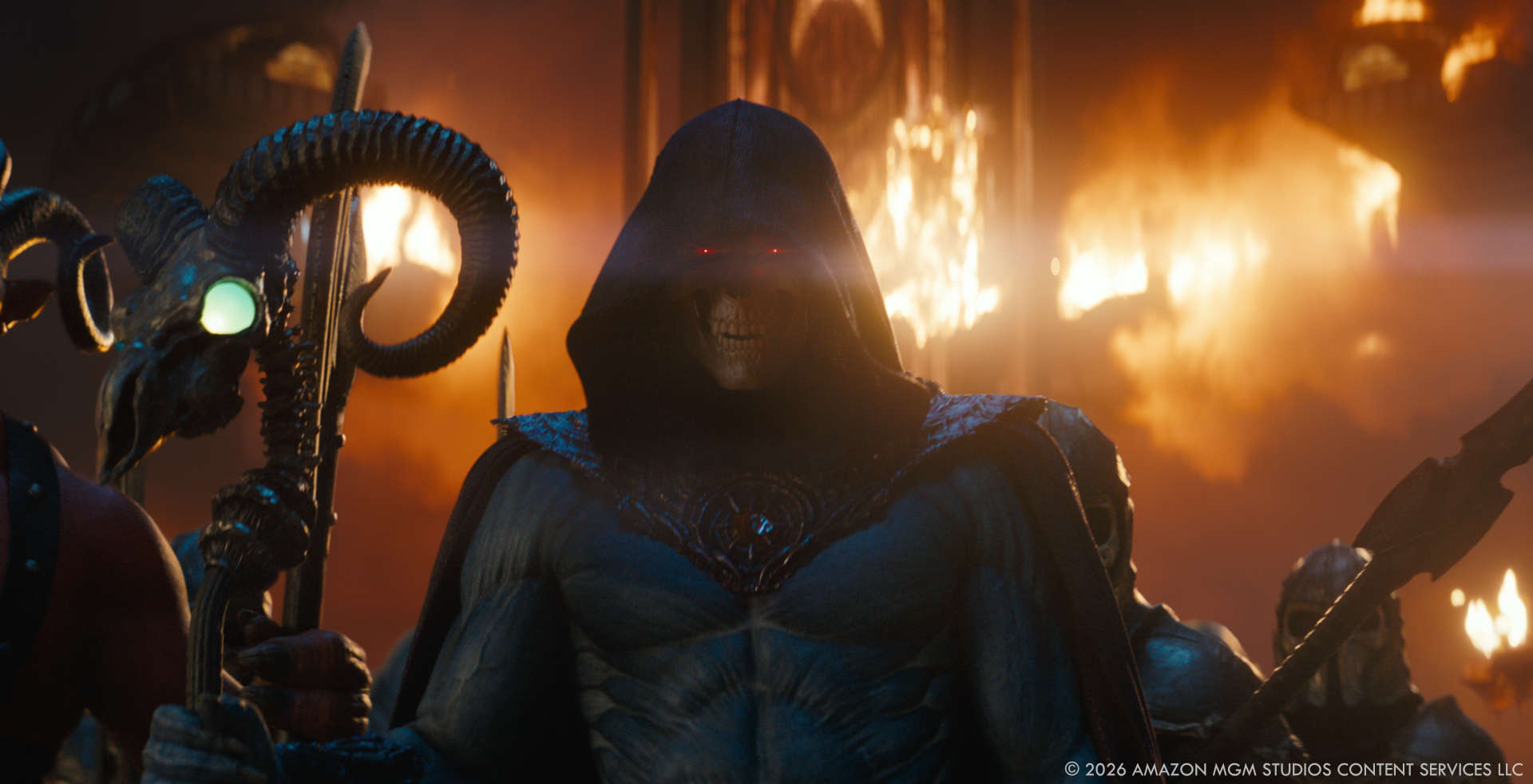
The majority of the character design for Skeletor was done by the production’s art department. For the vast majority of the shots we worked on, we used Jared Leto’s performance and practical costume and our work was focused on replacing just the skull.
Because of that, our main responsibility was making sure the digital skull felt like it truly belonged in that environment and within that performance. It needed to feel physically real, like an object made of bone that was actually sitting inside the hood, reacting correctly to the set lighting and interacting naturally with the actor’s movement.
A big part of that was ensuring seamless integration with the photography. We spent a lot of time matching the lighting response and surface qualities so the skull felt embedded in the costume, rather than floating or feeling like a separate CG element.
Ultimately, the goal was to preserve everything that was already working in the practical build and performance, and just elevate the skull so it felt like a seamless extension of that work rather than a replacement.

What aspects of Skeletor’s facial animation required the most research and development?
Most facial animation systems rely heavily on features like lips, cheeks and a tongue to create speech, but Skeletor doesn’t have any of those! He’s essentially a skull, so many of the visual cues audiences subconsciously rely on to read dialogue aren’t available.
We began to run tests on this immediately. The challenge was finding the right balance. We wanted the skull to feel rigid, but we also needed enough flexibility to support speech and performance. If the skull remained completely rigid, it looked unconvincing and was just a flapping jaw. But, if we pushed the deformations too far, it started to feel rubbery and lost the sense of being a solid object.

How did you balance preserving Skeletor’s skeletal features while still delivering nuanced performances and emotions?
We definitely wanted Skeletor to feel like he was made of solid bone – rigid, hard and physically believable. But, at the same time, he still needed to express emotion and deliver a performance. That required a significant amount of testing around how far we could push deformation for expressions and phonemes without breaking the illusion that the skull was a solid object. If you are too subtle, the expression becomes unreadable; if you push it too far, the character starts to feel rubbery or cartoonish.
We focused on developing a system that allowed us to introduce subtle, carefully controlled deformations while maintaining the integrity of the skull’s shape and avoiding issues such as texture stretching. In addition to this, our Animators could also use eye movement, jaw mechanics and head twitches to communicate intent and emotion, rather than trying to force anything through extreme facial deformations.
Ultimately, the goal was to make audiences believe they were watching a living, performing character made of bone, not an animated skull being morphed into shapes it shouldn’t physically be able to achieve.
DNEG handled a significant portion of the Skeletor shots. Were there any particular sequences that became showcases for the character work?
The ‘Adam’s Escape’ sequence was a real showcase for Skeletor. It’s the first time we properly see the character in the film, so it needed to land both visually and in terms of performance. It also takes place against the backdrop of the burning city, which gave us a very strong, dramatic setting to play against.
Performance-wise, it’s quite a theatrical moment, and that really suited the character. Jared Leto delivered a very expressive, heightened performance, and the director was keen for us to retain as much of that nuance as possible in the CG skull.
It became a key sequence for establishing Skeletor’s presence in the film and for showing how far we could push performance within the constraints of a skeletal character.

Roboto has a very distinctive mechanical design. What were the key challenges in creating and animating her?
The initial brief for Roboto was that, despite having a recognisably humanoid form with two arms, two legs and a head, she shouldn’t move like a human. We wanted her movement to immediately communicate that she was a machine, not a person in a suit. To explore that, we looked at a lot of real-world robotics, particularly the work being done by Boston Dynamics, studying the unusual ways robots can balance, pivot and reposition themselves.
That thinking also influenced the design of the rig. We split the bicep and thigh sections so they could rotate a full 360 degrees, giving us movement possibilities that simply wouldn’t be possible with human anatomy. The challenge was then finding ways to use that freedom in animation that felt purposeful and character-driven, rather than just mechanical for the sake of it.
We also spent a surprising amount of time on her ‘eyes’. Roboto has a visor with an illuminated panel, and we found early on that viewers could sometimes read it more as a mouth or a graphic display than an eye. To address that, we developed a subtle treatment within the visor that created the impression of a pupil moving behind the illuminated surface. It’s quite an understated effect, but it gave Roboto a much clearer focal point and helped make the character feel more alive without compromising the design.
From a technical standpoint, another major challenge was maintaining the integrity of all the mechanical components. Roboto’s design includes numerous pistons, hinges and articulated elements, and those all had to function correctly throughout every performance. Whenever an arm, leg or torso section moved, the underlying mechanics needed to behave as if they had genuinely been engineered to work.
We also developed her transforming weapon systems. The guns that emerge from her hands weren’t simply effects added on top, they needed to be fully designed, engineered and integrated into the character so that the transformations felt believable and mechanically plausible. That required close collaboration between our modelling, rigging, animation and effects teams to ensure the transformation process worked from every angle.


Cringer is a fan-favorite character. How did you approach his performance and personality before his transformation into Battle Cat?
We spent quite a bit of time doing animation tests using dialogue from a variety of sources, exploring different interpretations of the character and trying to find the right balance for his personality. We wanted him to be slightly timid and cautious, but still likeable and someone the audience would root for. There was a danger of making him either too comedic or too cowardly, so it was really about finding that sweet spot.
At the same time, we wanted him to feel grounded as a believable feline. The animation team spent a lot of time studying references of real tigers and big cats, looking at everything from their posture and gait through to more subtle behaviours such as ear movement, eye darts, weight shifts and reactions to their surroundings. Even when Cringer is delivering dialogue or participating in character-driven scenes, we wanted those underlying animal behaviours to remain present.


Cringer and Battle Cat required extensive creature work. Can you talk about the fur, muscle simulation, and animation techniques used to bring them to life?
Cringer, Baby Cringer and Battle Cat were some of the most complex creature assets we created for the film. From the outset, the goal was to make them feel like believable animals with real weight, anatomy and physicality, while still allowing for the level of performance and personality required by the story.
To achieve that, we built the characters using a proprietary creature pipeline, leveraging our Ziva Creature FX toolset to develop the facial rig, muscle systems and simulation rigs.
The facial rig took some development as he’s not just a tiger, he’s a character with a distinct personality. We needed enough control to deliver nuanced expressions and emotional beats while remaining faithful to the anatomy of a large feline. A lot of effort went into ensuring the facial performance, body mechanics and muscle simulations all worked together visually.


The fur was another major component. Not only did it need to hold up in close-up shots, but it also had to respond naturally to movement, muscle deformation and environmental forces. The interaction between the animation, muscle simulation and fur simulation was critical in helping sell the scale and physical presence of the character.
One of the interesting challenges was that the same underlying creature pipeline and rig needed to support very different versions of the character, from the smaller, more vulnerable Baby Cringer through to the much larger and more powerful Battle Cat. While their personalities and physical scale are very different, we wanted them to feel connected as the same character throughout the film.


What were your best memories during this production?
Looking back, my strongest memories are really of the team effort behind the film. This was an incredibly ambitious project, spread across multiple continents and time zones with teams in Canada, Europe, India and Australia all contributing to the final result. There were certainly challenging moments, but what stands out most is how everyone came together.
I’d particularly like to acknowledge DNEG’s Executive Producer Jenn Fairweather, Animation Director Greg Fisher and Creative Director Chas Jarrett. Their support, guidance and leadership throughout the project was absolutely invaluable.
The same goes for our DFX Supervisors Nik Brownlee, Eric Chan and Jeffrey Charles Higgins, who were instrumental in shaping the work creatively on a day-to-day basis. They each brought their own strengths to the project and were constantly pushing the quality of the work while helping teams navigate some very complex creative challenges.
On the production side, our VFX Producer Vikram Chadha, along with our Associate Producers Brian Iankovs, Heather Martini and Vinay Karunakar, did an incredible job. On a show of this scale, with so many moving parts and teams spread around the world, the production team are absolutely critical and they were a huge part of the reason the project was successful.
DNEG VFX Supervisor Rhys Salcombe was instrumental in driving the development and build of Eternos, while Environment Supervisor Daniele Chindamo and his team carried that work through into the final shots across the film. Our lighting and compositing teams also faced a mammoth challenge, bringing together work across multiple sites and ensuring everything felt cohesive and consistent. That effort was led by Heather Ruttan, Chris Rickard, Vishal Shah and Himanshu Talreja on the lighting side, and by Kunal Chindarkar, Sai Kiran Reddy Telluri and Dmitry Uradovskiy in compositing.
There are honestly too many people to mention individually. More than 1,500 DNEG artists contributed to the film over the course of production, and every department played a role in bringing Eternia to life. Looking back, what I’m most proud of is what the team achieved collectively. It was a genuine global effort, and it was a privilege to be part of it.


How long have you worked on this film?
I was involved for the entirety of DNEG’s production schedule on the film, from the early planning and asset development stages through to final delivery. So, about 15 months in total.
What’s the VFX shots count?
DNEG’s final shot count was around 750.
What is your next project?
I’ve just taken a long vacation, so that’s what I’ve been focusing on!
A big thanks for your time.
WANT TO KNOW MORE?
DNEG: Dedicated page about Masters of the Universe on DNEG website.
© Vincent Frei – The Art of VFX – 2026