In 2018, Joseph Kasparian told us about Hybride’s work on Solo: A Star Wars Story. He went on to work on a number of projects, including The Book of Boba Fett, Obi-Wan Kenobi, The Mandalorian, and Skeleton Crew. He joined Rodeo FX in 2024 and has worked on House of the Dragon, The Sandman, Wednesday, and Stranger Things, among others.
How did you get involved in this film?
Rodeo FX was brought onto the project to help create some of the most ambitious environments and action sequences in Eternia. Given our experience with large-scale environment creation, complex vehicle work, and action-heavy visual effects sequences, we became involved early in pre-production and collaborated closely with Tim Burke, David Vickery and Rich Yeomans to help define the visual language of several key locations and sequences.
How was the collaboration with Director Travis Knight and with VFX Supervisors Tim Burke and David Vickery and VFX Producer Rich Yeomans?
We started collaborating very early on the show. While preparing for the shoot, they shared a very strong previs created by the team at Proof that we followed closely almost until the end of production. Travis defined the action really well and that previs ended up being a solid foundation for the storytelling, pacing, and action choreography.
We proposed concept art for every location to help define the look of the various environments we would be creating. Although the brief called for an “out of this world” vibrant aesthetic inspired by the classic 1980s toys and animated series, we grounded our work in real-world references to maintain credibility and visual richness. Our Skysled chase sequence travels through multiple distinct environments, from canyons and geothermal regions to the massive forest canopy and the world beneath it, requiring extensive visual development throughout the project.

What was your feeling to be part of such an iconic universe?
It was incredibly exciting to contribute to such an iconic franchise. Being able to build vehicles and environments that many of us grew up playing with was a unique experience. We approached the vehicles almost like toys brought to life, ensuring assets such as the Roton and Freight fighter were fully rigged and highly maneuverable so animators could create dynamic performances while staying true to their original designs.

What are the sequences made by Rodeo FX?
We were responsible for the Sky Sled Chase sequence, beginning in the canyon environments and continuing through the geothermal regions before concluding in the giant forest. We also completed work on the Forest Clearing sequence following Teela’s ship crash. For that sequence, Rodeo FX handled the environment work, look development, lighting, and final compositing, while incorporating animation and renderings for Skeletor’s Aurora that were provided by DNEG.

How did you approach the design and execution of the Sky Sled chase sequence through Eternia’s canyon environments?
For the Canyon section, our goal was to create environments that felt both fantastical and believable.
We began with drone reference footage captured over the mountainous landscapes of Iceland. Using this footage as a primary reference, we developed concept art to define and guide the artistic direction of the environment. The canyon’s scale, characterized by its expansive width and depth, winding rivers, and vibrant vegetation, provided a strong foundation for establishing the sequence’s distinctive visual identity.
The canyon also featured a variety of unique rock formations and cliff structures, many of which exhibited organic geological shapes and patterns. These non common characteristics played a key role in shaping the overall look and feel of the sequence.

What were the main challenges in creating the large-scale geothermal landscapes seen during the chase?
For the geothermal environment, we drew heavily from Icelandic landscapes to establish its volcanic character. We introduced yellow and orange sulfur deposits to add color variation to the otherwise gray terrain, while columns of smoke and low-lying steam helped create depth, atmosphere, and parallax throughout the sequence.
The addition of distant mountains and localized atmospheric effects gave us precise control over shot composition. We also chose to replace clouds with cyan auroras, which enhanced the sense of scale and added visual vibrancy against the blue sky.
The environment eventually transitions into a network of braided rivers leading toward a forest of giant red trees. Using Icelandic drone footage, river references, and sunset photography, we developed distinctive water surfaces that added complexity to the landscape and provided a natural transition into the next environment.
How did you balance practical photography and digital environments throughout the canyon and forest sequences?
Whenever possible, we used practical photography as a foundation and extended it digitally. Real-world textures, lighting references, and natural landscapes helped ground the environments, while digital extensions allowed us to dramatically increase scale and introduce the fantastical elements unique to Eternia. The objective was always to make the transitions between photographed and fully digital environments invisible to the audience.

Can you tell us about the different vehicles featured in the chase and the work involved in bringing them to life?
The sequence features several iconic Eternian vehicles, including the Teela ship, Sky Sled, the Roton, and the Freight fighter. Each asset required a high level of detail to hold up in close-up shots while also being robust enough for demanding action sequences. We built complete rigging systems for all the vehicles, allowing animators to push their performances while preserving the distinct characteristics fans would recognize from the original designs.
Roton
The Roton is a distinctive attack vehicle featuring two high-speed rotating blades capable of cutting through obstacles, along with fully articulated machine guns. Based on approved concept art, the vehicle required a complex rig to support its gyroscopic behavior, allowing the pilot to remain upright while the blades rotated around them. The blades could shift orientation and close together for more aggressive attacks. Red engine lights helped distinguish Rotons during large-scale action sequences involving multiple vehicles.
Freight Fighter
Inspired by a combination of a scorpion and a dragonfly, the Freight Fighter features rapidly rotating wings and an articulated tail that creates unique silhouettes during flight. A practical cockpit was built on set, which we extended in CG for close-up and action shots. Cyan engine lights and a dark pink color palette reinforced the vehicle’s retro-inspired aesthetic, while weathering helped ground it within the film’s diverse environments.
Teela Ship
The Teela Ship was partially constructed on set and recreated digitally using photography and blueprints. While exterior action sequences relied on the fully CG asset, many scenes took place inside the cockpit, requiring seamless integration between practical and digital elements. We enhanced the interiors with interactive lighting, reflections, window imperfections, and custom reflection setups to preserve as much live-action photography as possible.
Sky Sled
A practical Sky Sled was built for on-set photography and later replicated digitally using LiDAR scans and reference photography. The CG version allowed for dynamic aerial action, enabling rapid movement, sharp turns, and high-speed chase sequences that would not have been possible with the practical asset alone.

How did you choreograph and enhance the numerous explosions and destruction beats during the pursuit?
The chase featured many explosions. It was important that the action remained readable and that the scale of each explosion felt appropriate relative to its surroundings.
We developed a distinctive explosion look, emphasizing stylized visual elements to support the overall artistic direction. Each explosion was carefully crafted across multiple shots, as a single explosion could begin in one shot, continue into another, and conclude in a third.
Maintaining the three-dimensional quality of the explosions was critical because the camera was constantly moving at high speed. A simple explosion would quickly lose impact, so we layered multiple events within each explosion—secondary blasts, fragmentation, and successive detonations with phosphoric sparks —to maintain visual energy and scale.

What techniques were used to convey the speed, scale, and danger of the Skysled chase?
To convey the speed, scale, and danger of the Sky Sled chase, we combined dynamic camera work with large-scale environments, atmospheric effects, and detailed vehicle animation. Motion blur, volumetrics, and fast-moving environmental elements all helped reinforce the sense of momentum, while the constantly changing terrain kept the sequence feeling unpredictable and dangerous.
A key challenge was balancing speed with readability. We wanted the audience to feel the intensity of the chase without losing sight of the characters, so we carefully controlled camera movement and framing throughout the sequence.
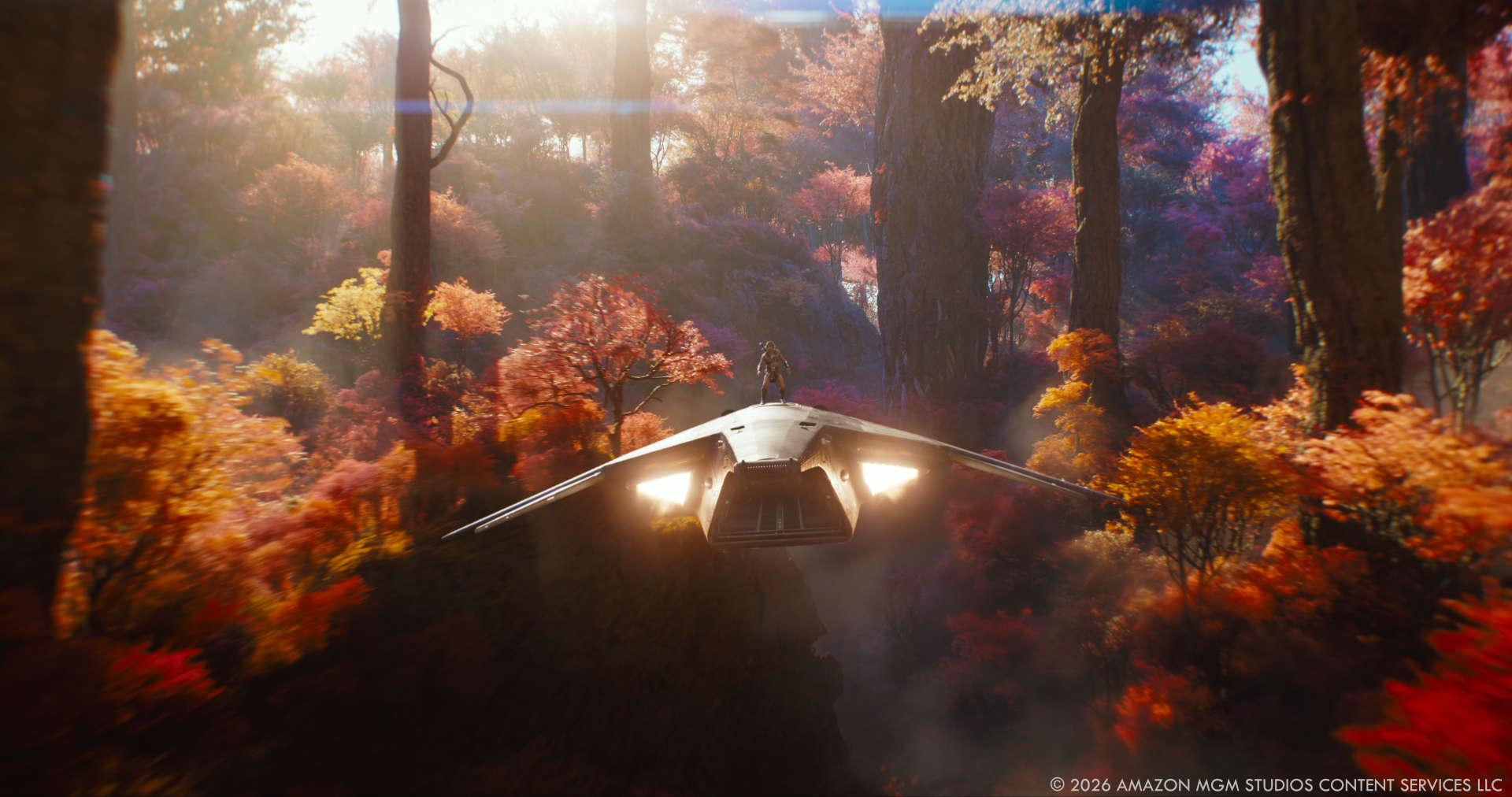
In the Bellow Canopy section, the enormous scale of the forest played an important role. Because the action moved at such high speeds, we had to carefully position trees and vegetation to avoid excessive motion blur while still creating strong parallax cues that communicated both scale and velocity.

How much of the surrounding forest environment was digitally created or extended by Rodeo FX?
The forest environment was inspired by concept artwork provided by the production team, which guided the creation of a library of vibrant plants and vegetation integrated into the practical set. By matching the visual language established on set, we were able to seamlessly extend the environment in CG, particularly for the Forest Clearing sequence that follows the crash.
While red trees defined the overall look of the forest, we introduced carefully controlled variations of yellow, orange, and occasional blue to create a vibrant, living ecosystem rather than an autumnal landscape. Rock formations and cliffs were used to break up the dense vegetation, provide visual contrast, and allow light to better illuminate the vehicles and characters.
One of the more unique aspects of the environment was our approach to depth. Rather than relying heavily on atmospheric fog, we gradually shifted distant elements toward cooler blue tones while preserving the saturation of foreground objects. Using color and saturation as depth cues allowed us to maintain the richness of the environment while still conveying scale.
The sequence ends with a dramatic crash in the forest. What were the biggest VFX challenges in that section?
The crash sequence combined many disciplines simultaneously. We had vehicle destruction, environmental interaction, vegetation simulations, debris, dust, atmospheric effects, and digital doubles all working together within a dense forest environment. One of the main challenges was maintaining clarity and emotional impact while managing a very large number of visual effects elements in each shot.
The sequence was equally interesting from both outside and inside the ship. Inside the cockpit, it was crucial to communicate that the ship was falling and losing control. Lighting changes, interactive effects, and environmental elements helped sell the instability. The goal was to try to stay away from feeling on a rail.
We also choreographed the windshield shattering and the wings breaking away, ensuring consistency with later night sequences featuring a ship that already had a broken windshield.


How did you create He-Man’s digital double, and in which situations was it required during the chase?
We ingested the He-Man Digidouble asset and used it in scenes that would have been nearly impossible to film practically. It was primarily used during shots that involved complex aerial stunts, dangerous action beats, vehicle interactions, and moments where the camera moved in ways that would be very difficult or unsafe to achieve practically. The goal was always to ensure a seamless transition between the actor and the digital character.
Throughout the forest chase, He-Man jumps from one vehicle to another, requiring careful transitions between live-action footage and the CG digital double. In some cases, we used the full CG body for interactive lighting while replacing the face with the actor’s filmed performance.
What’s your best memories during this production?
One of the highlights for me was definitely the vehicle design phase and exploring their range of motion. It felt like bringing childhood toys to life, imagining how they would move, maneuver, and express their own personalities. Even though we had strong previs as a foundation, we pushed the animation further to define the unique behavior of each vehicle. The Roton was particularly fun to work on because its spinning motion constantly generated dynamic and interesting silhouettes.
I also really enjoyed building the chase across multiple environments, each with its own visual identity while still feeling part of the same world. We wanted every location to evoke the spirit of the original comics and animated series while bringing a cinematic sense of scale and realism. Watching the sequence evolve from layout through final compositing while maintaining that colorful, animated energy was incredibly rewarding.
Finally, one of my best memories from the project was the collaboration with the production team, especially Travis Knight, Tim Burke, David Vickery, and Rich Yeomans. We started working together very early in the process and, throughout the show, it genuinely felt like we were all part of the same team. That level of trust and creative partnership made the experience particularly enjoyable.

How long have you worked on this show?
We worked on the show for about 15 month.
What’s the VFX shots count?
We had around 325 shots.
A big thanks for your time.
WANT TO KNOW MORE?
Rodeo FX: Dedicated page about Masters of the Universe on Rodeo FX website.
© Vincent Frei – The Art of VFX – 2026


