
With over 18 years of experience in visual effects, James HattSmith has built an impressive career across some of the industry’s most renowned studios. Before joining Untold Studios in 2021, he worked at Framestore, DNEG, and Cinesite, contributing to productions such as Guardians of the Galaxy, The Dark Crystal: Age of Resistance, The Wheel of Time, and The Sandman.
Peter Jopling started his career in visual effects in the early 1990s as a Flame artist. Over the years, he worked at leading studios including MPC, Digital Domain, The Mill, and Weta FX before joining Untold Studios in 2022. His credits span major productions such as Lara Croft: Tomb Raider, Batman Begins, Chernobyl, and The Running Man.
How did you get involved on this film?
Peter Jopling: We were approached by the production to take on this seq as it one of those complex creative missions that required agility and senior team that were both technically and creatively at the top of their game. It wasn’t really a traditional VFX seq, more a piece of feature animation, infused with VFX. It was a seq that fit Untold’s unique profile, and one that the production believed we’d be a great fit for.
How was the collaboration with Director Travis Knight and with VFX Supervisors Tim Burke and David Vickery and VFX Producer Rich Yeomans?
James HattSmith: I am a huge Stop Motion fan, and love everything that comes out of LAIKA, so the opportunity to work with Travis Knight was a career high. It was really insightful seeing his process and it was clear from our first meeting that he knew exactly how he wanted to present his vision for MOTU. It was nerve wracking at times. We were being tasked with opening his movie and setting the tone, which was no small feat. Travis having an animation background, and such a strong eye for design and colour, made for a really exciting project. He is a nice guy too.
Dave and Rich were excellent collaborators. We had very regular Creative Huddles where we would hammer out all the beats and discuss the tone and look. These huddles were always good fun and I really enjoyed the process. But, the importance of this sequence was never forgotten, the pressure was always on. We had fun none-the-less! As we joined the show fairly late in the process, we really benefitted from having lots of face time with the Anim supes at ILM. They had already been on the show for a year, so their experience with Travis was invaluable and really helped us find the right language for the sequence.
Peter Jopling: It was one of the best collaborations I’ve had. David was very gracious with his time and creative guidance and he also facilitated direct contact with TK to give us the most streamlined feedback, which proved critical in enabling faster iterations and clear creative targets. David and TK fostered a great sense of creative partnership which we grabbed with both hands and took creative ownership of the seq, driving it forward independently, offering creative solutions, but being mindful of staying within the brief.

What was your feeling to be part of such an iconic universe?
James HattSmith: Being of a certain age I sit very firmly within the demographic for a project like this. As soon as I heard of this project I was determined to be involved. Especially once I discovered Travis Knight was directing! I played with the toys, and watched the cartoon and, I think they played a part in me pursuing a creative career. A sequence like this also plays to my strengths as a supe, I love doing subjective, complex and creative work. It was really nice working with a team that also had fond memories of the MOTU cartoon and toys. We’re all a bunch of nerds after all!
Peter Jopling: Its was extremely good fun to be apart of, its a vibrant palette but very optically based which was an important part of the aesthetic for TK, it gave us a lot of latitude to add our own flourishes which was really rewarding experience.

What are the sequences made by Untold Studios?
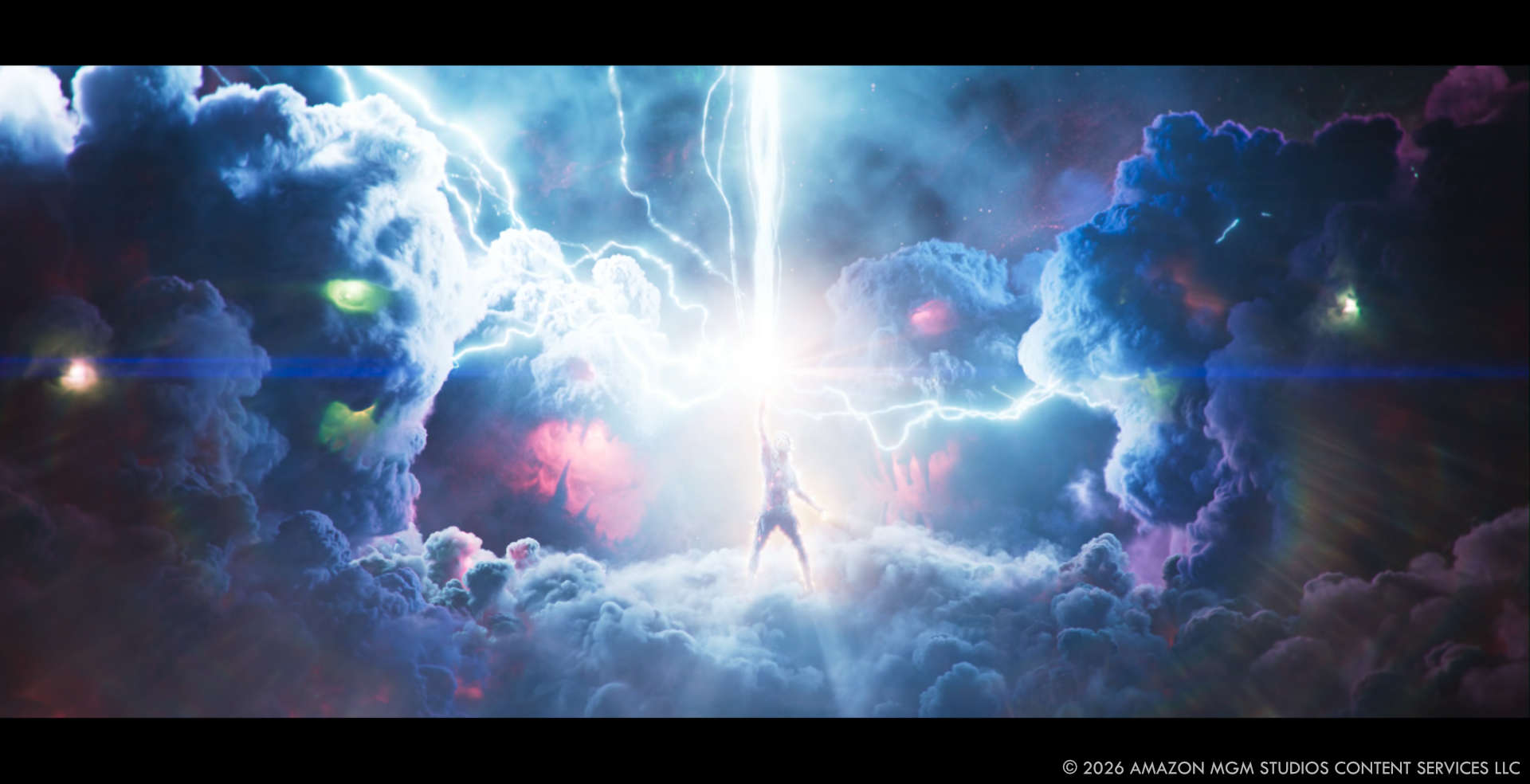
James HattSmith: We open the movie with a beautiful shot of Eternia, we then briefly visit its landscape. We have a fly-by with a dragon. We also created a 40+ second sequence telling of the forging of the Sword of Power and witness a legendary hero being imbibed with the power of the Universe to vanquish evil baddies. Using every colour in the paintbox.
The opening sequence introduces the forging of the Sword of Power through a cosmic journey. What was the original creative brief for this sequence?
James HattSmith: The original creative brief was pretty much that. An epic journey through the universe towards a huge power at its centre. Then the story of the Sword’s forging is told using Nebula formations. We were very lucky to receive really solid Animatics from Dave and Travis that we referenced throughout. The beats present in the Animatics are very similar to what ended up in the movie. The story telling was efficient and effective from an Animation stand point, look-wise we were encouraged to look at Space photography and imagine what they might look like when they move and figure out how to portray the huge scale. Initially the sequence was intended to be more of a oner, but it made much more sense to break it up into smaller pieces.

How did you approach turning galaxies, stars, and cosmic phenomena into characters and storytelling elements?
James HattSmith: We started with the boards. We had some excellent boards that Travis had put together that did an excellent job at showing the beats, but also giving a sense of the sheer scale of the world we had to build. We started with a concept, we wanted to try and establish as early as possible how ethereal or corporeal these creatures needed to be. Our Art Dept Supe Cameron Johnson started off by taking some of the Nebula photography, taking some of the structures and using them to build out the form of the Blacksmith. However, given we had a tight turnaround we couldn’t wait for one dept to feed into another. Everything was stacked up. We built the base models for the Characters, with simplified rows of sausages in place of a groom, We developed a procedural FX network that used the character’s topology as a source and would generate structures that matched the look seen in nebulas photography while respecting key shapes of the bodies’ anatomy. We also developed a system of dynamic evolution of these shapes that complemented the animation. In terms of shading we needed to find the right balance between the internal lighting that made the shapes look like astrophotography through bright highlights and silhouettes of dark areas and the environment lights that highlighted the action of the characters in the shots in order to make these cosmic creatures believable when animated.

What were the biggest visual references that inspired the look and feel of this cosmic world?
James HattSmith: We scoured the NASA archives for all their most beautiful Nebula images. We grouped them by structure and colour and established the language for each of our main structures, those being the Blacksmith, the Baddies and the Hero. We also looked at a lot of slo mo footage of super huge storms, breaking down the various scales of detail and the currents of movement within them. In researching Nebula photography Dave Vickery was especially keen to use broad washes of colour to help silhouette our characters nicely, and in terms of the nebula structures themselves, we wanted to really sell the idea that there is light within them and different textures of nebula forms such as the beautiful thready areas that silhouette really nicely.

In terms of colour palette we always had the Filmation series in the back of our minds. We even directly reference the spinning sword device from the show. We also referenced ILMs work for the transformation which was working really well, so we broke that down into pieces and recreated it for our Heroes transformation. ILM were really good at sending us all the bits and pieces that made up the shot, they were excellent collaborators.
Can you explain how the team balanced large-scale FX work with the need to clearly guide the audience through the creation of the sword?
James HattSmith: Constant iteration. As I mentioned we had a tight turnaround and everything was stacked up, so we were having to constantly work in every discipline through to the end. Running dailies from a timeline and always viewing with the team in sequence was essential. Every team member, in every discipline needed to liaise with each of their counterparts. Looking at the entire sequence everyday with everyone together meant that we were all on the same page at all times.
Lighting plays a crucial role in the sequence. How did you develop the evolving color palette and illumination throughout the journey?
James HattSmith: Lighting was definitely crucial. In researching NASA photography we realised that their space telescopes are capturing in invisible wavelengths such as infra red to capture light and heat data. These images are then colour mapped by astrophotographers to standard red, green, and blue to give us the Hubble Palette. Our FX passes contained no colour baked in, we had all sorts of attributes that could be used to change hues in isolated areas based on density, but the colours were all controlled in the lighting. The localised density was also tweakable in lighting so that we could have absolute control. The colour palette was something we wanted to keep quite fluid, so enabling Comp to have control was essential. There were more AOVs than I’ve ever seen for each of these characters and our incredible team of compers did an incredible job wrangling them all.

What were the most challenging FX simulations involved in creating the cosmic entities and the forging process itself?
James HattSmith: The Blacksmith and the Hero were probably the trickiest. Establishing the evolution of movement, how much motion should be transferred into the sim from anim and general levels of density was an ongoing conversation. Add to that the sheer level of detail required as well as the differences in scale between the Hero and Blacksmith it became even more challenging.
How closely did your artists collaborate across FX, lighting, compositing, and design departments to achieve such a painterly and cinematic result?
James HattSmith: Our team worked even more closely than they would do normally. If you can imagine the vibe of delivery week, with all the artists firing on all cylinders and helping each other out. Due to the short turnaround it was as though we were in the delivery week for the entirety of the project. It was exciting and dynamic. The attributes and AOVs set up by FX and Lighting which fed through to comp were always being refined and improved based on feedback in dailies as well as our comp team. It was super collaborative, because it had to be.

Looking back at the finished sequence, which shot or moment best represents the technical and artistic achievements of Untold Studios on Masters of the Universe?
James HattSmith: I think the entire sequence really shows off Untold’s strengths. Very complex, short turnaround and creatively unique. There is a lot of storytelling crammed into a very short sequence. Every discipline brought their A game.
Peter Joplin: I think the blacksmith (giant nebula god) and our hero (as a cloud volume powering up) represent Untold’s technical and creative ability across all the disciplines to convey TK’s intent for this seq. Its storytelling in it purest form: from asset creation, animation, FX, lighting and comp. Essentially, its a piece of feature anim as much as is VFX.

What’s your best memories during this production?
James HattSmith: The last Director review that we had with Travis. It had been a hard show, lots of spinning plates, but when Travis watched it through in its entirety with a smile on his face and approved it we were all pretty stoked! The whole project was so much fun, we were creating a really unique sequence with an amazing team. It’s something we’re all incredibly proud of.
How long have you worked on this show?
James HattSmith: About 4 ½ months.
What’s the VFX shots count?
James HattSmith: Technically 4, but with the forging sequence broken up into bits it worked out as about 12!
What is your next project?
Hannah Leagas (Head of Marketing): Not allowed to say 🙂
A big thanks for your time.
© Vincent Frei – The Art of VFX – 2026


