
With over 15 years of experience in visual effects, Hnedel Maximore has built an impressive career across multiple studios, notably FuseFX. After transitioning to freelance work as a VFX Supervisor in 2020, he led the visual effects on Hunters Season 2 and Them Season 2. He joins us today to share insights into his work on Spider-Noir.
For more than a decade in the visual effects industry, Brooke Noska has worked on numerous acclaimed projects such as Black Sails, The Walking Dead, The Orville, and The Santa Clauses.
What is your background?
I came to VFX after a short career in Architecture. I started my VFX career in automotive advertising in the Detroit area, and then moved out to Los Angeles in 2010. After freelancing on various commercials, game cinematics, features and TV shows, I took a staff role at FuseFX as a Lead CG generalist. Through a series of amazing opportunities and projects, I was able to move up to VFX supervisor at FuseFX. I made the pivot to studio side VFX Supervisor early 2020.
How did you get involved on this series?
I had just wrapped work on two projects for Amazon and Sony, when I heard this project was greenlit. I asked the Amazon and Sony VFX Execs to be considered, and they presented me as one of the candidates to the showrunners and EPs. After reading the first script and season outline, I put together a pitch deck to help map out my thoughts on the show. Co-Showrunners Oren Uziel and Steve Lightfoot and the EPs at Lord & Miller responded really well to what I presented and hired me as the VFX Supervisor.

How was the collaboration with the showrunner and the directors?
Oren and Steve were both very collaborative and pretty clear on their vision for the series. Oren is a walking encyclopedia on film Noir, and Steve has a ton of TV experience especially coming from shows like The Punisher. All our directors came on board with the same desire as Oren and Steve. We’re here to make a character driven Noir detective series, with the twist being that our lead characters have super abilities.
How did you approach selecting the different VFX studios involved in the project?
We cast vendors based on their past work and reels they pitched to the show. When Brooke Noska and I broke down the season we quickly realized that in order to avoid complex shared shots and assets, we had to cast the work by shot complexity and character relationship. So for example, hero Digi shots of Ben/Noir swinging in the city went to ILM. Flint Marko (Sandman) went to ILM. Dirk (Megawatt) electricity effects would be split with ILM (if he was against NOIR) and Barnstorm VFX (when he’s solo). Creatures and ‘high concept’ one offs went to Cinesite Montreal. Addison’s fire and Lonnie Lincoln’s hardened shell went to Eyeline and all things DeAging was done at CoSA. Other non recurring environment work went to Ingenuity Studios.
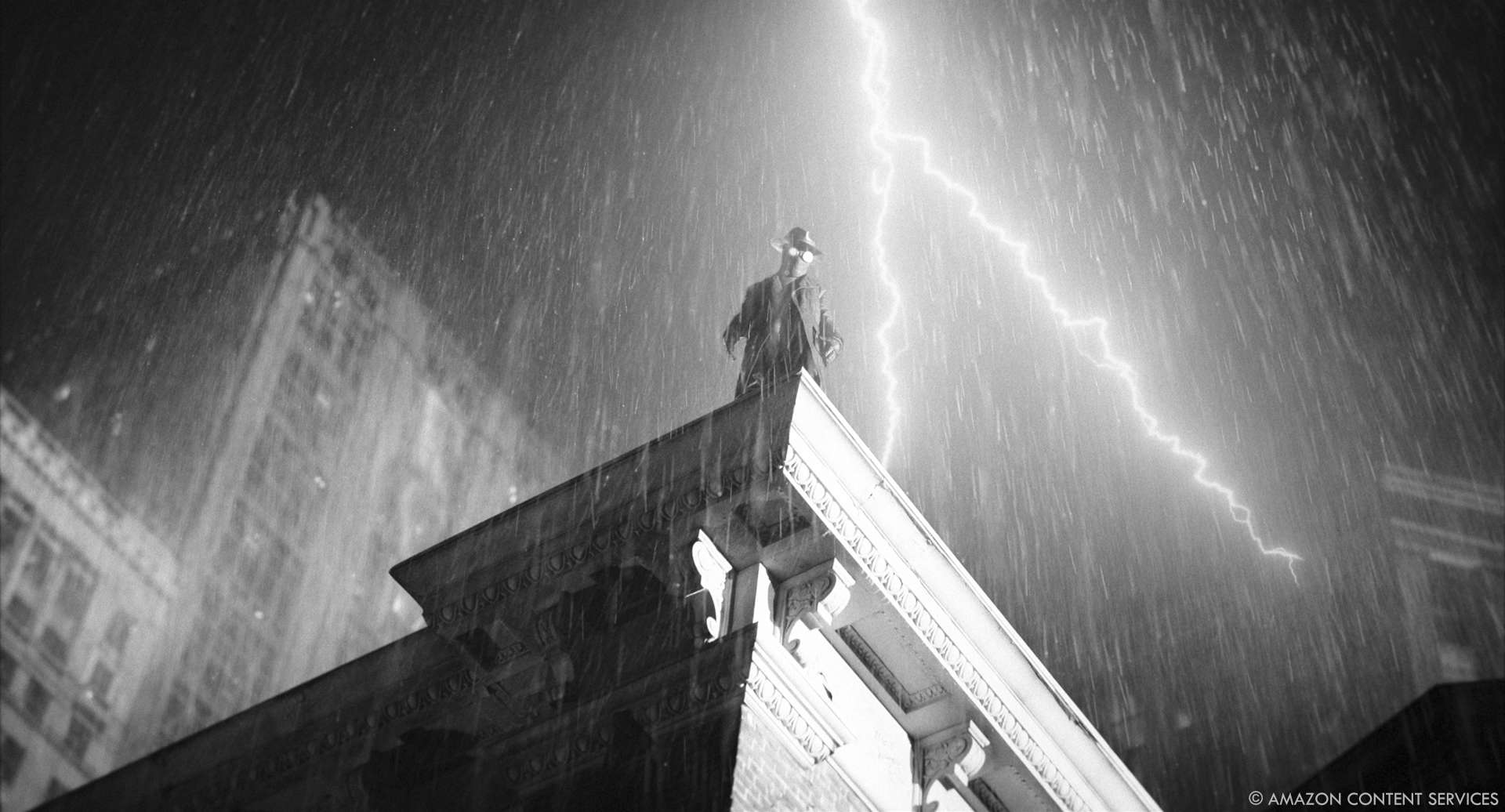
Spider-Noir is such a striking homage to classic film noir, how early did the black-and-white visual approach shape your VFX strategy?
Pretty early. We always knew the show was going to be black and white. The plan was always to shoot color and apply our BW LUT last. Within a week or two of starting production it was confirmed that we would be delivering both B&W and Color versions. This is when things changed for everyone on the production. Our DP Darran Tiernan took a very inclusive approach with all department heads. We had a week to shoot a few test scenes to help inform color and texture choices for our dual delivery. Then Darran and Colorist Pankaj Bajpai came up with the B&W and color looks. Once those looks were approved by the EPs, all the heads of department (production design, costumes, hair and makeup, props etc.) were invited to a DI session to see how a particular color choice translated in both LUTs. Every HOD also got a Sony FX3 with both color profiles loaded, allowing them to photograph and check color swatches, textures as well as makeup in order to make adjustments on their own before we started filming.

Did working in black and white change the way you approached lighting, textures, atmospherics, and compositing?
Not really. Our VFX pipeline worked in color with both B&W and Color LUTs applied at the end. The best practice is to always match the plate photography. Since our amazing DPs Darren Tiernan and Peter Demming had already set the tone in the foreground plates, it was just a matter of us matching in VFX.
What were the biggest challenges in recreating 1930s New York at the scale required for the series?
Balancing Historical accuracy with the tone of the show. Noir is set in depression era NYC and it was very important to depict the highs and glamour of the wealthy against the lows of the depression. We took every opportunity to illustrate this especially in the scenes on Silvermane’s penthouse balcony overlooking Central Park.

How did you balance historical authenticity with the stylized noir aesthetic when building the city digitally?
New York has very strict rules on how accurately the city is represented in TV/Film. Because we have quite a few iconic buildings in the series (Empire State, Chrysler etc). We had to stay very close to historical reality. We relied heavily on reference photography from OldNYC.org.
How much of Spider-Noir’s New York was fully digital versus enhanced practical locations?
Production was based in Los Angeles. So all our wide exterior shots have quite a bit of VFX. The rooftop fight at the end of 101 was filmed on stage with blue screen, the convoy sequence at the end of 102 was filmed on 3 blocks near downtown LA, and the Universal backlot was used for the 104 Noir v. Dirk fight and the 108 finale.

What were the key challenges in creating Spider-Noir’s traversal across the city while keeping his movement believable and characterful?
Ben Reilly/Noir is a middle aged man unlike the Peter Parkers we’re all familiar with. So even though we studied the way other Spiders swing, Oren Uziel (Showrunner/Showcreator) made it very clear from the beginning that Ben was no spring chicken. Oren’s directive to VFX and Stunts was to make sure that Noir’s physicality was always a little messy and opportunistic. We worked very closely with Cameron Neilson (ILM VFX Sup) and Kevin Martel (ILM Anim Sup) to refine the mechanics of his swinging. The approach was to always make him feel heavy, less flexible and when appropriate a little sloppy, especially with his hard landings.

Can you break down the rooftop car fight sequence and the VFX work required to make that action feel so dynamic?
This was such a rewarding sequence to work on. The sequence was designed by our 2nd Unit Director Freddy Bouciegues, with Previs help from Torchlight. The final shots were completed by the team at ILM. As scripted, the driving portion of the sequence happens over 8-10 city blocks, but Production couldn’t lock down more than 3 blocks in the warehouse district where we filmed. The exterior car shots are the real cars with lots of set extensions. With the street running east/west, for morning/early afternoon sun location, we filmed with camera facing south and then redressed the opposite side of the street during lunch break to film with camera facing north in the afternoon. This allowed us to have proper lighting continuity for all our exterior car plates. Interior driving shots were filmed in a static car in a blue cove outside near our location. With our vehicle plates and lighting working, we always knew we would have to do set extensions and additional set dressing using scanned props to make the reused background buildings unique.
All the beats of Noir dodging bullets and webbing back to catch the car were shot on a static car with CG moving environments. Same for the interior 360 shot where Noir pulls goons through the car window.
How did you approach the design and animation of Spider-Noir himself, particularly his silhouette, cape movement?
Noir’s costume was designed and created by our Costume Designer Trayce Gigi Fields. Our friends at Scanable scanned Noir in multiple variations which gave ILM enough data to rebuild the digidouble and have lots of control for cloth simulation.
The villains bring powers like fire, electricity, and sand, how did you develop the visual language for each of these abilities?
As much as possible, Oren wanted our powers to be very grounded. With that in mind, we pulled a lot of inspiration for nature. For Addison’s fire, we leaned more towards clean flames with minimal smoke, but added lots of embers since he’s wearing wool fabric. All the fire shots are full VFX and were done by Eyeline. We worked with costumes and our gaffer to have flexible RGB LED panels stitched to his clothing so we had real interactive lights sourcing from his body.

Dirk’s prosthetic veins are similar to the real life scars of lightning strike survivors. Working with concept artist Kino Scialaba, VFX started some initial concepts for Dirk. Those initial concepts were further refined and the prosthetics were built by Vincent Van Dyke. Vincent and his team made two sets of veins. Scarrend skin colored for scenes when Dirk was not lit and chroma green for scenes that required VFX glowing. As a subtle way to enhance his performance, the electricity pulsing through his veins moves faster and glows brighter when he’s in a heightened emotional state. ILM developed the look, and the Dirk shot work was split between ILM and Barnstorm depending on the scene.

Sandman went through quite a few iterations. He was scripted as having churning sand when he’s in an elevated state. We experimented with subtle sand swirling as if it was being stirred from below the surface. We also tried a sound vibration approach similar to the Cymatics series by artist Nigel John Stanford. Where sound is used to create interesting patterns in sand/feral fluid. While these were cool to see, they started to pull too much attention from the actor’s performance. Ultimately we landed on a look that takes cues from hyperlapse footage of mold spores growing.

Was there a specific powers sequence that proved especially difficult from a simulation or animation standpoint?
Sandman took a while to develop. Not because the grain simulation was super difficult or ground breaking, but because we had to be very careful not to distract from the actor’s performance. We’re a character driven show, with VFX serving in a support role. We had a similar challenge with Dirk and his pulsing/glow electricity. The subdermal glow of light under his skin required quite a bit of tweaking in order to be visible in both our B&W and Color looks.

Film noir often relies heavily on reflections and visual distortion, did that influence the VFX approach throughout the series?
Not in a literal sense. We tried to capture as much of these distortions and reflections in camera when we could. With the exception of the Mirror sequence in 108, all the reflections you see in the show have very little VFX. Ben’s spider sense was also captured in camera using a custom tilt-shift lens that our DP brought to the show. The drug induced distortions in 106 and the flashbacks throughout the season were developed by our in-house compositor Jorge Macias.
The mirror sequence at the end is visually striking, what were the biggest creative and technical challenges behind making that scene work?
Another super fun sequence to work on. Heavily influenced by the scene in The Lady from Shanghai, this sequence was filmed in a mirrored set. The bullet hits, cracks and fractured reflections were all done in VFX. We shot lots of glass cracking and breaking elements which were used in the final comp. Because this was a mirrored set, we also had a ton of complex paint work, because there really was no place to hide the camera and operator. Suzie Ashkam and the team at Cinesite Montreal made this sequence sing.
How long have you worked on this show?
25 months from early prep to wrapping post.

What is your next project?
Nothing confirmed at this time.
What are the four movies that gave you the passion for cinema?
Hard to pick just 4, but I often rewatch: The Fall (Tarsem Singh movie from 2006), The Usual Suspects, Inception and Dr Strangelove.
A big thanks for your time.
WANT TO KNOW MORE?
ILM: Dedicated page about Spider-Noir on ILM website.
Cinesite: Dedicated page about Spider-Noir in Cinesite website.
© Vincent Frei – The Art of VFX – 2026


