

After sharing insights into the visual effects of Beast with us in 2022, Enrik Pavdeja went on to work on projects such as The Diplomat and Prehistoric Planet. He now discusses his newest collaboration with filmmaker Baltasar Kormákur.
Having previously broken down the visual effects of The Lost Bus, Gavin Round is back to talk about the unique challenges and VFX work that brought Apex to life.
Last year, Mohen Leo took us behind the scenes of the visual effects work on Andor Season 2. Now, he returns to discuss something completely different: ILM’s stunning VFX work on Apex.
How did you get involved in this film?
Enrik // I became involved very early, before the project had officially been greenlit. Balt shared the script with me while the film was still being developed, and I began putting together a comprehensive VFX breakdown to help evaluate the scope of the work and identify how visual effects could support the filmmaking.
Outside of the opportunity to work with Balt again, what attracted me to the project was that the visual effects weren’t simply solving technical challenges. They were fundamental to how the film would be made. The story required audiences to believe they were watching characters navigate immense mountain faces, dangerous river systems and remote wilderness, but many of those environments either didn’t exist in the form required by the story or couldn’t be filmed safely or practically.
From the earliest stages, I worked closely with Balt, Ray Angelic – Line Producer, Lawrence Sher – Director of Photography, Jean-Vincent Puzos – Production Designer, and later Sigurður Eyþórsson, our Editor, to determine how locations, sets, cinematography, editorial, and visual effects would work together. Having worked with both Balt and Jean-Vincent previously on Beast, there was already a shared understanding of how production design and visual effects could complement one another.
Gavin // I was brought in by Netflix for post in the UK, taking over from the wonderful VFX Producer Fiona Crawford, who produced through prep and shoot in Australia.
How was the collaboration with Director Baltasar Kormákur?
Enrik // One of the things I enjoy most about working with Balt is that visual effects are never really the starting point of the conversation. Everything starts with story.
Balt is always asking what the audience needs to understand in a particular moment. Sometimes that’s the scale of a mountain, sometimes it’s how dangerous a river feels, and sometimes it’s simply helping the audience understand where a character is and why they’re making a certain decision.
A lot of our discussions revolved around the environments themselves. The mountain wasn’t just a backdrop; it became part of the storytelling. We spent a surprising amount of time figuring out where people could and couldn’t go, what routes felt plausible, and how the terrain could help communicate the challenges facing the characters.
The same was true of the river journey. It wasn’t enough for it to look impressive. Every section needed to feel like it was taking Sasha somewhere, both physically and emotionally.
Even when sequences became heavily digital, Balt always pushed us towards something that felt honest and natural rather than spectacular for the sake of it.
Gavin // This was the second project both Enrik and I had worked on with Baltasar, albeit separately. I worked on Baltasar’s Adrift back in 2018, and Enrik recently supervised Beast in 2022. Enrik had already established a great working relationship with Baltasar, which was really helpful for me, coming in kind of late to the project.

How did you approach selecting the different VFX studios involved in the project?
Enrik // The selection process was really about finding creative partners that aligned with the specific challenges of the film.
One of the things we established early was that the film wasn’t simply about creating visual effects. It was about creating believable worlds that felt natural and grounded in reality. Different sequences presented different creative and technical challenges, so we looked for teams whose strengths aligned with those needs.
During prep, we worked with Control Chaos on previs for portions of the river sequences, helping us explore geography, action beats and camera language before photography began.
For the river sequences, we partnered with Mohen Leo and the team at ILM. The challenge wasn’t simply water simulation. We were designing an entire journey that combined multiple locations into a single coherent environment while maintaining a naturalistic photographic quality. Mohen and his team were fantastic collaborators throughout the process and brought an enormous amount of experience to some incredibly ambitious sequences.
For the mountain sequences, we worked closely with Gavin McKenzie and the team at Framestore. Gavin was involved in many of the key creative conversations around the mountain work. Together with Balt, we explored how the environment itself could contribute to the storytelling by shaping routes, obstacles and landmarks that helped orient the audience and communicate the challenges facing the characters.
Union Visual Effects, Host and Proof also played important roles across the show, delivering a wide range of invisible effects, environment work, postvis and final shots.
The success of the film really came from bringing together teams that understood the overall philosophy of the project. Everything needed to feel photographic, grounded and believable, regardless of how much digital work was actually involved.


How early were you involved in shaping the invisible VFX approach for Apex?
Enrik // From the very beginning.
One of my favourite things about the finished film is that most audiences probably won’t realise how much visual effects work they’re actually looking at.
The objective was never to create a visual effects showcase. It was to create a believable world and make audiences feel that everything had been photographed exactly as they were seeing it.
A huge amount of planning happened before photography began. We looked at locations, designed capture strategies, developed previs and postvis workflows, and began thinking about how production design, cinematography and visual effects would combine to create the environments required by the story.
Many of the biggest creative decisions had very little to do with visual effects and everything to do with storytelling. We spent a lot of time thinking about routes, transitions, landmarks and how audiences would move through the environments. We weren’t simply recreating locations. We were creating the version of those locations that best served the film.
Editorial became an important part of that process as well. We worked very closely with Siggy throughout post-production as we shaped both the mountain and river sequences. Because many of the environments were still evolving, the edit and the visual effects work often developed side by side.


What were the main challenges in recreating the Norwegian mountain environments?
Enrik // The challenge wasn’t actually recreating the Troll Wall. We had great references, extensive photogrammetry and texture photography, so building the mountain wasn’t the difficult part.
The real challenge was figuring out how to tell the story on it.
The majority of the climbing action was filmed on an outdoor climbing set designed by Jean-Vincent and his team. The set was remarkably versatile and allowed us to stage a huge amount of action within a relatively small footprint. While the set was being developed, Jean-Vincent and I spent a lot of time discussing how the physical build and the digital environment could work together.
What audiences see on screen is really a combination of both. The performers are interacting with something tangible and real, while the mountain surrounding them has been shaped and extended to support the story.
Larry’s photography then gave us a very clear visual target. Outside of matching the lighting, every time we modified or extended the environment, we were asking ourselves whether it still felt like something Larry could have photographed.
Editorial also played a significant role. Working closely with Siggy, we continued refining the geography throughout post-production, ensuring the audience always understood where the characters were on the climb and why they were making specific decisions as the sequence progressed.
Gavin // The main challenge really was to realistically depict a route for our characters to climb over the various scenes. Baltasar was very keen for us to show why they had to go a certain way, so we worked with Framestore’s Gavin McKenzie to carve a virtual route into the rock wall, blocking their paths in some directions while opening it in others. We did the same thing for the end climb, too.
How did you enhance the sense of height and vertigo in the opening sequence?
Enrik // Because we had rebuilt the Troll Wall digitally, we had complete control over the geography and scale of the environment.
A lot of the work involved carefully shaping the audience’s perception of height. We would adjust the visible drop below the climbers, modify sight lines, alter the steepness of the terrain and create camera positions that emphasised exposure and vulnerability.
Importantly, those decisions were always driven by story. Balt wanted audiences to understand exactly what the characters were facing. The sense of vertigo comes not only from seeing a huge drop but from understanding the consequences of being in that position.
The combination of Larry’s photography, the practical performances and the digital environment allowed us to create a much greater sense of scale than would have been possible at the real location or physical set alone.
Gavin // We often cheated the perspective from what was shot on the set build, which was fairly straight forward to do in most cases. Every opportunity we had, we made the mountain feel as steep and dangerous as we could by losing more of the set piece and cheating the angles to see as much of the ground as possible. In a few instances, we used fully CG shots so we could really tip the camera over the edge for maximum vertigo!


What balance did you aim for between practical footage and digital environment work?
Enrik // We never really thought of it as a balance between practical and digital.
Our priority was always to preserve the performances and the photography. If we could capture something for real, we wanted to keep it. The digital work then became an extension of the filmmaking process.
Many of the film’s largest sequences are built around practical performances captured on relatively modest physical builds. Visual effects then expanded those worlds beyond what could realistically be constructed or photographed.
For me, the most successful visual effects work is when audiences don’t think about visual effects at all. They simply believe in the world and the characters within it.
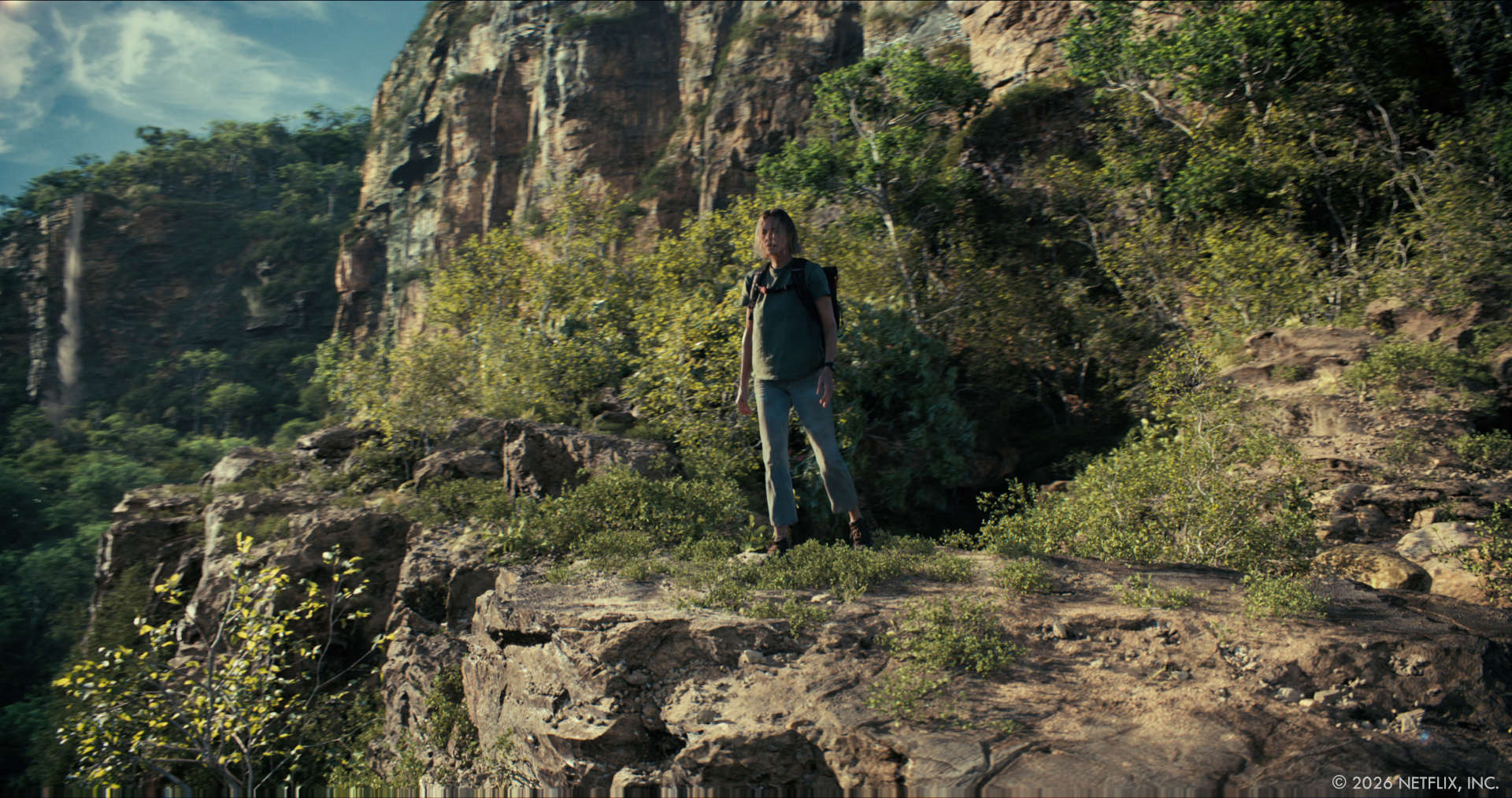
Gavin // The Australian locations were so beautiful that we tried to keep as much as we could, but, owing to various sequences being shot over several locations, we had to create a digital blend of the various locations to bring them all together. Including mapping out journeys over waterfalls and creating a logical geography in which Sasha could get lost in.
Mohen // The majority of ILM’s work involved creating visual continuity between back-to-back shots that were often filmed in completely different locations.
Early on, the filmmakers decided to capture as much dynamic action as possible in-camera. Instead of filming close-ups of Charlize and Taron statically against a bluescreen, the production had them actually kayak on-location (for calmer river conditions) and at the Penrith Whitewater Stadium near Sydney. Additionally, some of the dynamic drone footage following Sasha and Ben down the river was shot with stunt performers in New Zealand, where longer stretches of rapids with a higher degree of difficulty were more easily accessible.
This meant that shots in the same sequence could cut back and forth between an Australian river, a New Zealand river, and an artificial whitewater park. Our challenge was to make all of these locations feel coherent and continuous, which often meant not only replacing the banks and background landscape but also a large part of the river surface.
Nonetheless, having a real performer in a kayak paddling on moving water anchored each shot in a sense of realism, even when nearly every other part of the plate was digitally replaced. I really commend Enrik and his team for committing to this approach. Even though the plate integration between real and CG water often proved challenging for the compositors (under the leadership of Comp Supe Robin Beard), I think it paid off.

How much of the Australian wilderness was digitally extended or fully created?
Enrik // More than audiences might realise.
The real locations provided the visual foundation for the film, but many of the environments evolved significantly to support the narrative.
The river sequence is probably the best example. What appears to be a single continuous environment is actually a carefully designed world built from multiple New Zealand rivers, Australian landscapes and extensive digital environment work.
The same philosophy applied throughout the film. We always started with reality, but we weren’t afraid to reshape that reality if it helped tell the story more effectively.
Gavin // We kept as much as we could and what was augmented or extended was done so using location plate photography, scans and textures.
Mohen // In addition to the banks and backgrounds of the river journey, a key part of our work was selling the idea that Sasha is trapped in this remote part of the wilderness with Ben. Our Generalist team, under Guy Williams, digitally augmented cliffs and canyon walls to make the river valley feel inescapable. There is also one massive establishing shot of Sasha on a cliff edge surveying the whole valley as the camera pulls further and further back. Aside from a bluescreen plate of Charlize, this shot is fully CG.


What techniques did you use to maintain realism in such grounded, natural settings?
Enrik // The biggest contributor was reference.
Every major environment was documented extensively using lidar, photogrammetry, texture photography, aerial surveys and drone arrays. We captured enormous amounts of real-world information, which gave the artists a very strong foundation.
Equally important was maintaining consistency. Larry’s photography became the anchor point for the entire show. One of Larry’s great strengths is that he allows locations and natural conditions to drive the visual language of the film rather than imposing a style onto them. That philosophy became a guiding principle for visual effects as well.
Whether we were building a mountain, a river system or a fully digital world, every decision was measured against the photographic reality established on location or set.
Gavin // Again, we had so much practical photography to draw from and each environment was sourced from photogrammetry, plates and textures.
Mohen // From the start, Enrik encouraged us to base everything on the real Australian nature locations Balt had visited and filmed. Enrik and his team captured extensive and beautiful reference footage in every one of the amazing and remote places they visited. Our Environments Lead, Jack O’Kersey, and his team used this material both as direct visual reference and as a basis for in-depth research, identifying the specific trees and plants of the region and matching rocks, cliffs, and even underwater riverbeds.


Can you break down the VFX work involved in the river sequence?
Enrik // The river sequence was probably the most complex piece of filmmaking in the movie because we weren’t recreating a real river. We were building a journey.
We filmed across multiple locations in New Zealand, some of them only accessible by helicopter, and then filmed the majority of our cast work later at Penrith Whitewater Stadium in Australia.
The challenge was bringing all of those elements together into something that felt like a single continuous experience.
Working closely with Mohen and the team at ILM, we developed a world that blended elements of New Zealand river systems with the scale and character of the Australian Blue Mountains. The environment wasn’t designed to match one specific location. It was designed to support Sasha’s journey through the film.
Editorial became a huge part of that process. Siggy and I spent a lot of time working through how the audience would travel through the environment, where important story beats should land and how the landscape itself could help support those moments.
One of the advantages of having a complete digital world was that it gave us tremendous flexibility. As the edit evolved, the environment could evolve with it. Entire sections of the river, surrounding terrain, transitions and even camera paths were refined throughout post-production.
The finished sequences contains extensive environment work, complete 360-degree digital worlds, water simulation, vegetation and wind simulation, sky replacement, digi-doubles, and a number of fully CG shots. What I’m most proud of is that, hopefully, audiences won’t notice any of it.


Gavin // Most of the rapids sequences were shot at Penrith Whitewater Park, which had man-made rapids for our cast to kayak and swim through. So we got all that water interaction that we were able to retain while pretty much replacing everything else, other than the immediate surrounding water. We were tasked with creating a logical journey for Sasha to travel using plates shot over multiple locations including the Australian Blue Mountains, rivers in New Zealand and Penrith Water Park. We worked with Mohen Leo and his team at ILM to create a bespoke landscape combining all of these different locations while attempting to be faithful to the beautiful Australian landscape.
Mohen // In addition to making the landscape coherent, we also had to help create increasingly dangerous rapids. In many shots, this involved fully replacing the river surface except for the section directly around the performer, so the water violently cascaded and splashed over the CG rocks and banks. David Kirchner and the FX team ran complex water and spray simulations in Houdini, creating everything from close-ups where the camera inches above and below the surface to soaring drone views showing miles of rapids—sometimes within a single shot.
After our Layout team closely matched the plate geography, CG Supervisor Toby Keip and I would discuss how to break down each shot into what we would preserve from the plate and where to blend into the CG water and landscape. We often did a quick concept paintover to get Balt’s and Enrik’s approval on the blocking; then, the Environments and Generalist teams would build out the banks and backgrounds before passing that geometry to FX to run water simulations. There was frequently some back-and-forth, as rocks could create unwanted splashes or flow that didn’t integrate well with the plate water. Once we had sign-off on how everything moved, Guillaume Lenoel and the Lighting team took over to give everything the golden, sunlit feel of the Australian location plates.


Were digi-doubles used during the climbing scenes, and in which situations?
Enrik // Yes, but we used them selectively.
The vast majority of the climbing performances were photographed practically on the stage builds. Digi-doubles were primarily used when we needed camera positions that couldn’t be achieved safely or physically, or when we wanted to fully exploit the scale of the digital environments.
They also appeared in several fully CG shots where the camera could move through the world in ways that simply wouldn’t have been possible with traditional photography.
Our aim was to preserve the real performances whenever possible and only use digital doubles where they genuinely enhanced the storytelling.
Gavin // We used dig-doubles sparingly and only where we really needed to get a camera in a vertigo-inducing position that we couldn’t achieve practically.


What role did lighting and compositing play in keeping the VFX invisible?
Enrik // They were absolutely essential.
Larry established a very natural photographic language for the film and that became our benchmark throughout post-production. Whether we were extending an environment, creating weather or building an entirely digital shot, the question was always the same: does it still feel like it belongs in the movie Larry photographed?
The compositing teams then brought together all of those different layers in a way that feels seamless.
Gavin // I’ll let Enrik field this one.
Looking at the final climbing sequence, what were the key invisible enhancements audiences might not notice?
Enrik // What audiences are less likely to notice is how much work went into shaping the route itself.
Working closely with Balt, Siggy, Gavin and the Framestore team, we spent a lot of time refining where the characters could go, where they couldn’t go and how the terrain could help communicate the decisions they were making.
In many ways, the mountain became another character in the sequence.
Gavin // There were safety wires cleverly disguised as in-camera ropes and then some had to be digitally removed. The safety harnesses, both over and under the clothing, often led to costume bunching up so in many cases whole legs and torsos had to be digitally rebuilt. As with the Troll Wall at the start of the movie it was important to Baltasar that we tell the story of the climb; why they had to take the route they took. So this again involved creating overhangs and obstacles that they could not climb over and showing less treacherous routes that became the path they had to take.


How long have you worked on this film?
Enrik // I worked on the project informally from around May 2024 during development, officially joined in October 2024, relocated to Australia in November for production, and remained involved through final delivery in May 2026.
In total, it was roughly a two-year journey from the earliest development discussions through to completion.
Gavin // Although I only came on for post I clocked in around 12 months as there was some cross-over with Baltasar’s next project.
What’s the VFX shots count?
Enrik // 743 shots.
Gavin // 743
What is your next project?
Enrik // I’m currently working with Baltasar again on The Big Fix for Netflix.
Lastly, I’d like to acknowledge the incredible work of Mohen Leo and the team at ILM, Gavin McKenzie and the team at Framestore, as well as FPS, Union, Host, Proof, Control Chaos, Industrial Pixel, Clear Angle, XM2 and Heli Guy. Much of the visual effects work on Apex is intentionally invisible, but this would be a very different film without the talent, creativity, hard work and dedication of those teams.
Gavin // I’m working with Enrik again on Baltasar’s ‘The Big Fix’ for Netflix.
A big thanks for your time.
WANT TO KNOW MORE?
Framestore: Dedicated page about Apex on Framestore website.
ILM: Dedicated page about Apex on ILM website.
Rising Sun Pictures: Dedicated page about Apex on Rising Sun Pictures website.
© Vincent Frei – The Art of VFX – 2026


