
Last year, Gong Myung Lee took us behind the scenes of the visual effects for the first season of Daredevil: Born Again. She returns to discuss the creative and technical challenges of the new season.
Fahed Alhabib has spent nearly two decades in the visual effects industry, contributing to a wide range of productions including 47 Ronin, Christopher Robin, Maleficent: Mistress of Evil, and Ms. Marvel.
How did your approach to invisible VFX evolve from Season 1 to Season 2 of Daredevil: Born Again?
Season 2 pushed the scale further, but the philosophy stayed the same: keep everything grounded, performance-driven, and rooted in plausible physics. What really evolved was how far we felt we could push the invisible work without breaking the grounded feel of the show.
Coming into Season 2, we already had a strong shared foundation with showrunner Dario Scardapane and Marvel’s creative team — led by Brad Winderbaum and Sana Amanat — about what this version of Daredevil should feel like. Because everyone already understood the language of the show, we could push the scale and complexity further much earlier in prep. We expanded our oner techniques, did more complex digi-double transitions, took on larger-scale environment and water work, and integrated more ambitious stunt choreography across the season.
Justin Benson and Aaron Moorhead came back for our opener and really set the tone. Our new directors — Solvan “Slick” Naim on Episodes 3 and 4, Angela Barnes on 5 and 6, and Iain B. MacDonald on 7 and 8 — each brought their own instincts to the action and camera language, which kept the season feeling fresh block to block. DPs Hillary Spera and Jeff Waldron carried that visual continuity through every setup.
Jessica Jones was a good example of that balance. We wanted her to feel powerful, but still grounded within the world we’d already established.

What were the main challenges in maintaining seamless continuity between the two seasons?
Continuity was really important because Season 1 had already established a strong visual language for the show. We had a solid internal bible for the characters, the action, the weapons, the Sensory work, and the overall camera language — so the challenge wasn’t reinventing the show, it was evolving it without losing its identity.
What we dubbed the “Grande” Sensory was probably the biggest example of that. In Season 1, we established the look using our three-headed monster camera array — a coordinated zoom-and-dolly that feels like a fisheye but is actually a wide stitch reprojected through a custom lens distortion. In Season 2, our directors wanted the Sensory to move through objects the way sound itself travels — through walls, through glass, through architecture. The challenge was figuring out how to do that in a grounded, optical way without tipping into something overly stylized. Those are the kinds of problems that make the work fun.
We also wanted the escalation of violence and intensity to track emotionally with the story the same way it did in Season 1. The directors, DPs, and stunt team kept finding ways to push the language further without losing what made it feel like Born Again.

How was the VFX workload distributed across the different studios involved in Season 2?
We distributed work based on what each vendor did best and what the sequence needed.
The Third Floor was with us from the beginning, handling previs, techviz, and postvis across the season, which gave everybody a blueprint before we hit set.
Eyeline took on all the large-scale boat and water work — the Northern Star build, the East River capsizing, the explosions, and the aftermath.
Storm Studios carried a huge amount of the fight integration across the season: Cherry apartment, Josie’s Bar, the Bullseye diner fight, Daredevil vs Bullseye in the apartment, and Fogwell’s.
Wylie Co. VFX handled the Episode 3 oner end-to-end, including the stitching methodology and environment work.
FOLKS took on Episode 6 — the Task Force staging area fight, explosions, and the Daredevil and Fisk basement fight. Curated focused on key kill beats and the car shootout sequence.
For Episode 8, Important Looking Pirates (ILP) handled the climax — the Bullseye vs Bullseye fight, the Matt vs Fisk hallway fights, the Brooklyn Public Library facade work, and CG crowd work.
Phosphene handled the Sensory work this season, along with driving comps, Avengers Tower, and the projection work for the City Hall riots.
EDI Effetti Digitali Italiani built CG environments for the New York landscape, while Ingenuity Studios handled bespoke character animation for the attempted governor’s assassin sequence.
Lola Visual Effects handled all of our head and face replacement work, which became much more extensive in Season 2. A lot of the work involved full head replacements rather than just face replacements, which is significantly more difficult because the entire silhouette and performance have to hold up seamlessly from every angle. They did really exceptional work throughout the season.
Anibrain carried a large amount of paint, cleanup, and invisible support work across the season. It’s the kind of work audiences hopefully never notice, but those small details are often what keep the illusion together. They did an incredible amount of heavy lifting for us throughout the season.
Cantina Creative and Red Black Studios handled graphics work across the show. And our in-house VFX editors did a huge amount of postvis work that helped us move really quickly.
How extensively were digi-doubles used to enhance the fight sequences this season?
Pretty extensively, but ideally in ways the audience never notices.
We never want to replace practical stunt work unless we really need to. Digi-doubles are there to help bridge transitions, keep the movement believable, and safely pull off moments that would be impossible or too limiting to do practically.
A few moments that should hopefully read as completely practical: several digi transitions inside the Episode 3 oner, Daredevil’s jump down from Josie’s roof, and the moment in the Episode 8 rotunda where Jessica Jones and Daredevil leap onto the mezzanine — both of those are digital takeovers. The Episode 4 Fogwell’s beat where Daredevil and Bullseye crash through the glass is another one. We also did a significant amount of stunt head replacement work throughout the season.
Our default is still to do it for real. The presence of a strong prosthetic SFX makeup team and a stunt department actually pushes everybody to attempt more practically, which gives us much better reference whenever we do need to take over digitally. We also worked closely with stunts to capture mocap of key action beats, so the CG animation still carries the performer’s weight and timing.
What role did VFX play in pushing the intensity and realism of the combat scenes?
For us, VFX in combat works best when it’s focused around impact and consequence.
Whenever possible, we reverse-engineer from the aftermath backwards. SFX and the makeup team build the wound or cut for after the fight, because that’s ultimately what the audience sees. VFX then matches that look and progression at the moment of impact so everything feels physically connected from shot to shot.
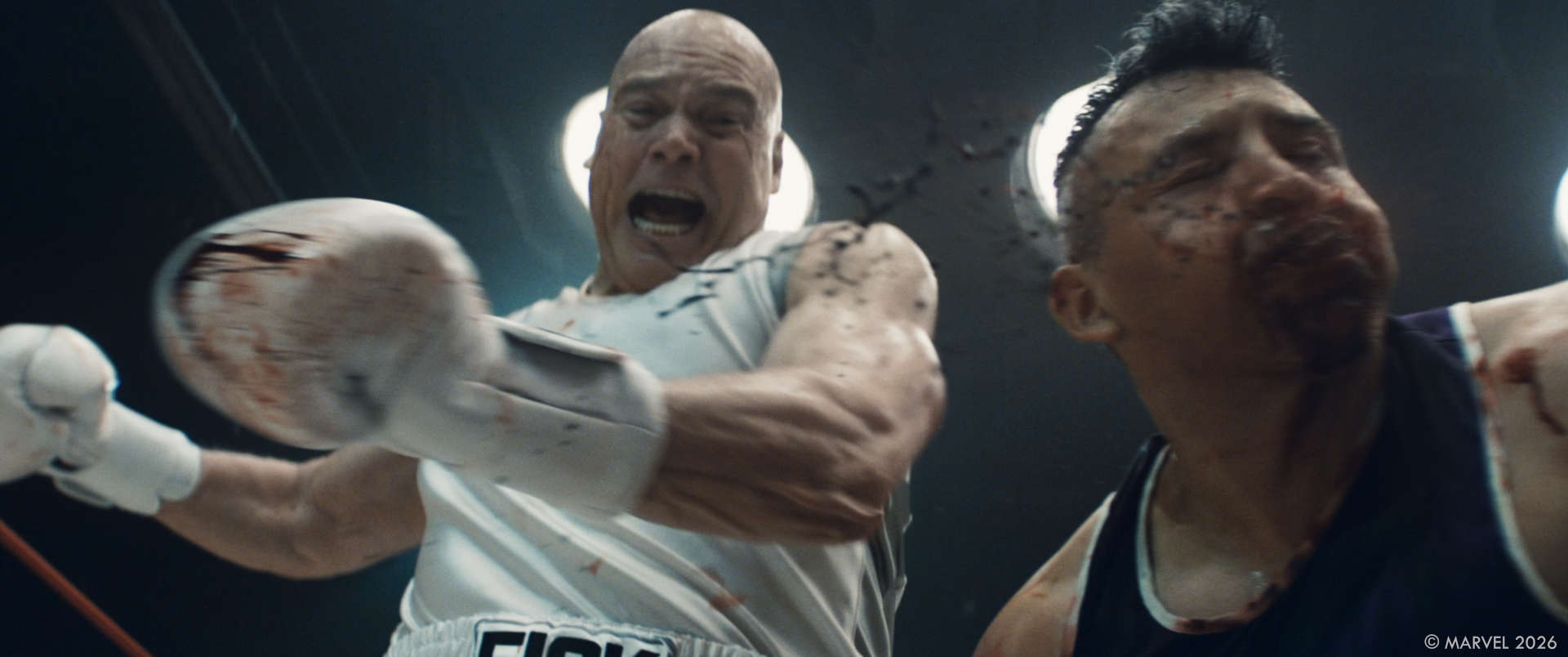
The same logic applies to costume damage and blood work — revealing a cut through a costume tear, enhancing squibs, extending blood sprays, or helping impacts carry through across multiple angles.
A lot of the realism actually comes from restraint. Subtle contact warps, accurate weapon behavior, smoke interaction, and wound continuity and progression are usually what make the action feel physical instead of overly stylized. Editorial ramps can also do wonders.

How did you collaborate with stunt teams and directors to plan these invisible effects?
Prep was critical. Our action director Philip Silvera and his team would build incredibly detailed stunt-viz and choreography, which helped us identify where VFX support would actually be needed.
From there, it was really just constant collaboration between departments. The directors and Marvel’s creatives weighed in on performance, including specific comic-book poses and silhouettes they wanted incorporated into the choreography. We coordinated closely with SFX and the makeup team on practical blood hits, prosthetics, and atmospherics, while the props team built stunt-friendly and VFX-friendly versions of the weapons.
We always tried to design the practical and VFX approaches together from the beginning — planning stitch points, coordinating blood work, and identifying where digi-double work would best support the action while still keeping the performances feeling real. By the time we got to set, everybody was already on the same page.
Were there specific sequences that required more complex invisible VFX than in Season 1?
Season 2 was simply bigger than Season 1, and several sequences pushed us further than anything we’d attempted in the first season. What’s interesting is that despite the larger scale, the vast majority of the VFX work on the show was still designed to be invisible. Even the biggest sequences were usually built around supporting practical photography rather than replacing it.
The boat sequence in Episode 1 was the largest scale we’d ever tackled on the show and the team at Eyeline nailed it. The creative mandate was “go big without going cartoony.” We shot a practical vessel on the water for lighting and physics reference, then replaced it with a much larger CG cargo ship — the Northern Star — using LiDAR and photogrammetry to keep it feeling physically believable.
In the below deck fight, the prosthetic arm-break work was combined with CG blood and skin simulation. The flooding corridor started as a practical catwalk build with our actor on a proxy set for lighting reference, then extended into a full CG environment with a digi-double takeover and fluid simulation work. The sinking and aftermath were also heavily grounded in real-world reference from cargo ship disasters and historical East River wrecks.
The Episode 3 oner was one of the most satisfying sequences of the season — not because the stitching itself was unprecedented, but because it was so well-planned. Going into it, we’d learned a great deal from our first oner attempt in Season 1 and had really refined our stitching methodology. We started with extensive stunt-viz and postvis, then validated stitch points practically during production with editorial support on set.
Our rule of thumb was that the sequence needed to work 70–80% practically to the naked eye before VFX refinement even began. The remaining 20% may require heavier CG work, but because the foundation is practical, the VFX stays invisible. Wylie did an amazing job with it.
The diner fight is a much more intricate sequence than people probably realize. There’s extensive weapon work threaded throughout the choreography, and Storm even built both live and cooked CG lobsters for it — a fun detail I won’t say too much more about.
Our production designer Michael Shaw was also key to making that set work. It originally started as fully chrome with 360-degree reflective panels, and Michael’s team treated the surfaces to read more like frosted metallic finishes. That preserved the look the directors wanted while still allowing the camera team to shoot fully 360. Sometimes the most important VFX decision is the preventative one.
Other standout sequences included the Fogwell’s boxing fight, the Episode 8 rotunda raid, and the Bullseye vs Bullseye doppelgänger fight with all of its knife animation work.
The Task Force staging fight with Jessica Jones in Episode 6 also evolved significantly during production and ended up requiring a much larger amount of fire and explosion work in post than originally planned. Folks handled that sequence beautifully under real time pressure.
Full head replacements were also a major challenge this season. They are meaningfully harder than face-only work because the entire silhouette has to hold up seamlessly from every angle. Lola did exceptional work there.
The Brooklyn Public Library facade, which had to re-read as the Supreme Court, was another interesting design-led VFX problem handled by ILP, along with crowd work for the surrounding plaza and riot sequences. That’s the kind of invisible support work that, when done well, audiences hopefully never notice.
What technical or pipeline improvements helped you achieve more efficient or refined results this season?
By Season 2 we were a well-oiled machine, and most of the improvements were in the unglamorous parts of the pipeline.
On set, we had tighter data capture protocols and a VFX team that the crew fully understood and trusted — no friction, no hiccups during shoot days. Data capture happened much more cleanly and consistently across the season because everybody already knew what needed to be captured. We also supplemented with mocap shoots, SFX element shoots, and Vale facial capture for key sequences.
Our internal tracking and database systems also became much more efficient, so information was flowing to vendors much faster rather than constantly being rebuilt by hand. Pipeline standards between vendors were locked earlier, and our in-house VFX editors sharpened the postvis turnaround, which helped editorial and VFX stay synced as the cut evolved.
Tools-wise, the on-set capture stayed fairly standard but tailored to the sequence: LiDAR, photogrammetry, witness cameras, HDRIs, lens grids — the usual toolkit, just executed really cleanly. Techviz also remained essential for planning more complicated sequences before we got to set.
By Season 2, the shorthand between Production, stunts, camera, editorial, and VFX had become incredibly efficient. Decisions that might have taken hours in Season 1 were happening in minutes. That’s really what allowed the scale of Season 2 to work.
Can you share an example of an invisible VFX shot that audiences would never suspect was enhanced?
One of the most rewarding parts of working on a show like this is hearing audiences debate whether certain moments were practical when they were actually heavily augmented or fully digital.
There’s one significant invisible VFX thread running through the season across a surprisingly large number of shots that we’re still intentionally not talking about too specifically. The fact that most people never questioned it is probably the best compliment that kind of work can get.
Looking back on the project, what aspects of the visual effects are you most proud of?
I’m probably most proud of how cohesive everything felt across the season. The scale got much bigger in Season 2, but we worked really hard to make sure the VFX still felt grounded in the world and invisible to the audience.
The boat work, the oner, the fight sequences, the head replacements — there was a huge amount of complex work spread across the show, but what made it all successful was the collaboration between departments. Stunts, camera, editorial, production design, SFX, makeup, post, and VFX were all constantly working together and pushing in the same direction.
And ultimately, that’s always the goal with invisible VFX. If the audience stays immersed in the story and never stops to think about the work, then we’ve done our job.
How long have you worked on this show?
Since Season 1 — end of 2022 to present.
What’s the VFX shot count?
1,447 across Season 2.
What is your next project?
Not sure yet. Catching up on some sleep first.
A big thanks for your time.
// VFX BREAKDOWN
// TRAILERS
WANT TO KNOW MORE?
EDI Effetti Digitali Italiani: Dedicated page about Daredevil: Born Again – Season 2 on EDI Effetti Digitali Italiani website.
Important Looking Pirates: Dedicated page about Daredevil: Born Again – Season 2 on Important Looking Pirates website.
Storm Studios: Dedicated page about Daredevil: Born Again – Season 2 on Storm Studios website.
© Vincent Frei – The Art of VFX – 2026


