Back in 2023, Eric Saindon walked us through Weta FX’s groundbreaking work on Avatar: The Way of Water. He now returns to share insights into the next chapter of the saga on Pandora.
Daniel Barrett first shared insights into Weta FX’s animation work on Dawn of the Planet of the Apes in 2014. He later brought his talents to major productions like Fast & Furious 7, War for the Planet of the Apes, and Avatar: The Way of Water.
Richard Baneham is a two-time Academy Award-winning Visual Effects Supervisor, Executive Producer, and 2nd Unit Director on the Avatar sequels. With a strong foundation in traditional animation, Richie made the leap to CG on The Iron Giant before becoming a key figure in some of the most groundbreaking films of the past two decades, including The Lord of the Rings trilogy, Alita: Battle Angel, and Avatar: The Way of Water.
You were both already VFX Supervisor and Animation Supervisor, respectively, on Avatar: The Way of Water. What was your first reaction when you discovered the new creative and technical challenges of Fire and Ash?
Eric Saindon (ES) – Upon reading the script for Avatar: Fire and Ash I was excited and nervous at the same time about the challenges. Fire is always a big challenge for scale and speed, if you get either wrong it will always look fake and take away from the storytelling.
Daniel Barrett (DB) – I was most excited at the prospect of the new characters – especially Varang. I had already seen a little of Oona’s performance (as well as artwork of Varang) and I couldn’t wait to start bringing the performance and the character together.
On the creatures front I was pretty nervous about the Tsyong. I’ve never personally been a fan of animating tentacles and I knew that we’d need to invest a lot of time in creating an animation rig that gave the animators everything that they needed, while still being fast enough to easily use.
Richard Baneham (RB) – Because we shot Avatar: The Way of Water and Avatar: Fire and Ash simultaneously, the challenges were similar, but not the same. In Way of Water, there was a considerable expansion to our cast. By the time we started performance capture in 2017 we had moved to a stereo head-rig, which allowed us to record our actors’ performances in a manner that enabled us to build a topographical representation of the actor puppet, which instilled real confidence in the QC process. In essence, it gave us a way to ensure that we truly understood what the actors face was doing, and therefore put us in a position to transpose their performance to their characters as accurately as possible. During movie 2, Weta were evolving the animation tools as the movie progressed. By movie three, the animators were truly wielding the tools with confidence.

How did your experiences on the previous film influence the way you approached the scale and complexity of this new chapter?
ES – One of the advantages we had on Fire and Ash was continuity. Our artists moved straight from The Way of Water into this film, so years of experience with the same characters and effects carried us forward. That meant we could focus on refining and elevating the work rather than reinventing the wheel, and it allowed us to deliver a much bigger, more complex film with greater efficiency. What’s remarkable is that, despite the increase in characters and simulation work, Fire and Ash was completed using fewer overall compute hours than the film before it.
DB – Moving straight from The Way of Water into Fire and Ash gave us a unique opportunity. The fact that we understood the process so well meant that we were very confident that we knew what it would take to deliver the film. While there were some new challenges to account for, we were able to resource the team appropriately and create a schedule that worked for everyone. Fire and Ash was both the biggest film I’ve worked on and also the smoothest. That’s a rare thing.
RB – For me, it was twofold. On the front end, we had to generate a new system that was fully integrated with our post vendor that allowed us to represent all compositional elements: environment, character and creature performance, lighting, effects, atmospheric, etc. A fidelity that would truly represent our intention in post. This way, we could generate a frame-accurate template for the movies. On the post-EFX side, scalability was the key, as the sheer number of new characters presented an enormous challenge.

The introduction of the Ash People adds a darker, more aggressive tone to the world of Pandora. What were the key artistic and technical considerations in bringing this new tribe to life?
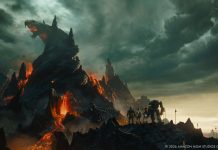
ES – The Ash village is set within a vast, desolate volcanic landscape, centered around the remains of a burnt-out Hometree destroyed by a previous eruption. It is here that we are introduced to the Ash clan, the Mangkwan, and their leader Varang, portrayed by Oona Chaplin. Their appearance is deliberately more aggressive and confrontational than other Na’vi, defined by body modifications, piercings, and layers of charcoal, ash, and ochre war paint.
The Mangkwan—and Varang in particular—move differently from other Na’vi, a choice that reinforces their cultural opposition and reflects their fractured relationship with Eywa. In close collaboration with the art department at LEI, we generated thousands of reference images informed by real-world cultures from across the globe. We also spent extensive time physically applying ash and paint to performers, replicating how these materials would realistically be used within the village. Applying the paint by hand, using fingers rather than tools, introduced subtle texture and variation that translated directly into the digital work.
In parallel, the costume department constructed the majority of the wardrobes and dressed live performers in them, allowing us to study authentic movement, fit, and behavior. This hands-on approach ensured that the digital characters felt grounded, tactile, and culturally distinct within the world of Pandora.


DB – Oona Chaplin deserves much of the credit for giving the Mangkwan the unique physicality that sets them apart from other Na’vi on Pandora. The Na’vi who we are already familiar with have this sort of upright grace where the shoulders lead their movement. Varang is led by her hips. Oona gives this amazing, sinewy physical performance that embodies all of Varang’s combined fury and control. I love the shot where we are first properly introduced to her. That walk out of her yurt tells you just about everything you need to know about her.


RB – The Ash clan was a unique challenge. A lot of credit has to go to our production design and costumes/wardrobe team. Which really set the tone with an amazing look. Combine that with a unique motion vocabulary and incredibly committed, embodied performances by our troop and Oona Chaplin as their Ash clan leader. Add to that dramatic and sculptural lighting in every shot, and an amazing sound track/theme. It felt like every department/discipline came together to do the best work. It’s something I’m very proud of.
Can you walk us through the design and development process of the Ash People from their cultural identity to their distinct physical traits and movement style?
RB – One of the traits we employed in the motion vocabulary was for all of the Ash clan to always be submissive to Varang in their physical posture. If you look closely, the whole Ash hoard deliberately crouch in order to always remain below her.

There is a major sequence set inside a human base, which seems to push the integration between actors, sets, and CG extensions even further. How did you approach the blend between practical environments and full-CG architecture?
ES – The advantage we have working with James Cameron is pre-planning. Every shot in the film is first realized through performance capture before any virtual cinematography is applied to the performances. Because Jim shoots the virtual cameras on fully realized digital sets prior to live-action photography, the art department is able to construct physical sets to exact dimensions, ensuring precise alignment between the virtual and practical environments. One of the issues VFX artists always face is having to manipulate plates to work with CG characters for interaction and lighting. Since we always know what interaction is going to happen and what the final lighting will be for the scene, we can start our integration process before the plates are even shot.

The film features extremely close interactions between the actors and CG creatures. How have Weta’s tools and workflows evolved since The Way of Water to make these interactions more believable?
ES – The other advantage and hardship we have is shooting in native stereo. Films are always much more complicated in native stereo because everything needs to be in exactly the right place in world space or they will be wrong in stereo. With the multiple cameras though we are able to generate per frame geometry for each shot that allows for much better interaction between live action and cg.
DB – A lot of credit needs to go to the camera team at Weta. There is nowhere to hide with plate and CG interaction in a stereo show, and we needed perfect matchmoves to stand a chance of getting it right. We also had very good digi doubles for all key characters, so when things got really really tough, we could replace their hands and limbs. Spider had a very handy armband that we could use as a split point for when the going got tough.

Performance capture has always been at the heart of the Avatar franchise. What refinements or breakthroughs were implemented this time to improve fidelity, especially in facial animation?
ES – Our facial pipeline was updated for speed and artist control for this film but the underlying structure was already in a great position for Fire and Ash. The big update for this film was actually in the characters bodies. Weta FX’s new skin deformation system was developed and uses a hybrid approach of machine learning and artistry to achieve realistic, predictable, high-quality results more efficiently. Instead of rigging anatomical features like muscles, tendons and skin, BodyOpt, our internal name, only focuses on the outer skin and is based on a sophisticated mesh neural network, trained on a curated and high-quality dataset, in addition to powerful runtime components that further refine the result. BodyOpt also features an advanced range of features such as a fast secondary dynamics system driven by muscle activations, supplementary deformers for skin sliding, breathing and performance driven activation shapes, allowing artists to authentically recreate an actor’s performance.
DB – The major developments in the facial pipeline was improving the tools for the animators. The system was developed while in production on The Way of Water, so we only took it as far as we needed to get the work done. The animators wrote a pretty big wish-list over the course of that film and Fire and Ash gave us the opportunity to refine things. Everything that we did was designed to get the tool out of the way. We wanted the day-to-day to be smooth for the animators so that all of their energy was spent with the actor’s performances, rather than jumping through technical hoops.

Can you talk about the evolution of Weta’s water, fire, and atmospheric simulation tools since the last film, and how they contributed to the more intense visual tone of Fire and Ash?
ES – Our effects work is built on a physics-based simulation framework called Loki, which allows different simulations to interact with and influence one another within a shot. That means explosions don’t just look dramatic—they displace air, drive dust and atmosphere, and affect everything around them. The same system handles subtle interactions as well, like vegetation reacting naturally as a character moves through the forest.
Avatar: Fire and Ash includes more than 2,000 water-effects shots—on par with The Way of Water—as well as over 1,000 digital fire shots, created at a level of fidelity we haven’t achieved before. These range from flaming arrows and flamethrowers to large-scale explosions and even fire tornadoes. To support that scale, we developed a new in-house fire solver that gives artists intuitive control over fuel types, combustion behavior, soot, and oxygen balance, without requiring them to be experts in chemistry. That combination of physical accuracy and artistic control was key to delivering fire that feels grounded, expressive, and deeply integrated into the world.

What innovations in lighting, rendering, and simulation allowed Weta to achieve the dense level of detail we see in these new environments and assets?
ES – I would say one key to innovation is always going to finer and finer detail in every aspect of our pipeline. For our in-house renderer, Manuka, has been continuously improved to deliver even more performance and realism. Improvements include a neural network-driven noise estimator for adaptive sampling, ensuring that computation time is spent where it really counts, as well as progressive denoising that allows artists to iterate faster on renders that are still in-progress. As stated above a new FX solver was written for more realistic fire simulations.
Within weeks of winning the Academy Award for Avatar: The Way of Water, Weta FX began advancing its water pipeline and toolset, Pahi, for Avatar: Fire and Ash. These developments included a new algorithm that allows large-scale water simulations to be more efficiently distributed across multiple machines, as well as streamlined workflows for transitioning between simulation states such as bulk water, spray, and mist.
To better support scale, we introduced spray drag masking and implemented a fully coupled two-phase air–water solve. We also added a new approach that simplifies workflows while enabling higher-resolution simulation in targeted regions, allowing us to concentrate detail where it mattered most.
In addition, we developed a unified bubble simulation system that allows low-resolution diffuse bubbles and high-resolution hero bubbles to be simulated simultaneously. This was paired with an expanded secondary foam simulation for dense, “thick” foam, significantly increasing fidelity in close-up shots and improving the sense of scale across all water simulations.

Avatar films are known for their massive shot counts and extremely complex sequences. How did your team structure the pipeline to maintain consistency across such a huge variety of environments, creatures, and FX?
ES – For this film, we organized the work across eight parallel teams covering both animation and lighting/compositing. Each team was led by a dedicated VFX Supervisor, along with compositing, FX, and CG supervisors, supported by lead lighters. In addition, overall FX, compositing, and CG supervisors provided show-level oversight to ensure alignment across all teams.
Artists were allocated and rebalanced between teams as production demands shifted, while a shared, standardized pipeline and workflow template was used throughout the show. This consistency in process and methodology allowed us to scale efficiently while maintaining a high and uniform level of visual quality across all teams and sequences.
DB – At Weta we have specializations within the wider motion team. We have a dedicated facial motion team who focus on facial performance; we have a motion edit team who deal in performance animation (performance capture); we have a crowds team who create simulations of large groups of characters and creatures; and we have an animation team who concentrate on creatures and vehicles, but also do some facial animation and a lot of stunt work.
The biggest challenge where it comes to performance animation is bringing the bodies and faces together early enough in the process so that we can ensure we are getting everything right. Head motion is a huge part of facial performance, so a facial animator cannot be done until the head is working. Facial animators routinely tweaked head animation while finaling their shots.

The Toruk makes a spectacular return in this film. What were the biggest challenges in updating its model, textures, and animation to meet today’s visual expectations?
ES – We have not seen Toruk since film 1 almost 15 years ago so we really had to start over on this creature. Our creatures pipeline, shaders, and textures have all changed dramatically in this time frame and what was once good no longer holds up to our standards or the audience’s expectations.
DB – The biggest challenge for us was reinstating a large library of motion that we had from the first film. We’ve learned a thing or two about rigging birds since Avatar and we agreed that updating the rig (and changing the skeleton) made sense. This meant that we had to recreate all of the motion that we broke by updating.
RB – Resurrecting reservoir of animation from the first movie and adapting it to the new puppet was labor intensive but incredibly worthwhile. It’s important that the audience felt like there was visual and motion continuity.

This climax feels both intense and emotionally charged. What were the biggest challenges in balancing spectacle, readability, and emotional clarity when so many characters, creatures, vehicles, and FX elements collide on screen?
ES – The core challenge in constructing this climax was maintaining emotional legibility amid an environment designed to be overwhelming. Technically, we were orchestrating hundreds of simultaneous elements—creature behaviors, vehicle choreography, large-scale fire and ash simulations, water–fire interaction, atmosphere, debris, and full-performance capture—across a battlefield that was constantly evolving. Without rigorous discipline, the spectacle can easily consume the narrative.
Our first priority was always storytelling. Every simulation, lighting cue, and camera move had to reinforce character stakes rather than distract from them. We built the sequence in layers: starting with clean performance beats, then adding key creature and vehicle actions, and only after those passed readability reviews did we introduce the heavy FX work. We only kept elements that supported the story and helped to direct the eye to the part of the image Jim wanted the audience to be looking; anything else was pared back or removed.
Another challenge was spatial coherence. With so many dynamic elements, audiences can lose track of where characters are relative to one another. We relied on controlled lighting gradients from the fire sources, constrained camera language, and disciplined use of silhouette to anchor the viewer. Jim is relentless about this; he wants the world to feel massive but the storytelling to stay intimate, and he challenged us constantly to ensure the emotional line wasn’t buried under visual noise.
Ultimately, the complexity was the point—but it had to be complexity with intent. Our mandate was to deliver scale and chaos while ensuring that every shot remained tied to a necessary part of the story. That balance required constant iteration, a lot of restraint, and a team skilled enough to push spectacle without breaking the emotional spine of the scene.

ILM also contributed to the film. How did you coordinate the creative and technical collaboration between Weta and ILM to ensure seamless visual continuity across sequences?
ES – For the past six years, I was seated just down the hall from Jim, which gave me daily access for discussions, questions, and shot reviews. At the same time, ILM’s VFX Supervisor, Nigel Sumner, was also located nearby. This proximity allowed us to meet regularly to review work, address challenges, and share reference, ensuring complete visual continuity and a consistent level of quality between the two studios.
RB – Both Weta and ILM were amazing collaborators with Lightstorm and each other. We knew ILM were more than capable of the visual integration of our hard-surface assets and environments we had worked with them on for the original Avatar. The real challenge was in achieving true continuity on our principal characters. From the look of the skin, the sub-surface displacement, and how it played in different light and conditions, to the groom and hair solver. How each dreadlock interacts with each other in terms of tension, for example. These were things that could be shared and referenced to achieve an appropriate look. The specificity of each individual performance, partnered with the idiosyncrasies of our actors, all had to be harnessed. This took us a long time at Weta and had to be achieved in a truncated timeline with ILM. Personally, I think ILM did a great job of rising to the challenge.
Looking back at the project, what aspect of the VFX work on Fire and Ash are you personally the most proud of, and why?
ES – I’m incredibly proud of the entire team for what we accomplished on this film. The scale of the visual effects and the depth of character performance went well beyond what we achieved on the previous film. Perhaps most meaningful to me, however, is that we were able to complete the project with very little overtime. Visual effects often carry a reputation for long, unsustainable hours, but thanks to the exceptional work of our production team and LEI, we maintained regular schedules and a genuinely healthy work–life balance.
DB – As I mentioned earlier, we managed to schedule Fire and Ash so that the work went very smoothly. Not only did this mean that the team managed to maintain some balance in their lives, but it also meant that Jim had flexibility to make changes late in the schedule. We’re not in the business of saying no to filmmakers, but it’s nice when you actually have the time to give it your absolute best.
And also Varang. I’m pretty darn proud of Varang.
RB – Bringing the character Varang to life on screen. Oona Chaplin gave an amazing performance, and it was incumbent on us to shepherd her performance to the screen. In many ways, this was the culmination of the relationship we built with Weta Animation and the facial crew, partnered with our facial-solver and an animation toolset that was scalable to new characters.

How long have you worked on this show?
ES – Because the performance capture and live-action shoots for Avatar: The Way of Water and Avatar: Fire and Ash happened simultaneously, my time on the two films overlapped significantly. I started work back in 2018 on Way of Water, then returned for additional live-action pickups in early 2023 for Fire and Ash before moving straight into the full post-production phase.
DB – The Way of Water and Fire and Ash worked like one, long film for me. I’ve been on these films for about 7 years.
RB – I originally came under the show in 2005/2006 when we were standing up the original proof of concept test for the first Avatar film. It’s really interesting to look back at where we began and how far we’ve come.

What’s the VFX shots count?
RB – Including Main-On-Ends:
Weta – 3,155 shots | 178.17 minutes
ILM – 227 shots | 11.25 minutes
Total: 3,382 shots | 189.41 minutes
(Main-on-ends = images used during the credit sequence)

What is your next project?
That’s an interesting question. We’re currently developing the next-gen system. Obviously, with the intention of being in a position to make Avatar 4 and 5. That’s the ideal system, which is completely agnostic and theoretically would put us in a position to service any major motion picture that was character, creature, and effects heavy.
A big thanks for your time.
WANT TO KNOW MORE?
Weta FX: Dedicated page about Avatar: Fire and Ash on Weta FX website.
ILM: Dedicated page about Avatar: Fire and Ash on ILM website.
© Vincent Frei – The Art of VFX – 2026