
Back in 2023, Tara DeMarco took us behind the visual effects of The Marvels. Now, she returns to discuss the VFX challenges behind the new series The Boroughs.
Steve Ellis began his visual effects career at DNEG in 2010, contributing to films including Inception, Total Recall, Fast & Furious 6, and Avengers: Age of Ultron. In 2015, he joined ILM, where he worked on Rogue One, Jurassic World: Fallen Kingdom, Avatar: The Way of Water, and A Quiet Place: Day One.
How did you get involved in this series?
Tara DeMarco (TD) // I was contacted through my agent by Upside Down Productions. They had seen my work on WandaVision and were interested in me for a similar creative challenge on The Boroughs: we had to construct a community out of many locations around Albuquerque, much like we did when building the fictional town of Westview. The Boroughs also clearly contained ambitious creature and effects work, which are both visual effects challenges that I love.
Steve Ellis (SE) // I had previously worked with Tara DeMarco on The Marvels. It was a massive project that spanned multiple years, and we became really close friends over the course of production. Even though we live in different parts of the world—I’m in London and she’s out in LA—we’re both keen cyclists, so whenever we find ourselves in each other’s city, we always make a point to meet up and ride together.
How was the collaboration with the showrunner and the directors?
TD // The collaboration with the showrunners, Will Matthews and Jeffrey Addiss, and all three of our directors was truly an exceptional experience. We worked together on visual effects keyframes and previs for all of the key sequences. We would really plan our shoot methodology throughly for each filming block. This allowed us the time to shoot great in-camera elements and plates to support the CG work.
How was the collaboration with VFX Supervisor Tara DeMarco?
SE // I’ve worked closely with Tara for years, so we naturally have a great shorthand. More importantly, I know what’s important to her and have a solid understanding of what she needs to be successful.
From the very beginning of the project, we were close partners. ILM made sure to provide Tara with everything she needed while on set, supplying pre-vis, tech-vis, and digital storyboards so she had the visual aids necessary to help guide the other departments during the shoot. Once we moved into post-production, we had our regular formal reviews, but we also spoke or texted almost every single day.
Just because we are friends doesn’t mean we get a free pass on the work, though! We have the kind of relationship where Tara can be completely direct and say, “I can’t show this yet,” but we can also talk openly and honestly about our ideas. It allows us to constantly push the work toward the absolute highest standard – that best-in-class quality we both expect and strive to deliver.
How did you approach selecting the different VFX studios involved in the project?
TD // I have a wonderful working relationship with Industrial Light & Magic. I had previously worked with VFX Supervisor Steve Ellis on The Marvels. I knew that his team would do a great job with this creature and could also really bring the effects of the story to life.
I loved the work that Framestore had done on Barbie and in several other films, creating seamless and photo-real CG environments. We ended up working with Framestore Montreal and the fantastic VFX Supervisor Roman Rico on establishing all of the environments. Additionally, the team at Framestore helped us with our cave of wonders and our magical peach transition.
I worked with several vendors for the first time, including Platige, Crafty Apes, and Ghost. Ghost handled all of the birds, which were wildly complex. The final bird shots needed to tell two stories at once. The birds in the murmuration had to die a violent death *and* create a path for Art to follow.
The language of glitching and mother “speaking” to Sam was created by the great team at Platige. Crafty Apes in Vancouver took the creative lead on our on a lot of our television static and uncanny flickering effects.
We also brought in SSVFX and SDFX Studios to help with our many clean-ups, environment extensions, and small invisible effects. They were both vendors I knew and loved from my time at Marvel.

How did you approach the VFX worldbuilding of the desert retirement town in The Boroughs?
TD // We collaborated extensively with Production Designer Ruth Ammon and the art department on creating a “town map”. Our map contained all of the physical structures where we filmed, placed in relationship to the hero cul de sac and town square. Our town plan had to make sense for the characters – for example, Sam has to be able to walk to the center of town, so it was only 1 mile from his house.
We worked with Pixomondo to create an early version of the map in Unreal Engine to help both with creative and technical decisions about the set build, the placement of blue screens, and the strategic placement of practical town infrastructure, like bus stops and decorative walls.
What were the main challenges in extending and enhancing the environments surrounding the community?
TD // We always strived for an authentic New Mexico landscape in our CG environment shots and set extensions. The town is very dry, with low atmosphere. We used the lighting reference from in-camera plates to inform sharpness, light bloom, and accurate depth-of-field fall off.
How did you balance realism and stylization in the desert landscapes and architecture?
TD // All of the landscaping and architecture ideas came from the extensive research done by the art department. Ruth Ammon and her incredible supervising art director, Michael Allen Glover, created bibles with hundreds of images references from the 50s and 60s in New Mexico and Palm Springs. We had an entire plant bible to choose from in deciding the landscaping!
Can you tell us about the beautiful particle sequence filling the house and the work done on the lighting?
TD // We called that sequence the “magic goo”. We started with VFX concept art keyframes, created by the extremely talented Jamie O’Hara. Jamie and our Episode 102 director, Ben Taylor, worked together on the look of the solid blood becoming liquid goo, and then the liquid exploding into “the stuff of the universe”.
Once we had approved keyframes, we worked with Cinematographer Matt Jensen and our Gaffer, Dan Riffel, to create an interactive lighting element that could change color, intensity, and pace. All of the flickering light in the room was captured in camera and then enhanced by the team at ILM to better integrate with their magic goo particles.
The show runners wanted to add a hint of the TV glitch element to the atmospheric clouds, if you look closely, it’s in there.
SE // This was a really special sequence to bring to life. We started with some truly stunning concept art from Jamie O’Hara; we knew instantly we had all the ingredients for something spectacular.
The script and the showrunners described the creature’s blood as ‘the stuff of the universe,’ and the characters experience this moment as nothing short of a miracle. To capture that profound sense of awe and hope, we linked Jamie’s artwork to concepts from physics. While those luminous, ethereal blue particles are the main component, we also wove in slowly vibrating strings, alongside these beautiful volumes of light which are frozen in time.
From a lighting and camera perspective, the show utilizes gorgeous anamorphic lenses with a very shallow depth of field. This gave us the perfect opportunity to lean into those elongated, wobbly bokeh effects, with the whole effect bathing the room in a dreamlike, celestial glow.
But above all, the movement through this cloud needed to feel deeply emotional and completely zen-like. As the characters move through the room, their natural air currents just barely waft the elements around them. We wanted it to feel like stepping inside a miracle; a deeply tactile experience where you could reach out, touch the ‘stuff of the universe,’ and watch the gentle eddies push these beautiful little micro-universes around. It is a moment of pure hope, showing how everything is connected and laid bare before you.
Ultimately, it was the passionate collaboration of an amazing team of artists who worked tirelessly to produce a sequence that feels as miraculous on screen as it does in the story.


How early did you begin developing the look and behavior of the Monsters?
TD // Showrunners Jeffrey Addiss and Will Matthews had already worked on the creature concept for a few weeks with Jerad Marantz before I joined the show. My very first task was to work with an animator to figure out a walk cycle for so many limbs. We started that work in June 2024, about 4 months before we began production.
I worked with animator Steve Beck and we quickly realized that the creature had too many limb segments! The legs you see in the final creature have 5 limb segments, but the original design had even more. Once the limb segments were modified, we continued our look development with the animation team in ILM.
SE // The creature was the very first thing we started on. While the foundational concept and look had already been figured out by Jeff, Will, Jamie, and other collaborators, the team at ILM developed the mechanics of the creature’s movement. We were specifically tasked with figuring out how it would navigate the bungalows of the Boroughs; how the creature would move across the ceilings, and ultimately lower itself down over its victims.
We knew right away what we didn’t want: it couldn’t feel like a giant spider. This creature is supposed to be ancient, so we leaned heavily into a concept we called “geriatric parkour.”
Jeff had a very clear vision for how it should move around within its environment. There was no magical anti-gravity or gecko-like stickiness; instead, the creature had to physically wedge and push itself into the structural beams. To ground this in reality, we studied lots of rock climbing footage, paying close attention to how climbers swing their body weight around and use hanging limbs as counterweights to maintain balance. We applied these mechanics to ensure every single hand placement and grab was intentional and calculated; rather than scurrying rapidly like a spider, the creature’s limbs had to realistically stretch, hold, pull, and actively support the heavy, awkward weight of its strange little body.
It was a fantastic animation challenge to make sure that even though this monster is entirely otherworldly, its presence in the room felt physical, heavy, and grounded in real-world mechanics.


What references or ideas inspired the design of the Monsters and their thin facial features and multi-legged anatomy?
TD // That is a question for Jeff and Jered! I know they wanted something very old and strange looking, that would be hard for the seniors to easily identify. We looked at several animal references for the retroreflective eye shine. We looked a quite a lot of reference of both young and older human athletes. We wanted the creatures to pressure hold across the ceilings, like Alex Honnold in Free Solo. The creature limbs needed to have muscle and tendon definition as well as significant skin laxity, for this, ILM found an amazing reference clip of an elderly ballerina.
SE // To ground the creature’s design in reality, our artists studied extensive references of old, wrinkly skin. A major source of inspiration for the team was a fantastic, elderly ballerina who is truly an inspiration to us all. Even in her 80s, she moves with elegance and grace, possessing a very taut, muscular frame with absolutely no body fat. The way her elderly skin sat over her muscles and the amount of incredibly fine, detailed wrinkles she had, provided the absolute perfect reference for how much our digital skin needed to dynamically fold and crease.
Replicating that level of detail required us to push our technical boundaries a lot. This specific inspiration actually led to our dynamic skin setup being at least double the resolution of a typical asset. We knew we needed that density to capture the incredibly high fidelity of skin wrinkling in our simulations. To achieve this, we employed specific techniques to subdivide the skin for the creature sim task, making it one or two levels more subdivided than the normal asset. This allowed us to inject every possible ounce of intricate detail directly into the skin simulations, giving the monster its uniquely ancient and tactile appearance.


What were the biggest animation challenges in making the Monsters feel both elegant and unsettling?
TD // I’d say one of the bigger challenges was scale vs. movement. The creatures are actually quite large, so we really had to play with blocking and timing to allow for our slower, older, humans to get away. We wanted to thread a needle between shock value (the yank at the end of the opening) vs. creep factor and slow, intentional movement.
SE // I am incredibly proud of how our animation team tackled this, because the core challenge wasn’t just technical; it was deeply emotional. We needed to take the audience on a very specific, transformative journey with this character. In episode one, the creature has to be terrifying; it is creepy, unsettling, and an agent of death. But as the story unfolds, that fear has to shift into empathy. We needed to elicit a genuine feeling of sadness as the audience watches the creatures suffer and ultimately realizes that these ancient beings are actually enslaved.
Conveying that tragedy was immensely difficult because the creatures have no mouths – they feed entirely through their proboscis – and their eyes are perfectly round without pronounced eyebrows to signal emotion. We engineered a dynamic shader that calculated the amount of stretching and compression across the face, so we could push digital blood into the relaxed areas of the skin, darkening specific skin folds to mimic the physiological reactions of pain and sorrow.
That same level of anatomical empathy extended to the creature’s body. Jeff was incredibly passionate about the concept of “tendon firing.” To make the audience truly feel the creature’s sheer exhaustion, the gross limb animation was often kept subtle, but we heavily animated the underlying tendons. You can vividly see the tension firing through its limbs as it holds itself above Jack, drags itself along the ground, or squeezes through the glass tubes to Mother’s chamber.
Typically, on a creature show, you develop a standard walk cycle for the animators to build from, but in the Boroughs every single sequence was completely bespoke. Whether the creature was pulling itself along the railway tracks, tightly constrained within the glass tubing, or traversing rocky cave environments, every single hand and foot plant had to be uniquely purposeful and adapted to the specific shape of the surface. We wanted them to feel incredibly old and deliberate in their movements. Seeing the final muscle, fascia, and skin simulations come together; watching those heavy deformations and wobbles beneath their loose, wrinkly skin, was a proud moment for all of us. It is what ultimately infused these unsettling monsters with a beautiful, tragic soul.


How did you approach the interaction between the Monsters and the practical environments on set?
TD // The team at Onyx Forge created several props and lighting-reference creatures for us. We had two hands, a proboscis, a bust, and eventually a full-size creature. We would film the actors without any monster interaction, just verbal cues. Once we had a good performance, we would come into frame with the appropriate reference prop – sometimes touching the cast with the tiny hands.
SE // As the creatures’ movements had to be so deliberate, seamless interaction with the practical sets was crucial. We had really good scanned models of the physical environments, so whether the creature was navigating the cave set or wedging itself into the bungalow ceilings, we had laser-accurate models to work with. Having this data meant our animators could interact with all the surfaces, ensuring that every shift in weight and hand placement felt grounded in the actual space.
We also had an amazing life-size practical creature created by Onyx Forge. Having a physical puppet on set is always invaluable to the filmmakers; it allows the crew to dial in the lighting and tone, work out the correct composition and framing, and provides the perfect stand-in for the actors to act against. For the digital team, this practical model gave us the perfect starting point to match our renders and composites to something real. Combining the set scans with the practical build from Onyx Forge gave us exactly what we needed to integrate the digital effects and make the monster feel like a genuine, heavy presence occupying the set.
Can you talk about the creation of Mother and the subtle work done on her face throughout the series?
TD // Jerad, Will and Jeff created the design for Mother and the team and Onyx created all of her prosthetics. We barely touched mother in visual effects. The only sequences with visual effects are the ones where she glows.
SE // In the final episode, we handled some very subtle, sub-surface glowing augmentation work on Mother’s face. Achieving such a delicate, sub-surface feel is actually incredibly complex, and it required a really great collaboration across multiple departments. Our layout team managed the precise digital face tracking, the FX team generated a huge toolset of elements, and our always incredible compositing team ultimately took all this and drove the final look.
To make sure the work resonated emotionally, we developed a specific visual language with Tara to describe the effects. We used terms like “storm” and “pulsing” to visually portray Mother’s anger and her shifting emotions. All of this subtle work was crucial for communicating her internal state as she builds towards her death moment, which is ultimately her moment of blissful release.


What were the technical and creative challenges behind Mother’s final explosion sequence?
TD // The visual effects of the Mother finale required a delicate touch. The facial prosthetics were significant and we wanted to show the audience that she was roiling inside, but allow as much performance to come through as possible. We created movement and flicker to show the distress that the character was in, but art directed the effect to stay away from her eyes.
Her boiling, roiling anger begins to emanate heat haze. It’s a beautiful and subtle way to show that heat intensity is growing. Her final glowing shots are enhanced by a flickering light in the entire environment. We achieved some of that with a practical lighting effect and some shots were significantly enhanced with CG.
SE // As with other sequences in the show, we needed Mother’s death scene to evoke a deep sense of beauty alongside the expected emotional weight. There is a poignant element of protection in this scene, with the creatures wrapping themselves around Mother to be with her in her final moments. Crucially, this is the exact moment she is finally released from her enslavement, so it is fundamentally a moment of freedom.
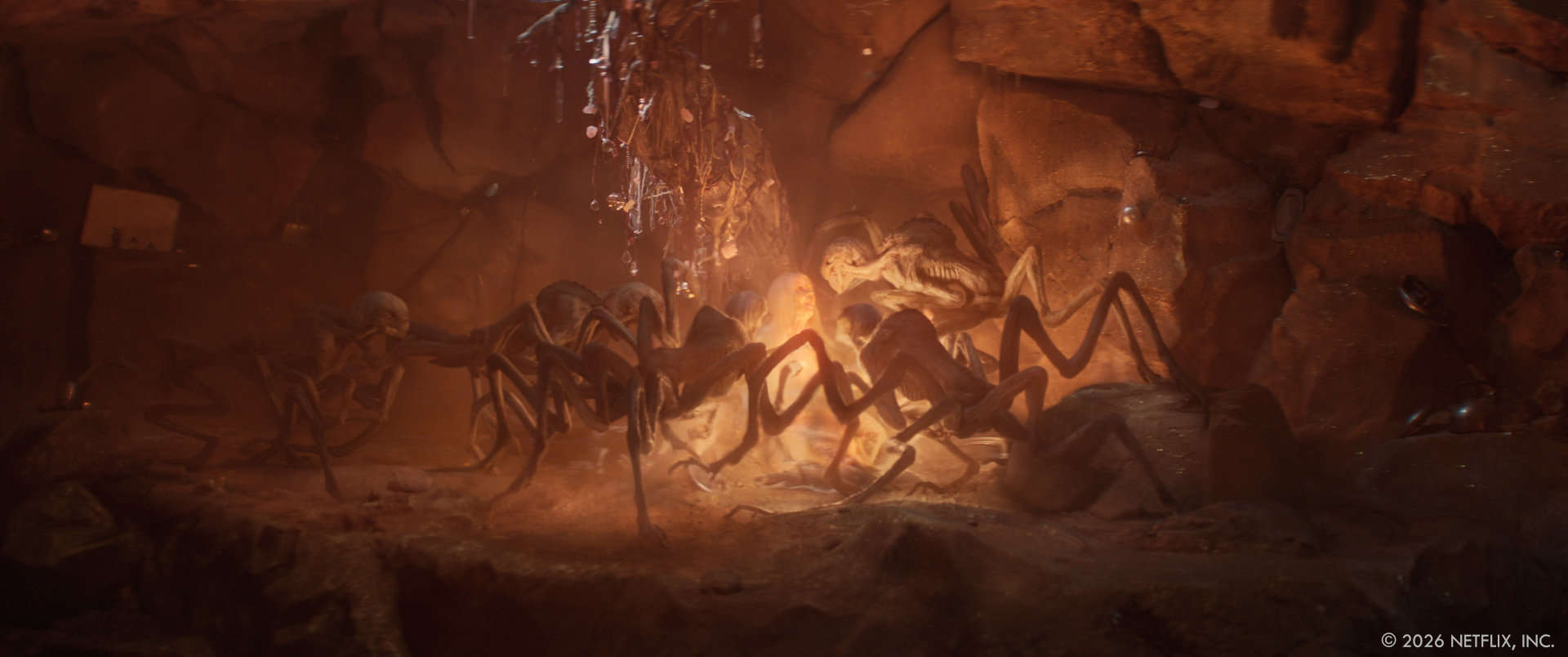
Creatively, we wanted her to look angelic as the sequence progresses, culminating in her exploding into pure light. The goal was to capture the visual beauty of that intense light emitting directly from her core and radiating out to illuminate the entire cave.
From a technical standpoint, we started with plates of Mother shot on the practical cave set. We then augmented those plates with the digital lighting, the creatures, and the various dynamic effects radiating outward from her. Because there was such a high level of physical and lighting interaction between Mother, the creatures, and the intense energy of the explosion, the sequence ultimately required a significant amount of digital replacement to ensure all the elements integrated seamlessly into the environment.
How was the cave environment with the peach tree designed and expanded through visual effects?
TD // The cave of wonders was a set build from the art department. They created a tree that could have it’s branches replaced and go from live to dead. It was quite incredible.
Visual effects enhanced these shots by adding a crystal-caustic light effect to the walls that we could not achieve in-camera.
Which sequence best represents the overall visual effects ambition of The Boroughs?
TD // The opening sequence of the show is an excellent showcase for our work. We open on a beautiful, invisible set extension of the hero house at night, then move into a series of slow, tension-building creature shots that escalate toward close, dramatic moments where the creature comes face to face with our lead actor.
How did you develop the various glitch effects seen throughout the series?
TD // We wanted the glitch effect to resemble the static you would see on Sam’s old TV. We looked at many eras of grain and static. We landed with an effect that leaned into tube television moire and old-school snow static.
Can you tell us about the de-aging and aging work featured in the show and the challenges of making those transformations feel natural?
TD // We had a couple of hero de-aging shots in the show. The team at Framestore helped with healing Art’s hand. Platige finished the shot where Art’s hair glitches from back to grey.
In both instances, we had to make sure the effect was simple and readable. Leaning into simplicity helped us keep those effects natural.
The deaths of several villains are particularly striking, how did you approach designing and executing this sequence?
TD // The villain finale was designed to happen in stages. We wanted to build tension and a win for Claire and Sam. Stage one was an activation, the characters were trapped in volumetric beams and we wanted to show that the TV-induced glitching was painful. Stage two forced transformation into their true monster selves. Director Augustine Frizzell really wanted to show a painful transition for Annaliese. We shot the character in both of her stages and scanned her with and without prosthetic makeup. The team at ILM designed a bespoke skin peel that has a leading edge of chromatic aberration and static, revealing paint-enhanced prosthetics underneath. The final stage was meant to be a callback to the magic goo from Episode 102. We wanted the goo inside of Annaliese to burst from within and leave us with magic particulate glow all around Blaine.


Is there any invisible effects that you want to reveal to us?
TD // We did a special motion control shot for Hank flying off the cliff in the car. For the practical shoot, we filmed with a dummy. Upon reviewing the footage, it *really* looked like a dummy. The team at ILM helped prep for filming Hank elements with the real actor in a static car, by tracking the camera and car movements, and negating the forward motion. That allowed us to bring in a motion control camera to move around a static Hank and convertible. The MoCo elements were then composited into plates of the practical car going off the cliff.
SE // The close up shots of the dying creature – the shallow focus shots of the face with the bullet wound and remnants of blood – after Judy shoots “Scar” in the underground mines are all digital.
Also, all the shots of Jack’s (Bill Pullman’s) cadaver in the morgue are actually digitally recreated head replacements using photography of Bill. This is some of the most technically invisible work that we did, and I hope nobody was aware that those were VFX shots.
There is a healthy mix of practical and CG crow shots in Brooksy’s final moments.
TD // In addition to the bigger environment shots, we did quite a lot of clean-up in the shots that didn’t feature the CG set extension. Our in-house team, led by Roxy Zuckerman, did quite a lot of re-sculpting of the prosthetics on Annaliese.
How long have you worked on this show?
TD // I worked on this show for 16 months.
We began at the end of May 2024 and delivered the series at the end of September 2025
What’s the VFX shots count?
TD // The entire series had just under 1200 shots
What is your next project?
TD // I don’t know quite yet. 🙂
A big thanks for your time.
WANT TO KNOW MORE?
ILM: Dedicated page about The Boroughs on ILM website.
Framestore: Dedicated page about The Boroughs on Framestore website.
© Vincent Frei – The Art of VFX – 2026