I originally intended to get into Japanese anime but I switched gears and focused on CG at the School of Visual Arts. I got some internships after graduating and then freelanced for nine years allaround shops in NY. I became a staff comper at FuseFX NY in 2015 and climbed through the ranks and now I’m a Digital Effects (DFX) Supervisor.
How did you and FuseFX get involved on this series?
The show’s VFX supervisor Jon Massey was formerly from FuseFX LA. We had worked together on 911 Season Four and when I heard he was on the show, I volunteered to lead it on the FuseFX end.
How was the collaboration with the showrunner and the directors?
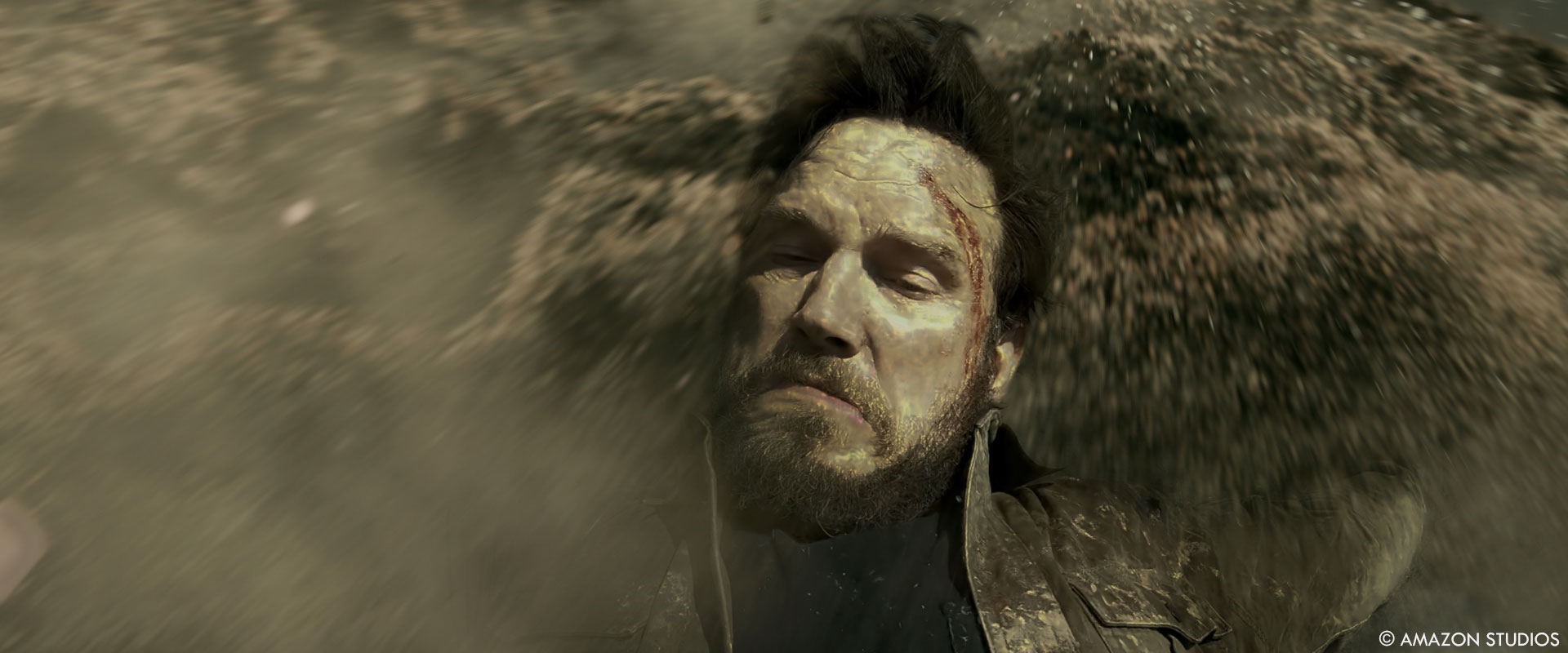
We didn’t work directly with the directors but we worked with the showrunner David DiGilio on the 106 landslide sequence. He was happy with the end product so that was a great feeling.
What were their expectations and approach about the visual effects?
The expectations were to create high-end, realistic VFX that didn’t take away from the story, only enhanced it. That is what we always do, always provide the best to our clients.
How did you organize the work with your VFX Producer?
Clark Harding was our VFX producer and the main things we discussed were how to split the work with our LA office and how many resources we needed. Since Clark was producing for both offices, it made communications easier and we were able to get quicker turnarounds.
How was the work split between the FuseFX offices?
NY took on most of the work and it was supervised by me. A selection of complex CG scenes were worked on in LA supervised by Evan Underwood.
What are the sequences made by FuseFX?
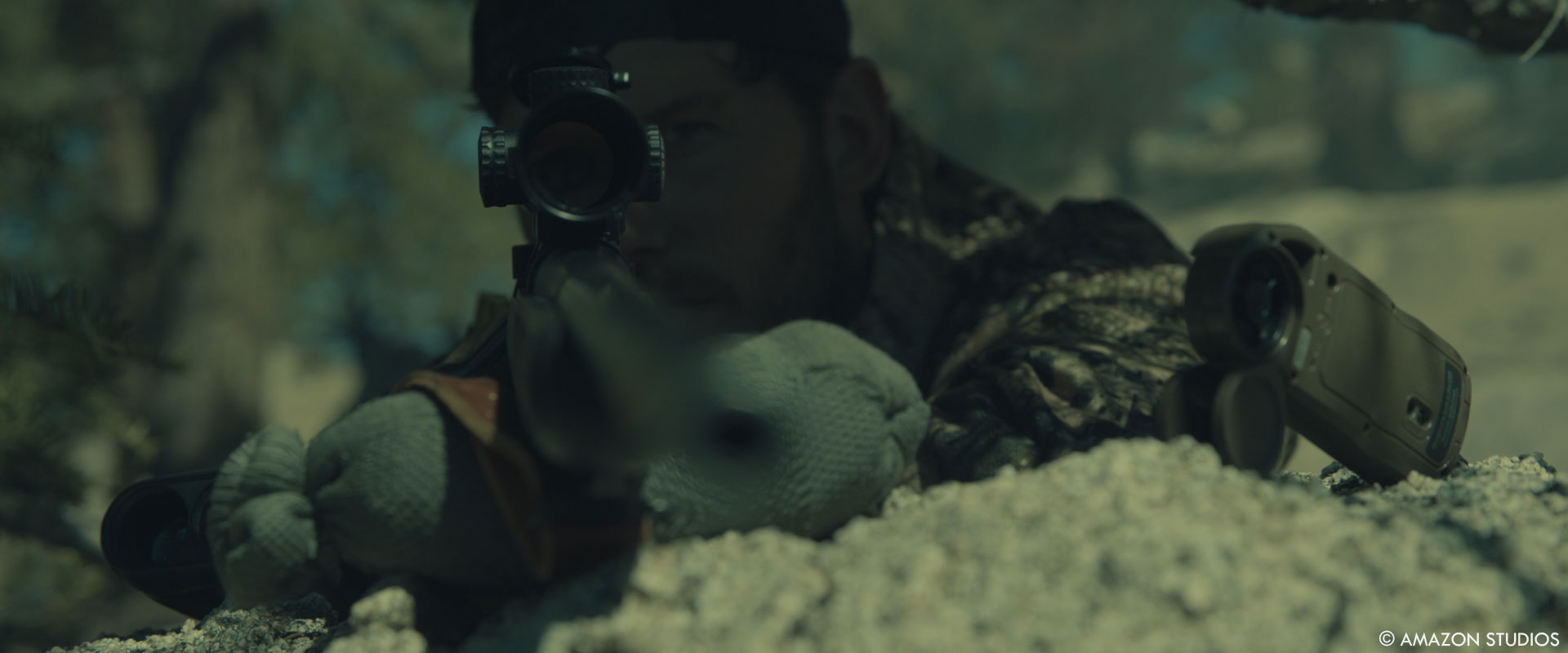
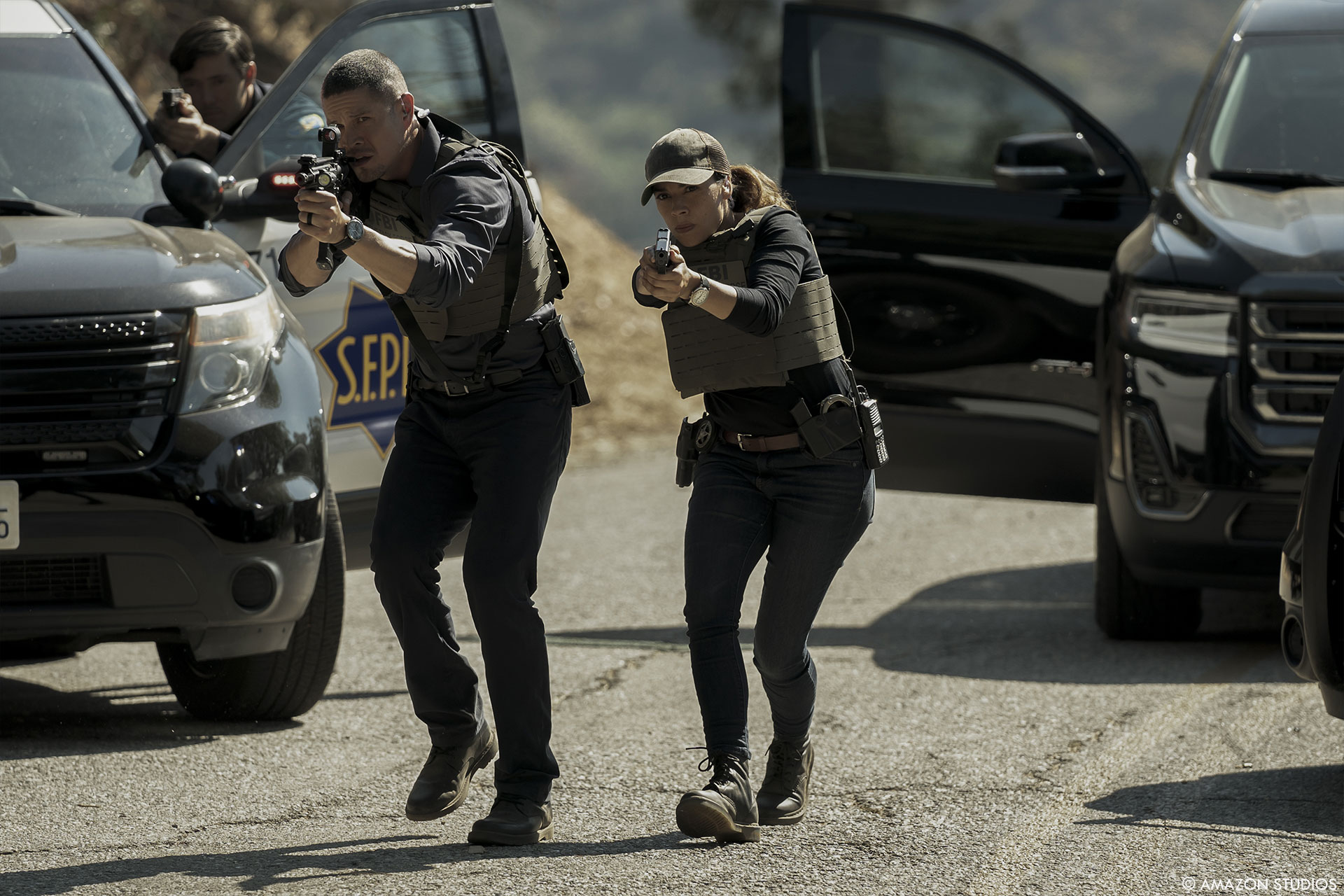
There was quite a range and we touched every episode so I’ll just mention the major highlights. We worked on the big beach battle sequence in 101, the night beach in 102, the CG starlings in 103, the Grand Tetons in 104, the battle sequence in 105, and the huge landslide in 106.
Can you elaborate about the creation of the environment in the intense first episode?
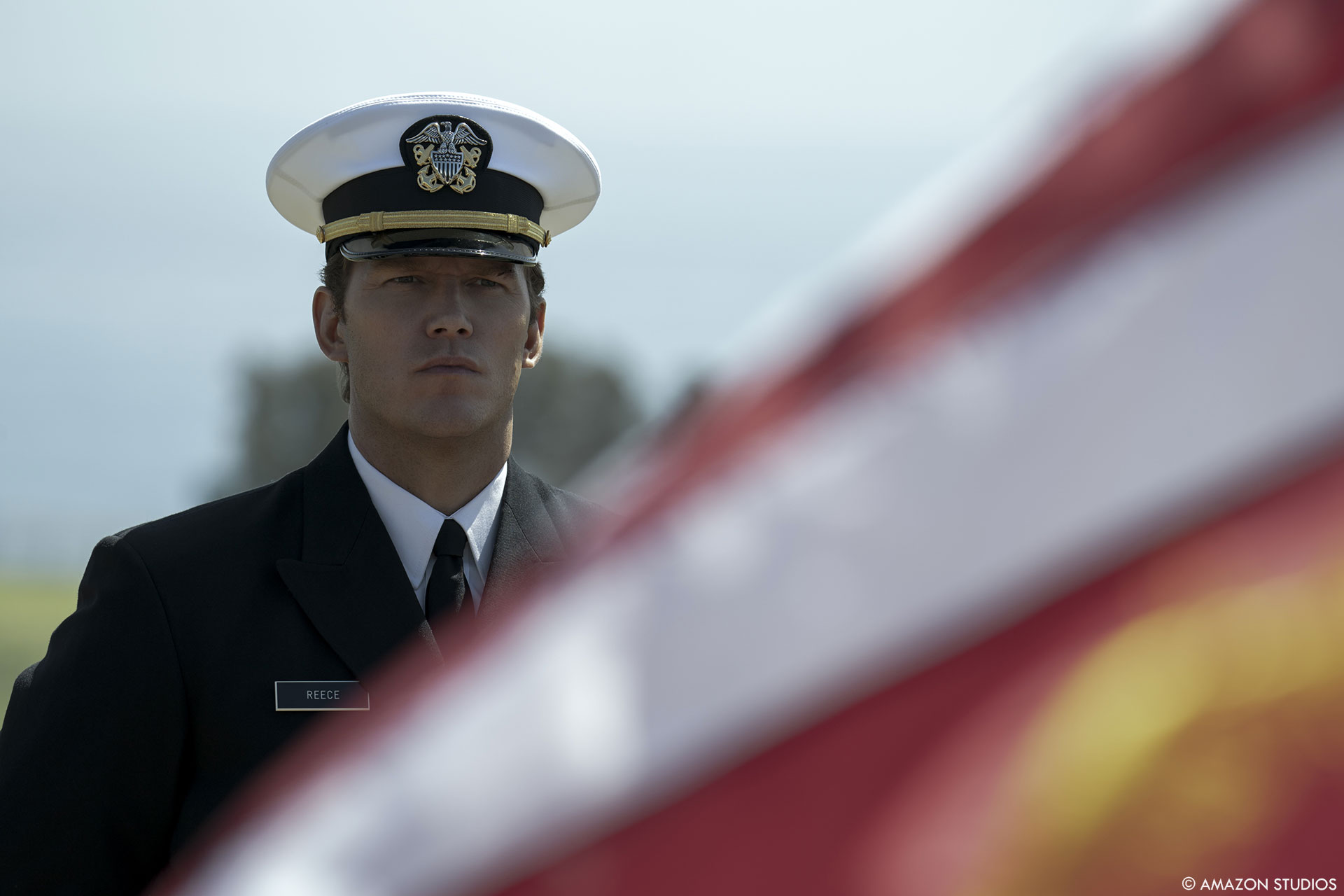
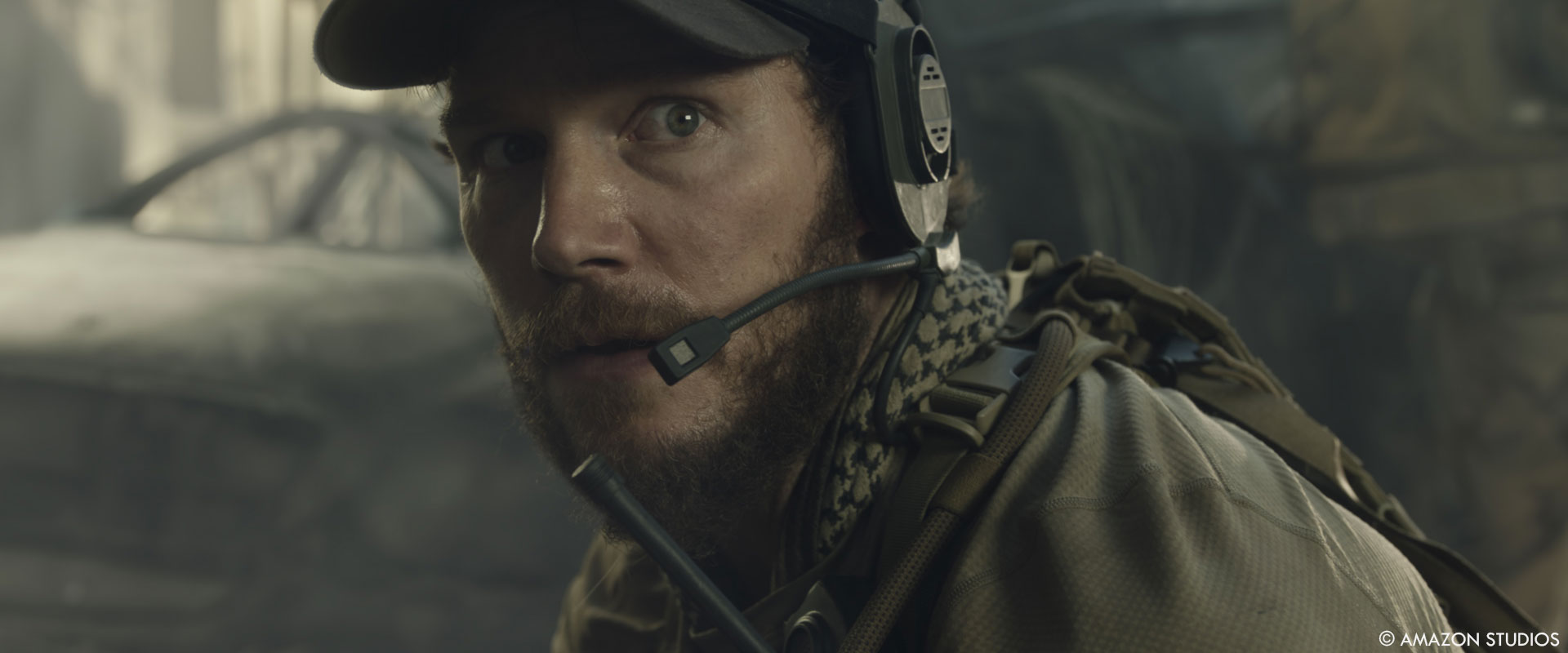
The first episode has a big beach battle that is the catalyst for the main character James Reece’s revenge journey. The practical beach set looked too calm and pleasant so we were tasked with making it feel more chaotic. Our NY team added layers of 3D and 2D rotor wash elements to help with the illusion that the helicopters were landing on the beach and the CG artists created the truck fires with tall, complex smoke plumes which really enhanced the scene. For the background environment, we put together a cliff range and integrated that on top of the lower practical cliffs. We also placed in a CG compound as the enemy base with multiple elements including a dirt road matte painting.
Which location was the most complicated to enhance?
The mountains for the landslide in 106 were definitely the most complicated. We created matte paintings to expand the mountain range, comped in CG trees and shrubs, enhanced practical explosions that trigger the landslide with more debris and smoke, and matte paintings for the surrounding environments before and after the landslide.
How did you create the various vehicles and especially the helicopters?
For the helicopters, we stitched another helicopter that was shot as an element plate and we comped it in the 101 beach battle scene. We added vehicles for 105’s opening shot. It was an overhead drone shot and both sides of the plate were replaced with stock footage and edited with matte paintings to expand the town area. The stock footage didn’t have any vehicles so 2D vehicles were comped in to feel more populated.
The series is full of muzzle flashes and explosions. How did you create them?
We gathered a huge library of muzzle flash stock elements and we used them throughout the season. For 105’s battle, we used Sapphire’s Muzzle Flash plugin to match the practical flashes. It worked out great using its 3D controls to line up with all the different angles of the firearms and we added more texture to the flashes for extra detail.
What was helpful to us when approaching muzzle flashes was the advice from the military consultants and prop master on which muzzle flashes to use for the battle scenes because there were different firearms used for each battle.
All the explosion shots we worked on were practical. Our contribution was enhancing them with a mix of CG and 2D elements. For example, the 101 crypt explosions were practical and our FX artist used a scan of the crypt to sim dust coming out of the bricks, he also created debris falling down in the foreground. The comper integrated the FX work and added 2D falling dust elements to layer the look further.
Which fight was the most complicated to enhance?
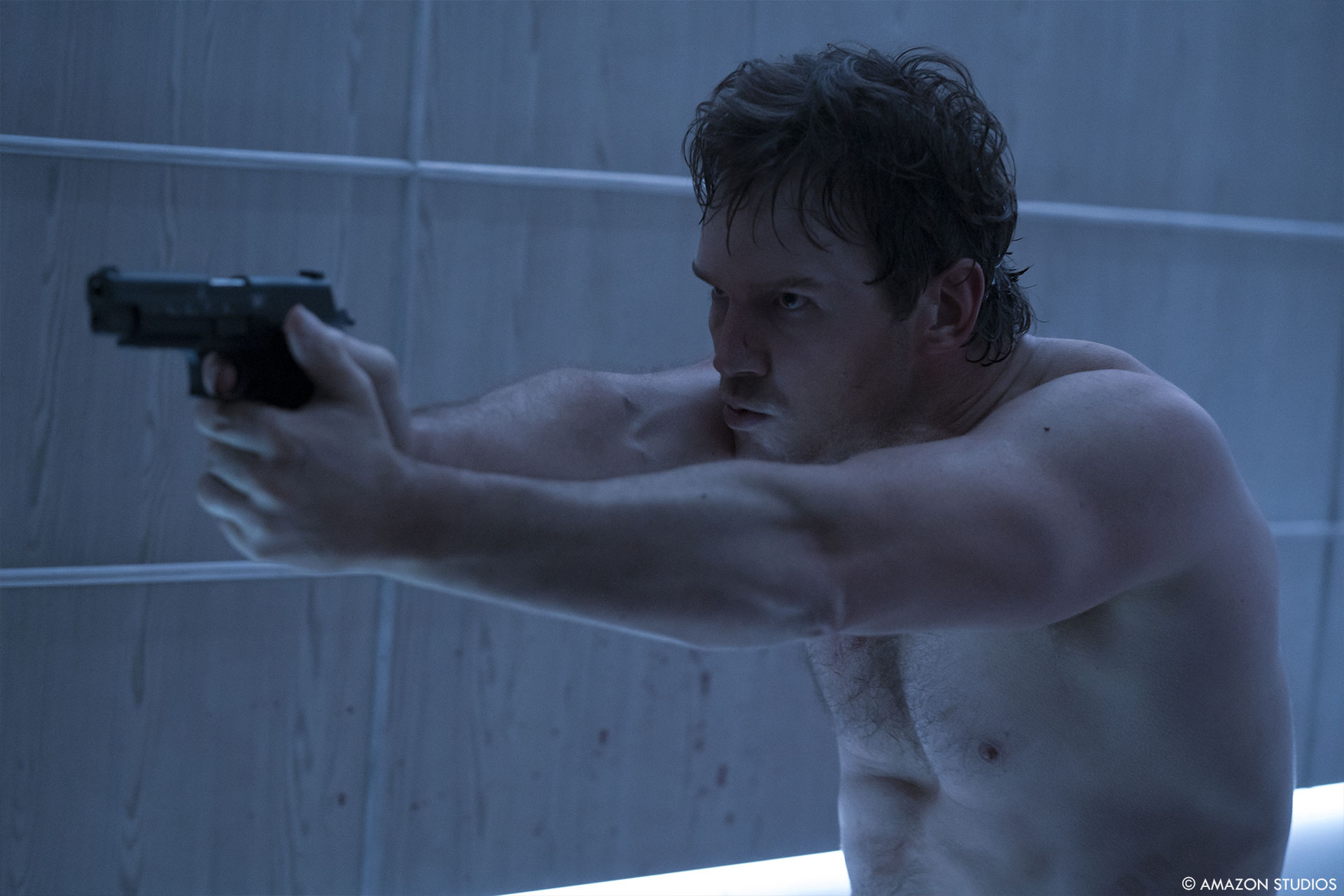
The 101 beach battle was the most complicated because of the many layers involved to create the drama and chaos. Along with all the environmental changes I mentioned above, we had to map out all the bullet hits, tracer rounds, and muzzle flashes for all the semi and automatic weapons which took quite a bit of juggling. The military consultants and the prop master provided us with the types of weapons we should match our elements to: AK-47s for the enemies, suppressed AR-15s for Reece’s team, and miniguns on the helicopters. We did custom FX bullet hits for each shot and we used 2D ground hits to help fill in the gaps.
The other layer was the rotor wash. The practical helicopters did not actually land on the beach when shooting. The NY FX team simmed rotor wash and they had to split the volume in half in order to fill up the open, outdoor space. Our compers used a procedural method to add more rotor wash in the foreground for depth.
How did you enhance the gore aspect during the fights?
We integrated a combination of stock elements to add more blood and wounds to things like 101’s decapitated head in the tunnel and the knife fight that happens later in the episode.
Outside of the fights, we created matte paintings of blood and tracked them onto the shirt of Marcus Boykin in 104 after his car flipped over.
Did you want to reveal to us any other invisible effects?
In 103, there’s a scene in which Reece interrogates a character named Saul Agnon. Reece is seen wearing black gloves but during filming, those gloves were taken off for some shots so we did rotomation of Chris Pratt’s hands and comped in CG gloves to maintain the continuity. We also kept the fireplace in mind when lighting the gloves to have the flickering light applied onto the gloves. It was subtle work but it paid off and we were happy with the results.
Which shot or sequence was the most challenging?
The 106 landslide sequence was by far the most challenging. It was so massive that some shots were completely replaced with CG and matte paintings. The dirt couldn’t look too dry or too muddy so the LA FX team did many rounds of testing to get the look and feel of the landslide right. Layers of rocks were also placed in to help make the dirt not look too sandy. Sim times were extensive and when they were ready, the LA compers were so great and responsive in taking those shots to the final looks. For the landslide settling at the end, matte painters created big dirt piles and we projected them onto the sims to help with the continuity of the aftermath.
What is your favorite shot or sequence?
My favorite is the 101 beach battle scene. It took a lot of coordinating but regardless, it was enjoyable to work on and to watch. Always feels good to be a part of the VFX that contributes to the story in a big way.
What is your best memory on this show?
The daily check-ins with my team always perked up my day. During the project, we renewed our love for Subway sandwiches together and we still check in on each other.
How long have you worked on this show?
It was an 8-month project for me.
What’s the VFX shots count?
297 VFX shots total for both FuseFX.
What was the size of your team?
We had around 30 people on the NY team and 40 people on the LA team.
What is your next project?
I can’t share the name of the project at this time but it is an upcoming feature and I’m very excited to be working on it.
What are the four movies that gave you the passion for cinema?
My father studied film in Italy during the ‘70s but he stopped pursuing it as a career when he moved to America. It didn’t stop him from sharing his love of cinema with my sister and I. He collected several bookcases worth of movies on VHS tapes and I would go through them while I was growing up. So I like to think that my father gave me the passion for cinema and movies like The Godfather, Some Like It Hot, West Side Story and so many others confirmed that passion. What gave me the passion for VFX was anime. If I had to pick four animes that influenced me the most while pursuing my career, it would be Sailor Moon, Neon Genesis Evangelion, Rurouni Kenshin, and Naruto.
A big thanks for your time.
// The Terminal List – VFX Breakdown – FuseFX
// The Terminal List – Trailer
WANT TO KNOW MORE? FuseFX: Dedicated page about The Terminal List on FuseFX website. Prime Video: You can watch The Terminal List on Prime Video.
Design Studio: Elastic Executive Creative Director: Angus Wall Creative Director: Kirk Shintani Storyboard Artist: Frank Dellafamina Concept Artist: Rustam Hasanov Designers: Nadia Tzuo, Kaya Thomas Type Design: Ben Woodlock Type Animation: Jim Pierce Previs: Chris Leone Modelers: Jose Limon, Joe Paniagua, Jade Smrz CG Lighter: Dustin Mellum, Ziyan Zhang, Scott Nishiki, Joe Chan-Nguyen, Ryan Taylor Dynamics: Jun Kim, Mike Bettinardi, Phiphat Pinyosophon, Miguel Salek CG Intern: Daycie De Luz Nuke Compositors: Martin Karlsson, Ashley Jahanshahi, Brian Yu, Eric Almeras Editor: Rachel Fowler Additional Editor: Javier Gonzalez Color Pipeline TD: Andrew Young Senior Producer: Paul Makowski
What was your feeling to be back in the Predator universe?
It’s been pretty amazing to be a part of it, and from the beginning I fell in love with the script and the concept that Dan and Patrick had developed. It felt like the story really brought it back to its core theme of the hunter and hunted, and it’s been a great experience with amazing people.
How was your collaboration with Director Dan Trachtenberg?
Dan’s a really great collaborative filmmaker, and I really believed in the story that he was trying to tell. Dan was very passionate about the effects and weapons at every stage of development, which made it a really fun and rewarding process.
How did you organize the work with your VFX Producer?
In addition to being a very talented producer, Jamie Stevenson is also a really great person. We very quickly became close friends and worked really well together as a team. We developed a breakdown and methodology together very early on that for the most part served as a guide to shooting VFX heavy scenes. There was also a huge amount of collaboration with the excellent practical effects team at ADI led by Alec and Tom who were tasked with creature design and building the suit and weapons.
Jamie brought in The Third Floor for previs very early in the process to help with pitch vis, and they were a close part of our team throughout the entire film right through to post vis. The vendors included Mr. X and MPC.
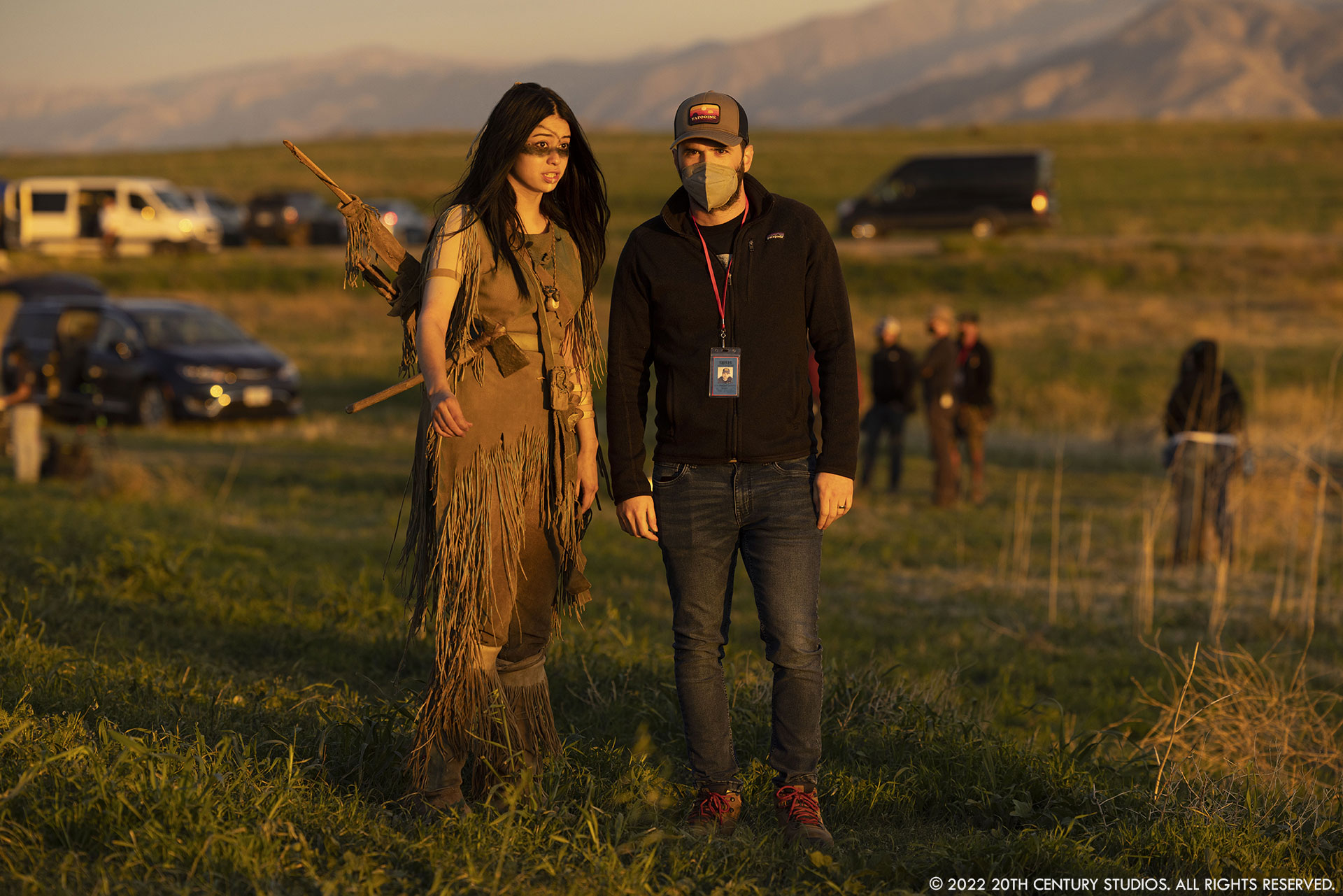
Director Dan Trachtenberg & Amber Midthunder
How did you choose the various vendors?
Despite all our best efforts to use real animals wherever possible, it quickly became apparent that with our tight shooting schedule and strict Disney animals policies, that we had a very long list of CG animals to build. That in turn left us with a pretty short list of vendors that we felt could attain the high level of realism the film demanded in such a short period of time, particularly for the sequence where the bear fights the Predator in a river, which was always going to be our most challenging sequence.
We ultimately decided to split the work between Mr. X who handled the majority of shots including the Predator cloaking and some of the creatures, and MPC who completed the Bear, Cougar, and Wolf shots. The team was led by Chris Uyede and Lachlan Christie in Montreal.
We also had an amazing in house flame artist, Mark Renton who handled the Predator vision shots and dozens of others. There was also a very last minute addition of the Predator spaceship, which was done by ILM.
Can you elaborates about this new Predator and his iconic weapons and tools?
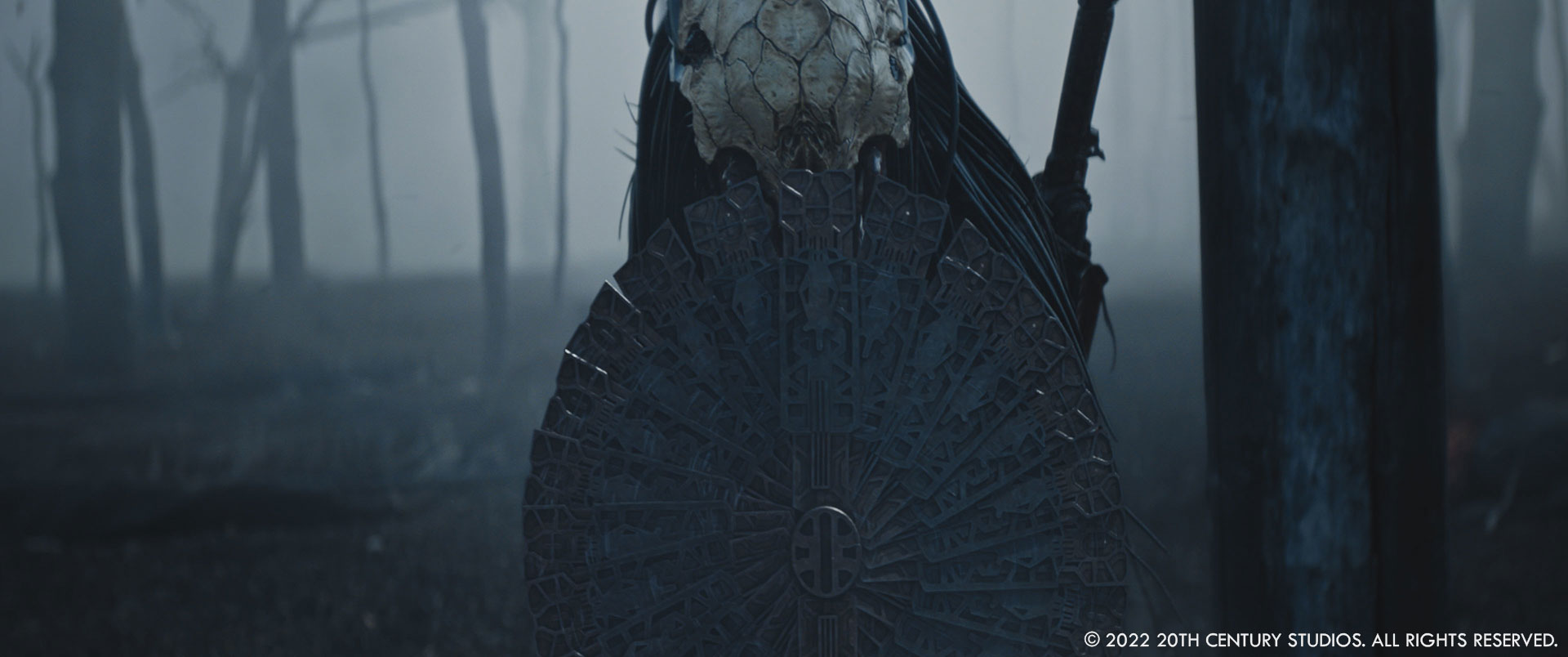
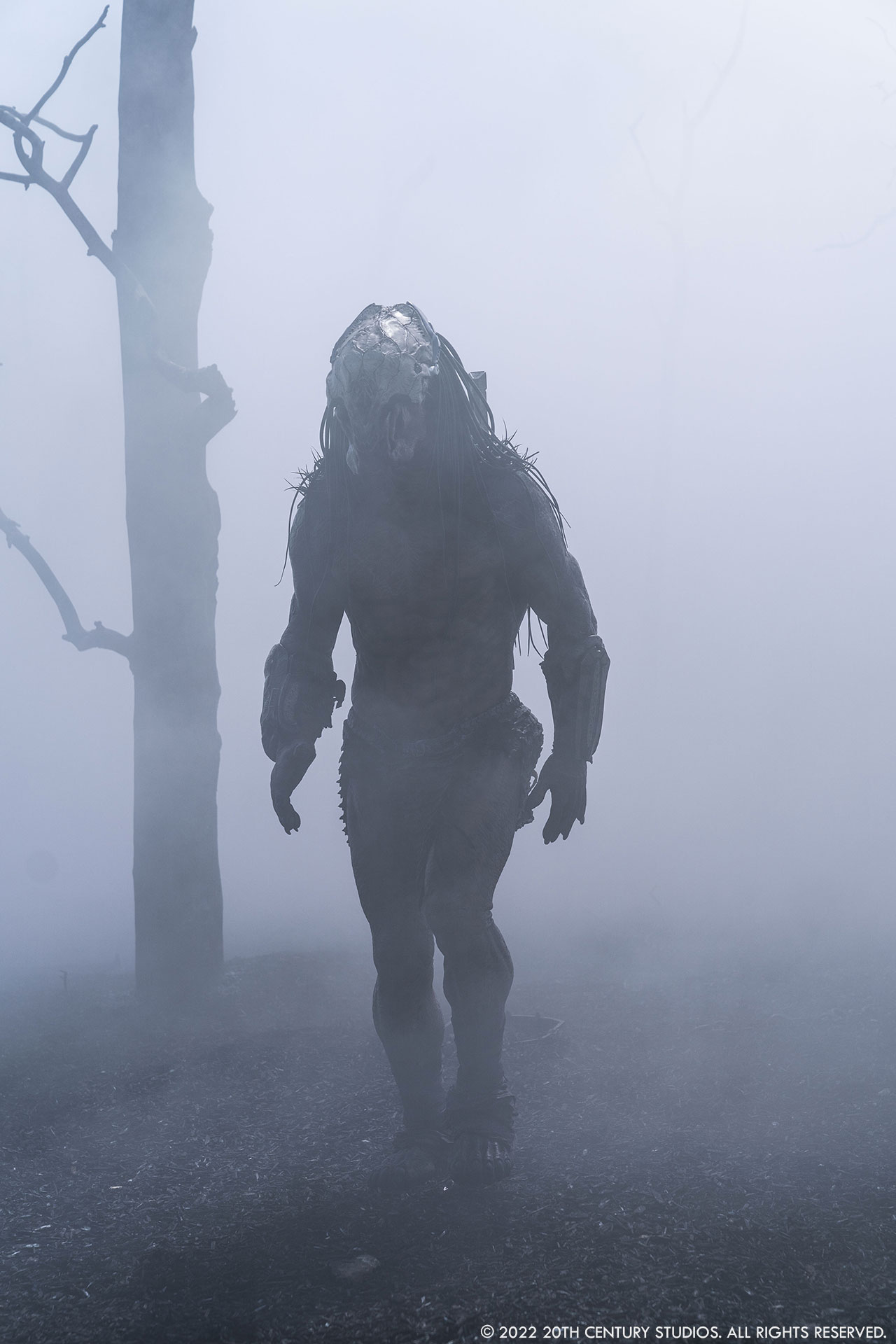
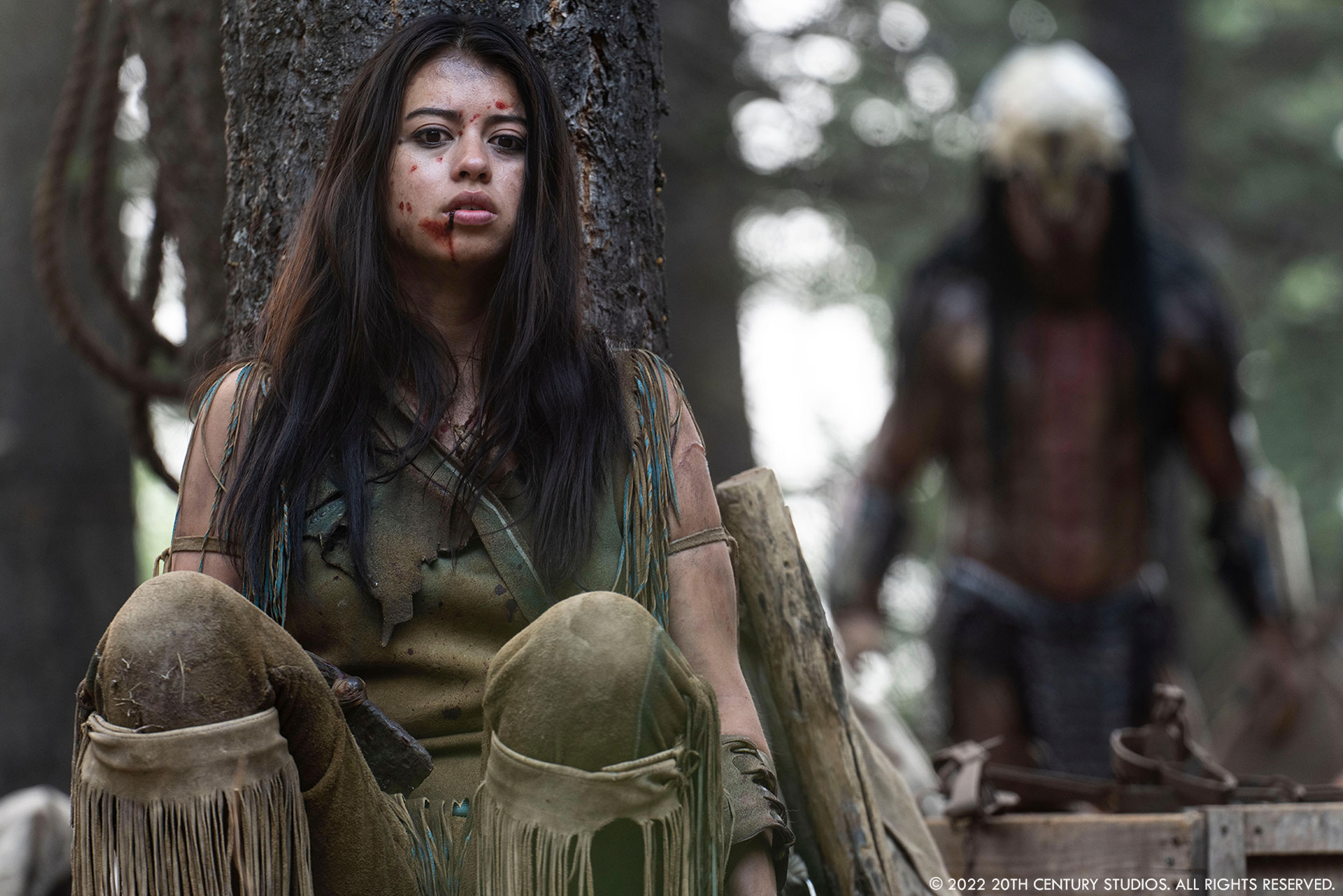
Dan dubbed the new Predator the “feral Predator”, to describe his lean and savage appearance and movement. The creature was developed at ADI who also built the suit and practical weapons. The goal was to have the suit and head be as lean as possible to avoid the bobblehead look and encumbered movements from some of the previous films. We wanted to be able to switch freely from CG Predator to the performer in a suit without having there be an obvious disconnect, so it was important that the suit design allowed the performer to have a full range of motion.
Alec and Tom, along with the team at ADI were tasked with packing the animatronics into as small a head as possible, and Dane Dilegro who played the Predator had to compress his head and neck to his chest throughout the shoot to try to make the head feel proportionate to the body.
In terms of the weapons and cloaking, we had a unique challenge in that the feral Predator lived almost 300 years prior to the jungle Predator’s encounter, so everything needed to feel like it was less technologically advanced, but still look like a modern visual effect. We looked closely at cuttlefish camouflage and old lenses, as well as the original optical effects in the OG Predator using inline mattes as developed by Joel Hynek and his team back in 1987.
How did you recreate his iconic optical camouflage and his infrared vision?
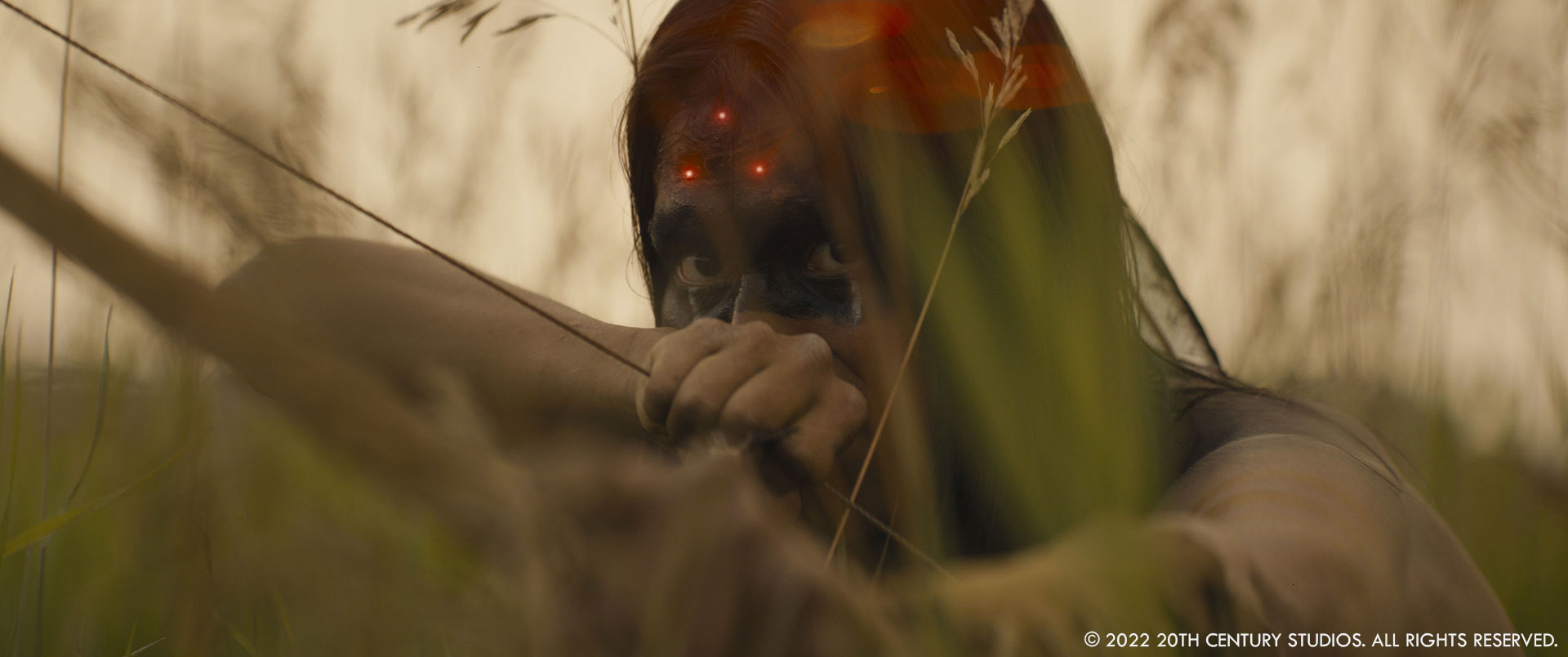
We decided that the older technology would manifest itself as “glitching” where the technology has latency problems compared to later Predator films. In particular, when something strikes it, the network would break down and take a while to recover. In terms of the actual camouflage look we iterated on the OG Predator inline matte idea and used refraction and heavy handed chromatic aberration through a hexagonal armour pattern.
We experimented with blue arcing, but Dan suggested red like his laser sighting which gave the look a much more sinister feel. In the end we did well over 100 iterations before we landed on something that Dan felt was right.
During the shoot, we always shot a performance pass with Dane in the suit, along with a clean pass so we had a performance and lighting reference for when we replaced it with a CG Predator. For some shots where we knew the Predator would be fully cloaked, we had Dane wear a mocap suit to capture his performance, but if there was a chance of seeing a decloaked or cloaking Predator then we used the practical suit.
For the Predator vision, which is such an iconic part of Predator, we really wanted to do it optically wherever possible and stay true to the original. We rented a FLIR thermal camera and built a makeshift optical beam splitter that we built from a cannibalized teleprompter so we could simultaneously shoot footage on our production cameras (Alexa LF mini) and the FLIR thermal camera. The beam splitter ensured that the footage from both the Alexa and FLIR were perfectly aligned, much in the same way that it was done on the original film (albeit for a tiny fraction of the cost). With a few lines of python scripting I was able to extract the raw temperature data from the files that could then be combined with the Arri raw footage. Our in house artist Mark Renton developed the hud display and color palette, and all of the shots were completed in house.
The movie is full of animals and especially a puma and a bear. How did you create them?
As much as we would have loved to have used real animals, it was simply impossible due to a combination of Disney regulations, schedule, and safety. So the next best thing was to provide as much reference as possible on set, including detailed previs for all of the sequences, and a stunt performer or puppeteer to provide eyeline and interaction for the actors. We developed a creature bible during prep to get very precise scale references, and then had those printed as life size cutouts so that Dan and Jeff could see them in relation to the actors for final sign off.
The mountain lion, bear, and wolves were handled by MPC. The buck, rabbits, rats, snakes, ant, buffalo, mouse, hawk, fish, vultures, and opossums were built by Mr. X.
Can you tell us more about their animation and interaction with the actors?
Wherever possible we tried to have a stunt performer or puppeteer stand in for the animals on set, because no matter how good your animation or creatures look, they’ll never be believable if the eyelines and performance of your actors don’t match. It wasn’t always possible for schedule or safety reasons, but we always tried to have reference of someone acting out the creature’s path, including that of the bear running through water behind Naru.
For the animation, we always tried to find real life behaviour, so for example, much of the performance of the bear fighting the Predator comes directly from library footage of real bears fighting.
Where was filmed the various exterior sequences?
Most of the film was shot near Calgary, Alberta.
How did you enhanced some environments?
We filmed a lot of the aerial shots on a drone, and there were a lot of removal of modern features and roads, as well as breaking up non-natural features like farmland and fences to make it feel like it was set in the 1700’s. The entire mountain lion sequence was a created environment, as Dan wanted a specific look where the characters and the trees were dark silhouettes and we couldn’t find the perfect location, so we shot it all as blue screen. Also, the wolf sequence which was added very late in the schedule was filmed near Los Angeles, so we also added the rocky mountains into that environment.
There is an intense oner during a fight. Can you tell us more about its shooting and creation?
The fight was shot as a oner, but we actually ended up using 5 separate takes to get the strongest parts of the stunts and action, which were seamlessly blended to hide the joins. Amber Midthunder (Naru) did a significant amount of the work towards the end, but her stunt double Tami was used for the rest of the sequence so we also had a number of face replacement shots. Most of the weapons throughout the sequence are CG, but we did use a few plant ons and practical knives where possible. Because we knew we would need to run multiple takes without time to change costumes, we committed to doing all of the blood in CG.
Can you tell us more about the gore aspect?
Dan had a philosophy that it can often be more entertaining to imagine the gore rather than having it be explicit, and I think that contributed to some of the most fun shots in the film. So instead of seeing a trapper’s decapitation we cut to an angle behind the tree he’s pinned to and we see the tree cut instead of his neck, or with the razor net we mostly see the aftermath of a log instead of the actual kill. I certainly wouldn’t argue that there’s no gore in the movie, but part of the fun of the Predator universe is being able to cheer for both the hunter and the hunted, and leaving a bit to the imagination helps with that balance.
Did you want to reveal to us any other invisible effects?
I’m not sure if this would count as an invisible effect, but I think we found a really great balance between practical Predator suit effects and CG Predator, to the point that I think a lot of people would struggle to tell the difference for the majority of shots. It was a great experience working together with the practical effects team at ADI, as well as the actor Dane.
Also, most of the aerial shots use digi-doubles of warriors or Naru and Surri. We had a little splinter unit that filmed with a drone in areas around the Stoney nation in Alberta, and then added CG characters to the plates for wider travel shots.
Which sequence or shot was the most challenging?
The bear sequence was always going to be our most technically challenging sequence. Having a bear in bright sunlight thrashing around in water whilst fighting and then bleeding all over a Predator kept me up at night on more than one occasion. We also had a few creature shots that were added very late in the schedule that were challenging in that we had to create new assets from scratch with only weeks remaining.
What is your best memory on this show?
I think it’s amazing to work on iconic creature projects, but the best memory I’ll have of this show is the people. Across all departments we had an amazing cast and crew that were really fun to work with.
A big thanks for your time.
// Prey – Trailer
// Prey – VFX Breakdown – MPC
WANT TO KNOW MORE? MPC: Dedicated page about Prey on MPC website. Disney+: You can now watch Prey on Disney+.
Let’s have a look at the variety of the work made by the teams of El Ranchito on the fourth season of Stranger Things:
WANT TO KNOW MORE? El Ranchito: Dedicated page about Stranger Things – Season 4 on El Ranchito website. Michael Maher & Terron Pratt: Here is my interview of Michael Maher (Production VFX Supervisor) & Terron Pratt (Production VFX Producer) about the Season 4 of Stranger Things. Netflix: You can watch Stranger Things on Netflix.
Don’t miss this VFX Breakdown showing the creatures and environments work made by the teams of Important Looking Pirates on the fourth season of Stranger Things!
WANT TO KNOW MORE? Michael Maher & Terron Pratt: Here is my interview of Michael Maher (Production VFX Supervisor) & Terron Pratt (Production VFX Producer) about the Season 4 of Stranger Things. Netflix: You can watch Stranger Things on Netflix.
Let’s explore the deep space from asteroids to exotic planets with the teams of Rodeo FX in the VFX Breakdown showing their work on the Paramount+ adaptation of Halo!
WANT TO KNOW MORE? Rodeo FX: Dedicated page about Halo on Rodeo FX website.
Pour offrir les meilleures expériences, nous utilisons des technologies telles que les cookies pour stocker et/ou accéder aux informations des appareils. Le fait de consentir à ces technologies nous permettra de traiter des données telles que le comportement de navigation ou les ID uniques sur ce site. Le fait de ne pas consentir ou de retirer son consentement peut avoir un effet négatif sur certaines caractéristiques et fonctions.
Fonctionnel
Always active
L’accès ou le stockage technique est strictement nécessaire dans la finalité d’intérêt légitime de permettre l’utilisation d’un service spécifique explicitement demandé par l’abonné ou l’utilisateur, ou dans le seul but d’effectuer la transmission d’une communication sur un réseau de communications électroniques.
Préférences
L’accès ou le stockage technique est nécessaire dans la finalité d’intérêt légitime de stocker des préférences qui ne sont pas demandées par l’abonné ou l’internaute.
Statistiques
Le stockage ou l’accès technique qui est utilisé exclusivement à des fins statistiques.Le stockage ou l’accès technique qui est utilisé exclusivement dans des finalités statistiques anonymes. En l’absence d’une assignation à comparaître, d’une conformité volontaire de la part de votre fournisseur d’accès à internet ou d’enregistrements supplémentaires provenant d’une tierce partie, les informations stockées ou extraites à cette seule fin ne peuvent généralement pas être utilisées pour vous identifier.
Marketing
L’accès ou le stockage technique est nécessaire pour créer des profils d’internautes afin d’envoyer des publicités, ou pour suivre l’utilisateur sur un site web ou sur plusieurs sites web ayant des finalités marketing similaires.